Choosing Between Modular and All-in-One LED Controllers
Executive Summary: Selecting the appropriate display processing infrastructure represents one of the most critical engineering decisions in any commercial, broadcast, or staging LED video wall deployment. Within the NovaStar ecosystem, the flagship H Series modular video splicing processors (H2, H5, H9, H15, H20) and the versatile VX Series all-in-one video controllers (VX400, VX600, VX1000, VX16s, and the next-generation VX Pro line) represent fundamentally divergent engineering philosophies. The H Series is built on a card-cage modular architecture offering pure hardware FPGA processing, slot-based input and output scalability, ultra-wide multi-screen irregular matrix splicing, cross-browser Web-GUI control, and full hardware power redundancy for mission-critical command centers. Conversely, the VX Series integrates video scaling, multi-format input switching, and LED sending card functions inside a compact 1U or 2U rackmount chassis with front-panel rotary knob navigation, purpose-built for fast-turnaround rental staging, corporate boardrooms, and houses of worship. This guide provides an exhaustive engineering comparison of both controller families across system architecture, pixel capacity, layer windowing, and project economics. |
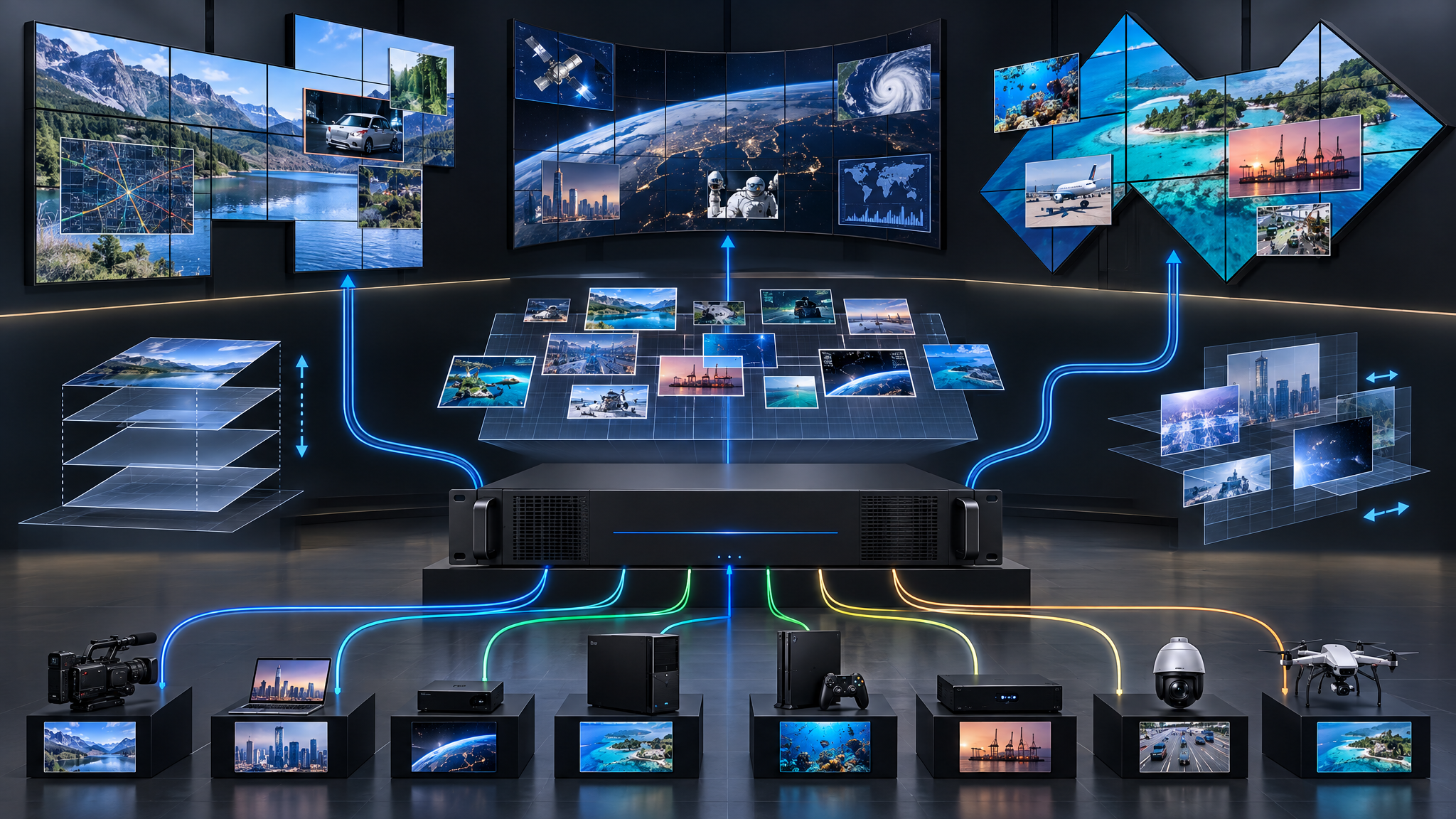
1. Architectural Overview and Core Engineering Divergence
To evaluate whether the NovaStar H Series or VX Series fits an AV project, engineers must understand the distinct architectural foundations that define each controller family:
A. NovaStar H Series — Modular Card-Cage Splicing Architecture: The NovaStar H Series employs an enterprise card-cage frame (available in 2U, 5U, 9U, 15U, and 20U chassis) equipped with a high-bandwidth passive backplane. System integrators configure custom slot cards for inputs (HDMI 2.0, DP 1.2, 12G-SDI, IP video streaming), output sending cards (16x Gigabit RJ45 ports or 2x 10G optical fiber ports per card), multi-viewer preview cards, dual-redundant main control cards, and dual-redundant hot-swappable power supplies. It functions simultaneously as an enterprise matrix switcher, video wall splicing processor, and master LED sending system.
B. NovaStar VX Series — Integrated All-In-One Appliance Architecture: The NovaStar VX Series is engineered as a self-contained, fixed-topology video controller appliance. It integrates video scaling, input format conversion, and multi-port Gigabit Ethernet sending outputs inside a single, compact 1U or 2U rackmount chassis. Equipped with a physical front-panel rotary encoder knob and LCD menu, the VX Series allows technicians to configure cabinet mapping, input cropping, and screen presets on-site without opening a computer.
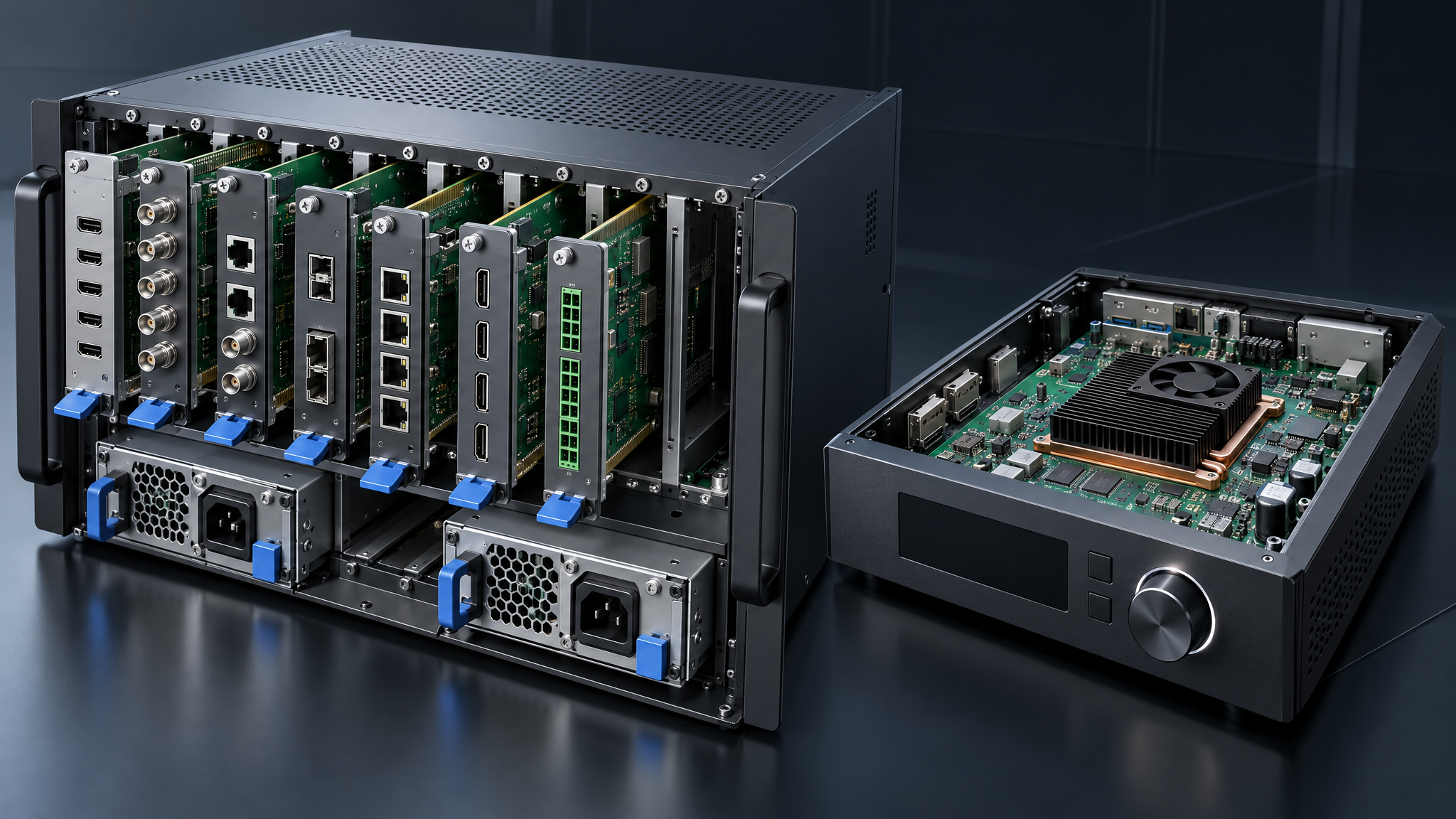
2. Master Architectural and Engineering Specification Matrix
The following engineering table correlates the complete technical, optical, electrical, and control parameters between the NovaStar H Series and VX Series.
Engineering Dimension | NovaStar H Series (Flagship Modular Splicers) | NovaStar VX Series (All-in-One Controllers) | Key Operational Significance |
Chassis Form Factor | Modular card-cage: H2 (2U), H5 (5U), H9 (9U), H15 (15U), H20 (20U) | Fixed appliance: VX400 (1U), VX600 (1U), VX1000 (1U), VX16s (2U) | H Series expands via slot cards; VX Series provides fixed plug-and-play |
Pixel Loading Capacity | 13 million (H2) to 208 million pixels (H20 max capacity) | 2.6 million (VX400), 3.9M (VX600), 6.5M (VX1000), 10.4M (VX16s) | H Series drives massive enterprise canvases; VX Series targets standard screens |
Input Output Modularity | Hot-swappable slots: HDMI 2.0, DP 1.2, 12G-SDI, IP, 10G Fiber | Fixed factory ports: HDMI, DVI, 3G-SDI, Optical in fixed configurations | H Series allows future card upgrades; VX Series has fixed interface count |
Splicing and Matrix | True multi-screen irregular matrix splicing across independent walls | Single display canvas scaling and basic multi-unit cascade | H Series manages complex multi-display canvases from a single chassis |
Layer Windowing (PIP) | Up to 16, 32, or 128 roaming layers with cross-screen movement | 2 to 3 layers (Primary layer plus 1 or 2 PIP sub-windows) | H Series enables multi-window command centers; VX Series supports basic PIP |
Long-Distance Fiber | Native 10G optical fiber output cards (transmitting up to 10 km) | Direct RJ45 Ethernet (up to 100 meters) and OPT backup ports | H Series eliminates external fiber converters for long control room runs |
Control User Interface | Embedded B and S Web-GUI (browser-based on Mac, PC, iOS, Android) | Front-panel rotary knob, LCD display, NovaLCT, SmartLCT software | H Series requires zero client software; VX Series offers fast knob setup |
Hardware Redundancy | Dual-redundant hot-swappable power supplies and dual main controllers | Single internal AC power supply and single main processing board | H Series guarantees 24-7 zero-downtime mission-critical reliability |
Audio Processing | Audio input embedding and multi-channel de-embedding via output cards | 3.5mm analog audio input and output, HDMI embedded audio pass | Both series support synchronized AV routing for commercial sound |
Estimated Price Range | Approx. 4,000 to 30,000+ USD (Depends on frame and card configuration) | Approx. 800 to 2,500 USD (Fixed all-in-one appliance price) | VX Series offers lower entry cost; H Series represents enterprise investment |
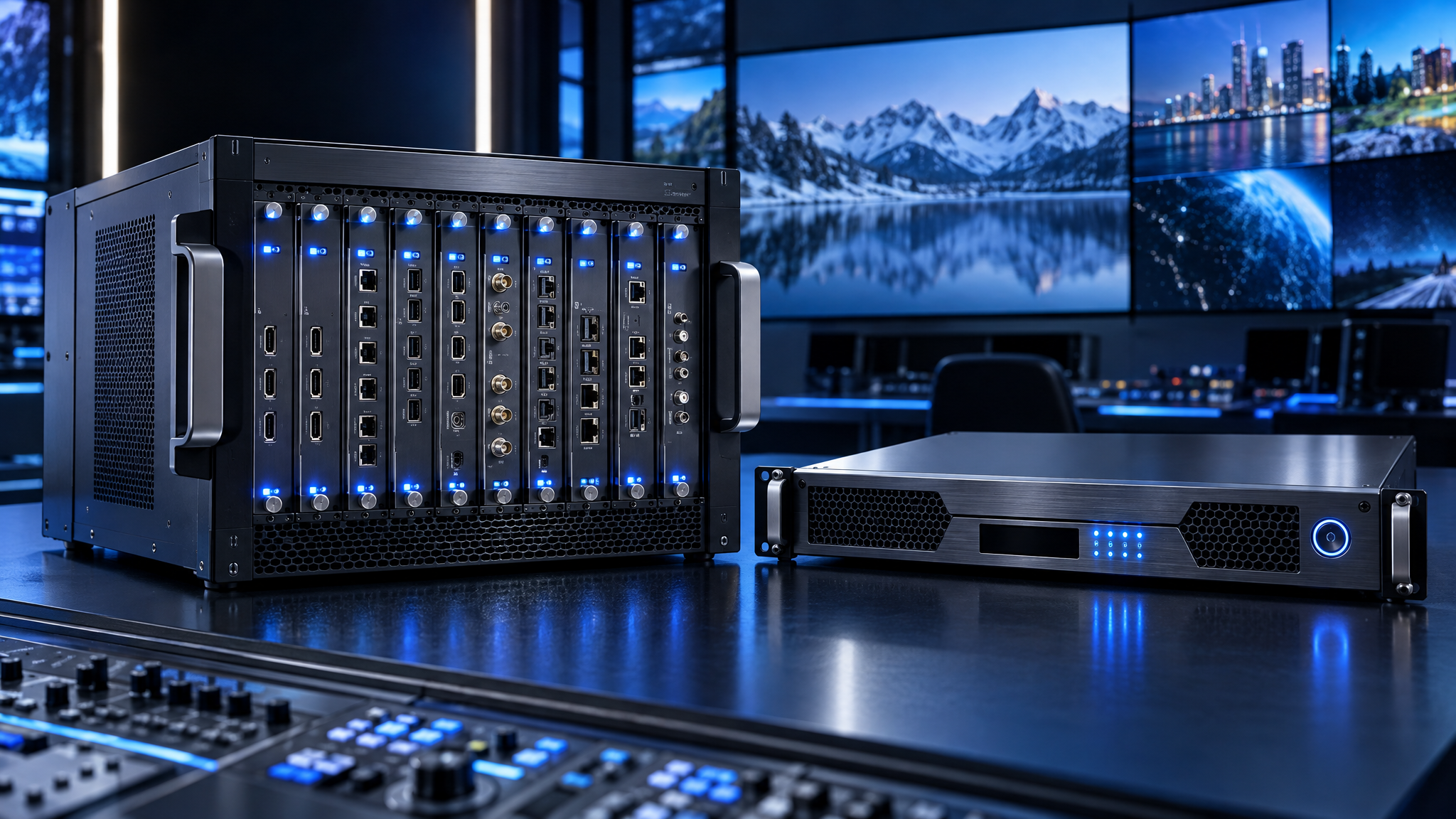
3. In-Depth Engineering Analysis Across 5 Critical Comparison Dimensions
To establish rigorous evaluation criteria, this analysis compares both controller families across five primary engineering dimensions:
Dimension 1: Modular Scalability vs Fixed Port Integration — The H Series modular card-cage chassis allows system architects to populate exact input and output cards required for day-one operation while retaining empty expansion slots for future facility growth. In contrast, the VX Series provides a fixed, pre-engineered input and output port complement. If an event requires additional SDI inputs or optical fiber links, VX users must deploy external signal converters.
Dimension 2: Multi-Screen Splicing and High-Density Layer Roaming — The H Series FPGA processing engine supports complex multi-screen canvas management, enabling one central H Series chassis to drive a main video wall, side auxiliary screens, and curved ribbon banners simultaneously with free layer roaming and smooth scaling across screen boundaries. The VX Series is optimized to drive a single primary LED display with up to 2 or 3 picture-in-picture (PIP) overlay windows.
Dimension 3: Long-Distance Fiber Optic Output vs Copper RJ45 — The H Series offers specialized 10G optical fiber output cards, transmitting high-bandwidth video data over single-mode or multi-mode fiber optic cables directly to remote fiber receiver boxes up to 10 kilometers away. The VX Series relies primarily on standard Gigabit RJ45 copper Ethernet cables (limited to 100 meters), with OPT ports functioning as optical backup or master links.
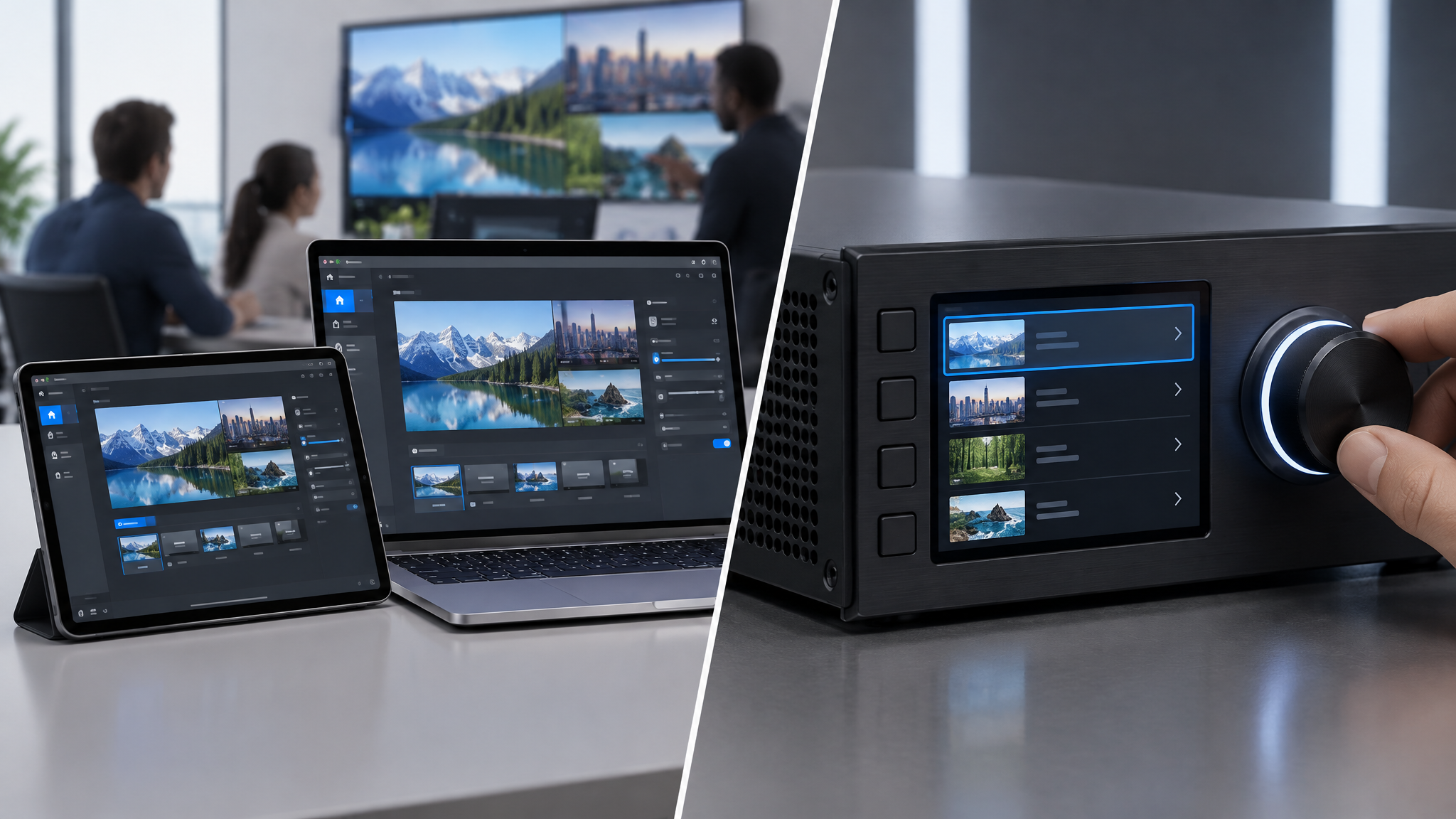
Dimension 4: Web-GUI Multi-User Collaboration vs Front-Panel Knob Control — The H Series features an embedded Web-GUI operating on a Browser and Server (B and S) architecture. Operators connect via any web browser on Windows, Mac, iPad, or Android tablets without installing client software. The VX Series excels in physical event operation: technicians use the front-panel rotary encoder knob and LCD menu for rapid on-site input switching, resolution scaling, and preset loading.
Dimension 5: Hardware Redundancy and Zero-Downtime Reliability — For 24-7 mission-critical operations (such as emergency command centers, traffic control hubs, and television broadcast studios), the H Series provides dual-redundant hot-swappable power supply units and dual main control cards. A power supply or controller failure triggers seamless millisecond failover without screen blackouts. The VX Series utilizes a single internal power supply, engineered for commercial reliability and lightweight transport.
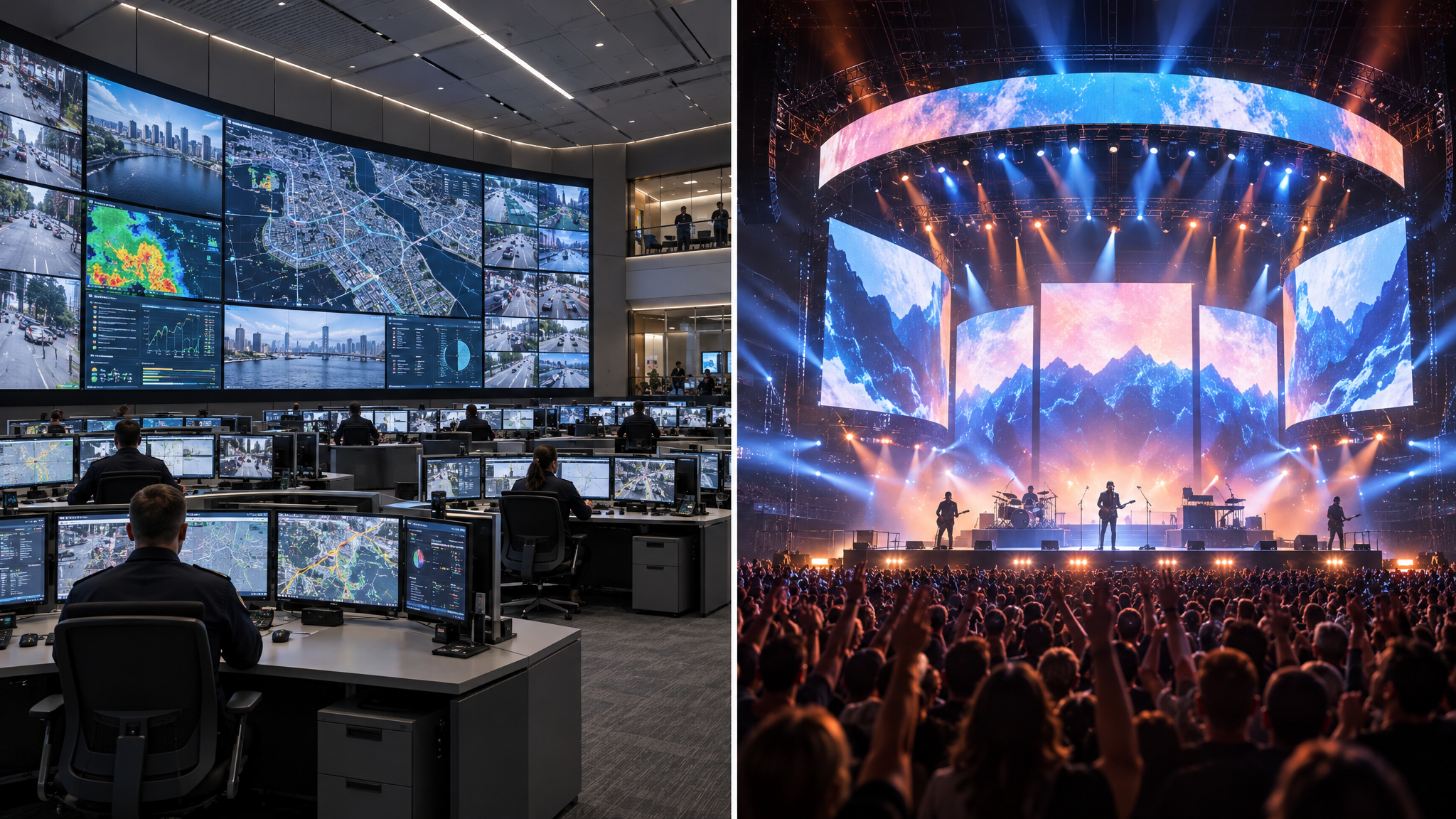
4. Scenario-Specific Application and Controller Selection Matrix
The following engineering table correlates specific AV deployment scenarios with recommended NovaStar controller models and architectural justification.
Deployment Environment | Recommended Controller Model | Primary Technical Requirements | Architectural Justification |
Municipal Emergency Command Center | NovaStar H Series (H9 or H15) | Multi-screen matrix, 32+ roaming layers, dual power redundancy | Drives ultra-wide multi-display canvas with zero-downtime hot-swap power |
Television Broadcast Studio and XR Stage | NovaStar H Series (H5 or H9) | 12G-SDI, Genlock sync, low-latency 10G optical fiber, HDR10 | Frame-synchronized ultra-high bandwidth with direct optical fiber feeds |
Live Concert Touring and Festival Stage | NovaStar VX Series (VX1000 or VX1000 Pro) | Fast physical knob setup, 6.5M pixel capacity, rugged 1U rackmount | Rapid on-site deployment, lightweight flight-case transport, quick mapping |
House of Worship and Auditorium | NovaStar VX Series (VX600 or VX1000) | Dual-layer PIP, seamless HDMI and DVI switching, audio pass | Cost-effective all-in-one appliance, simple volunteer operation |
Corporate Boardroom and Training Hall | NovaStar VX Series (VX400 or VX400 Pro) | 2.6M pixel capacity, ultra-compact 1U, multi-input scaling | Affordable meeting room controller with direct laptop HDMI presentation |
Commercial Shopping Mall Video Matrix | NovaStar H Series (H2 or H5) | Independent multi-zone scheduling, Web-GUI remote browser control | Controls multiple distributed lobby screens from one centralized frame |
5. Procurement Decision Tree, Economic Analysis, and Frequently Asked Questions
Procurement Recommendation: If your project involves a single primary LED display (under 10.4 million pixels) with simple layer overlay requirements, fast physical setup, and budget constraints, choose the NovaStar VX Series. If your project demands multi-screen irregular splicing, more than 4 picture-in-picture video layers, long-distance optical fiber distribution, browser-based multi-user control, or dual-redundant power supplies for 24-7 operation, invest in the NovaStar H Series.
Q1: Matrix Switcher Replacement — Question 1: Can the NovaStar H Series replace both an external matrix switcher and video processor?
Answer: Yes. The H Series is a true all-in-one modular video splicing processor and matrix switcher. It integrates multi-format input switching, video scaling, layer windowing, seamless preset transitions, and direct LED sending card outputs on a single FPGA backplane, eliminating the need for standalone matrix switchers and external sending boxes.
Q2: Standard VX vs VX Pro Series — Question 2: What is the main difference between the standard VX Series and the next-generation VX Pro Series?
Answer: The next-generation VX Pro Series (such as VX400 Pro, VX600 Pro, VX1000 Pro, and VX2000 Pro) introduces full HDMI 2.0 4K at 60Hz input processing, upgraded video scaling engines with ultra-low latency, and higher total pixel loading capacities, designed to succeed legacy VX models in modern 4K production environments.
Q3: B and S Web-GUI Architecture — Question 3: How does the H Series Web-GUI improve multi-user collaborative control?
Answer: Because the H Series runs an embedded B and S Web-GUI, operators can open Google Chrome or Apple Safari on any laptop or tablet on the local network to recall screen presets, adjust layer positioning, and switch video sources simultaneously without installing client software or USB driver packages.
Q4: VX Series Fiber Connectivity — Question 4: Can the VX Series transmit video over long distances via optical fiber?
Answer: Yes, models such as the VX1000 and VX16s feature OPT optical ports that can be connected to NovaStar fiber converters (such as CVT4K or CVT10) to transmit video data over single-mode optical fiber up to 10 kilometers. However, the H Series handles this natively via modular 10G optical fiber output cards without external converter boxes.
Q5: Total Cost of Ownership Comparison — Question 5: How do the two controller families compare in total cost of ownership (TCO)?
Answer: The VX Series offers an economical initial purchase price (approx. 800 to 2,500 USD) and minimal configuration complexity for straightforward single-screen projects. The H Series carries a higher entry cost (approx. 4,000 to 30,000+ USD depending on chassis and cards), but delivers superior long-term ROI for large enterprise installations by eliminating separate matrix switchers, fiber converters, and sending boxes, while allowing modular card-level upgrades over a 10-year facility lifecycle.