
Commercial Outdoor LED Signage: A Buying Guide, Cost Analysis, and Installation Considerations
What Counts as Commercial Outdoor LED Signage?
The category covers any permanently installed, weather-rated LED display used to communicate with people outside a building. The main formats behave very differently as purchases:
· Roadside billboards and spectaculars. Large-format screens on monopole or building-mounted steel structures, typically P8 to P16, read from 20 metres and beyond.
· Building facade media walls. Architectural LED surfaces that double as brand assets and, sometimes, advertising inventory. Usually P4 to P8.
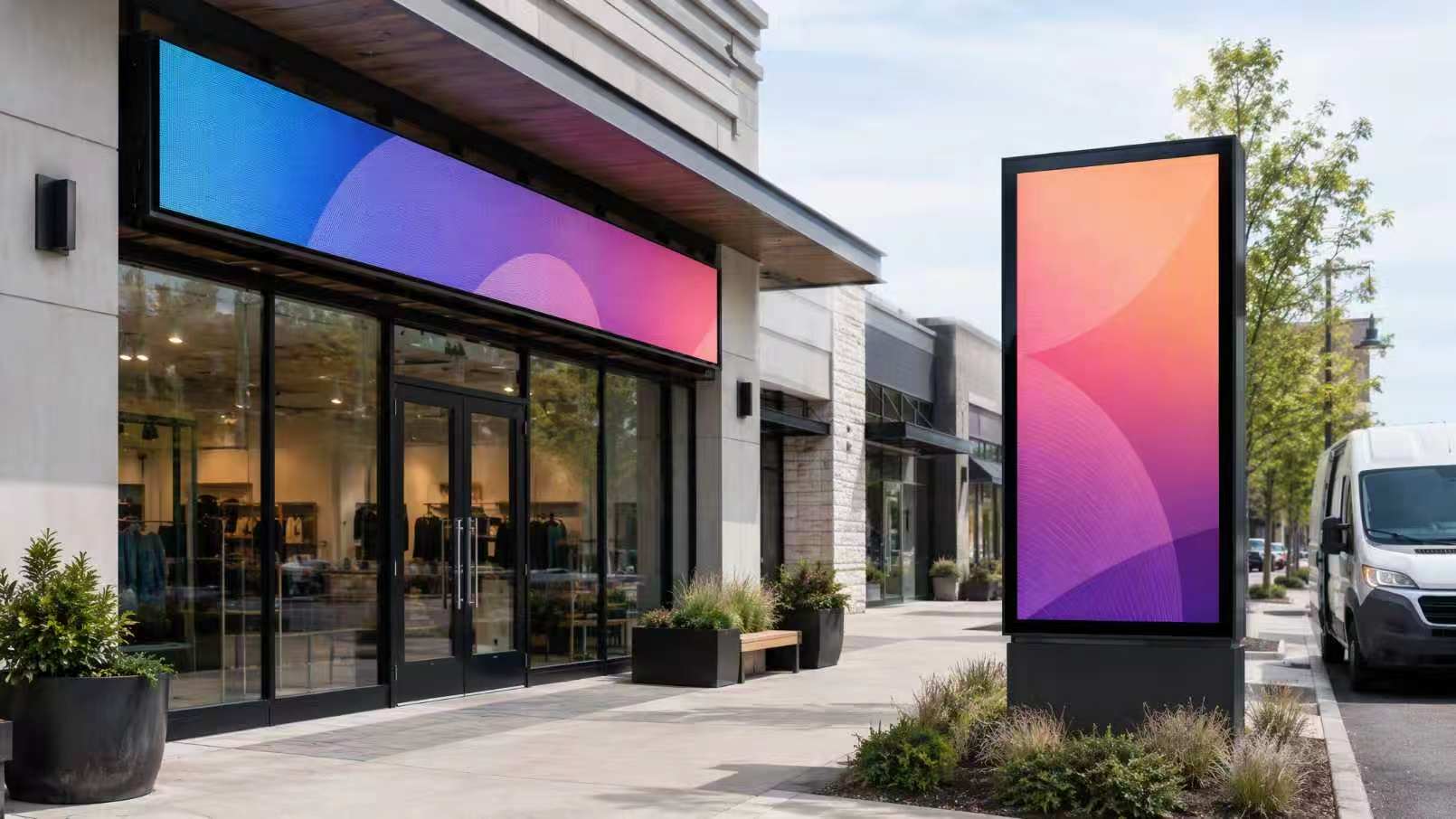
· Storefront signs and window displays. P2.5 to P5, close viewing, high refresh so the screen looks clean on a phone camera.
· Pylon and directory signs. Wayfinding and price signage at retail parks, fuel stations and dealerships.
· Transparent and mesh LED. For glass facades where daylight and sightlines must survive.
The checklist below applies to all of them; what changes is the weight you give each item.
Part 1: The Buying Guide
1. Pixel pitch is the first and biggest decision
Pixel pitch is the distance in millimetres between adjacent LEDs. It sets resolution per square metre, minimum comfortable viewing distance, and a large share of price. The working rule is roughly one millimetre of pitch per metre of viewing distance for comfortable reading of detail, stretchable to about 1.5–2× that distance when content is mostly large text and simple motion.
Pixel pitch | Viewing distance | Best suited to | Reference hardware price |
P10 | 20–30 m | Highway billboards, large ad boards | USD 280–420 / m² |
P8 | 15–25 m | City screens, building facades | USD 350–520 / m² |
P6 | 10–18 m | Retail facades, forecourts, squares | USD 420–680 / m² |
P5 | 8–12 m | Mall exteriors, hotel facades | USD 550–850 / m² |
P4 | 6–10 m | Landmark media walls, premium retail | USD 750–950 / m² |
Ranges reflect published supplier price guides for outdoor LED hardware in 2025–2026. Structure, installation, control and permits are additional.
Both failure modes are expensive. Over-specifying — P2.5 on a highway billboard nobody can approach — buys resolution the audience can never resolve. Under-specifying puts a coarse P10 on a shop window where customers stand two metres away and see individual pixels instead of the message.
2. Brightness and automatic dimming
Most outdoor screens sit at 5,000–6,000 nits, enough for a shaded facade or a screen angled away from the sun; strong direct sunlight and transport hubs typically need 7,000–10,000 nits. Peak brightness is only half the spec. Ask for an ambient light sensor with a dimming schedule: full output after dark is uncomfortable, invites complaints and often breaches local rules, while running at 40–60% at night cuts power use and extends hardware life.
3. Refresh rate and scan mode
Refresh rate decides whether the image looks solid to the eye and, increasingly, to a camera. 1,920 Hz is the practical minimum; 3,840 Hz is worth paying for if the sign will appear in broadcast footage, livestreams or customer videos — otherwise expect dark banding across every photo taken of it.
4. IP rating and cabinet construction
"Outdoor rated" means nothing on its own. Ask for a specific ingress protection rating: IP65 on the front face is the baseline for rain-facing surfaces, IP54 or better at the rear, and the sealing should be mechanical — gaskets, sealed connectors, cable glands — not sealant alone.
Cabinet material matters more than most buyers expect. Aluminium is lighter, dissipates heat better and resists corrosion; steel is cheaper and heavier, and needs proper treatment in coastal or humid climates. Because weight feeds structural cost, a lighter cabinet can pay for itself in steel.
5. Control system, content management and monitoring
The LED modules are the visible half of the product; the control system decides whether the sign is reliable for the next eight years. Ask for the controller and card model, locally available spare cards, scheduled playback with automatic restart after power loss, and remote monitoring of temperature, power-supply faults and module failure — so a dead panel is a notification, not a customer complaint three weeks later. Confirm the platform's annual licence cost.
Part 2: Cost Analysis
The five cost buckets
A complete budget has five parts, and hardware is only the first: hardware (cabinets, modules, power supplies, cards); structure and installation (steel frame, anchoring, rigging, lifting, electrical connection, commissioning); permits and engineering (sign permit, stamped drawings, electrical permit, sometimes a zoning or brightness review); content, control and connectivity; and operations (electricity, maintenance, spare parts, insurance).
Hardware: what a square metre buys
Current supplier guides put outdoor LED hardware at roughly USD 380–950 per square metre, driven mainly by pixel pitch. Within the same pitch, cost moves with brightness grade, IP rating, cabinet material and refresh rate. Larger projects get more stable unit pricing, and custom shapes are quoted per project — the structure behind them usually costs more than the screen.
Structure, installation, permits
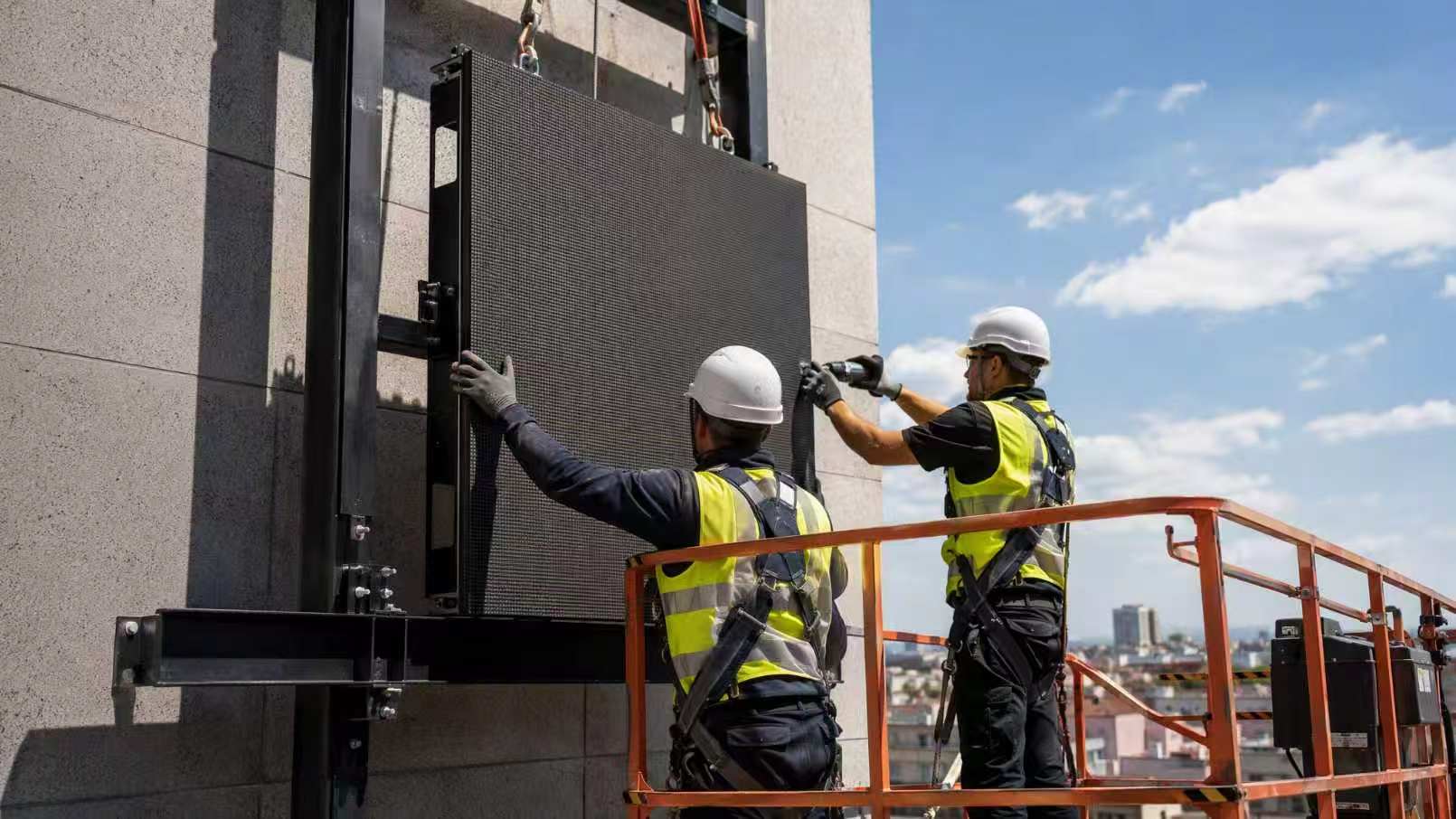
This is where budgets most often break. A wall-mounted screen on existing masonry is a simple job; a monopole billboard or rooftop frame is a construction project with engineering, access equipment and weather delays. Budget structure and rigging separately, use a contractor who has installed this screen size before, and remember lift rental and out-of-hours working.
Permits are local and typically cover structural adequacy, electrical compliance, size, setback from roads and illumination limits. Applications can take weeks to months and must be secured before the structure goes up; a screen waiting in a warehouse for a permit is the most expensive kind of inventory.
Operating cost: the number people forget
Electricity is a permanent line in the budget. One published example illustrates the scale: a 50 m² outdoor screen averaging 350 W/m² for 18 hours a day consumes roughly 115,000 kWh a year, about USD 11,500–23,000 annually at USD 0.10–0.20 per kWh. Over five years that can exceed the entire hardware cost of a mid-size screen — which is why brightness scheduling matters as much as price per square metre.
A worked budget for an 18 m² facade screen
An illustrative model, not a quotation: a 6 × 3 m P6 outdoor screen at 6,000 nits on a building facade, with rear access to an electrical room.
Line item | Low (USD) | High (USD) |
LED hardware, 18 m² at 500–620 / m² | 9,000 | 11,200 |
Steel structure, brackets, anchoring | 3,500 | 6,000 |
Installation labour, lift, electrical | 2,500 | 5,000 |
Control system, player, cabling, network | 1,200 | 2,500 |
Permits, structural and electrical engineering | 800 | 3,000 |
Content design and first-year CMS | 1,000 | 3,000 |
Contingency (about 8%) | 1,400 | 2,500 |
Estimated capital total | 19,400 | 33,200 |
Then add operating cost: at 250–350 W/m² average over 14 hours a day, the same screen uses roughly 23,000–32,000 kWh annually — a few thousand dollars at typical commercial tariffs, before maintenance.
Total cost of ownership
Over five years on a mid-size screen, hardware usually lands near 40–55% of total spend, with power, maintenance and connectivity making up the rest. Hence a procurement rule: a 15% cheaper screen that is 30% harder to service is not cheaper. Slow module swaps and no local spare parts convert straight into labour hours and dark-screen days.
Part 3: Installation Considerations
Structure and wind load
An outdoor screen is a sail. Wind load must be calculated for the local code and mounting height, and the design must anchor to structural members — not to cladding or a decorative panel. Get stamped drawings from a qualified structural engineer and treat that as non-negotiable. Screens that fail in storms rarely fail because the LED was bad; they fail because the frame was undersized.
Permits, placement and viewing angles
Confirm what is allowed before you buy: maximum sign area, height limits, setback, illumination limits, curfews, and whether animated content is permitted at all. Set mounting height from the real viewing geometry — where people are when they look at it — not from what looks balanced on the elevation drawing. LED is directional, so check quoted viewing angles rather than assuming a 180° field, and verify the screen will not glare into traffic or hang low over a loading bay.
Electrical supply and signal
The display needs a dedicated circuit sized for peak load plus headroom, correct phase configuration, earthing and surge protection — the last frequently omitted and expensive to repair. Confirm scope responsibility, because the electrician's work often ends where the supplier's begins, and that gap is where projects stall. Cable routes and a reliable network connection for content updates belong in the design, not the afterthought.
Commissioning and handover
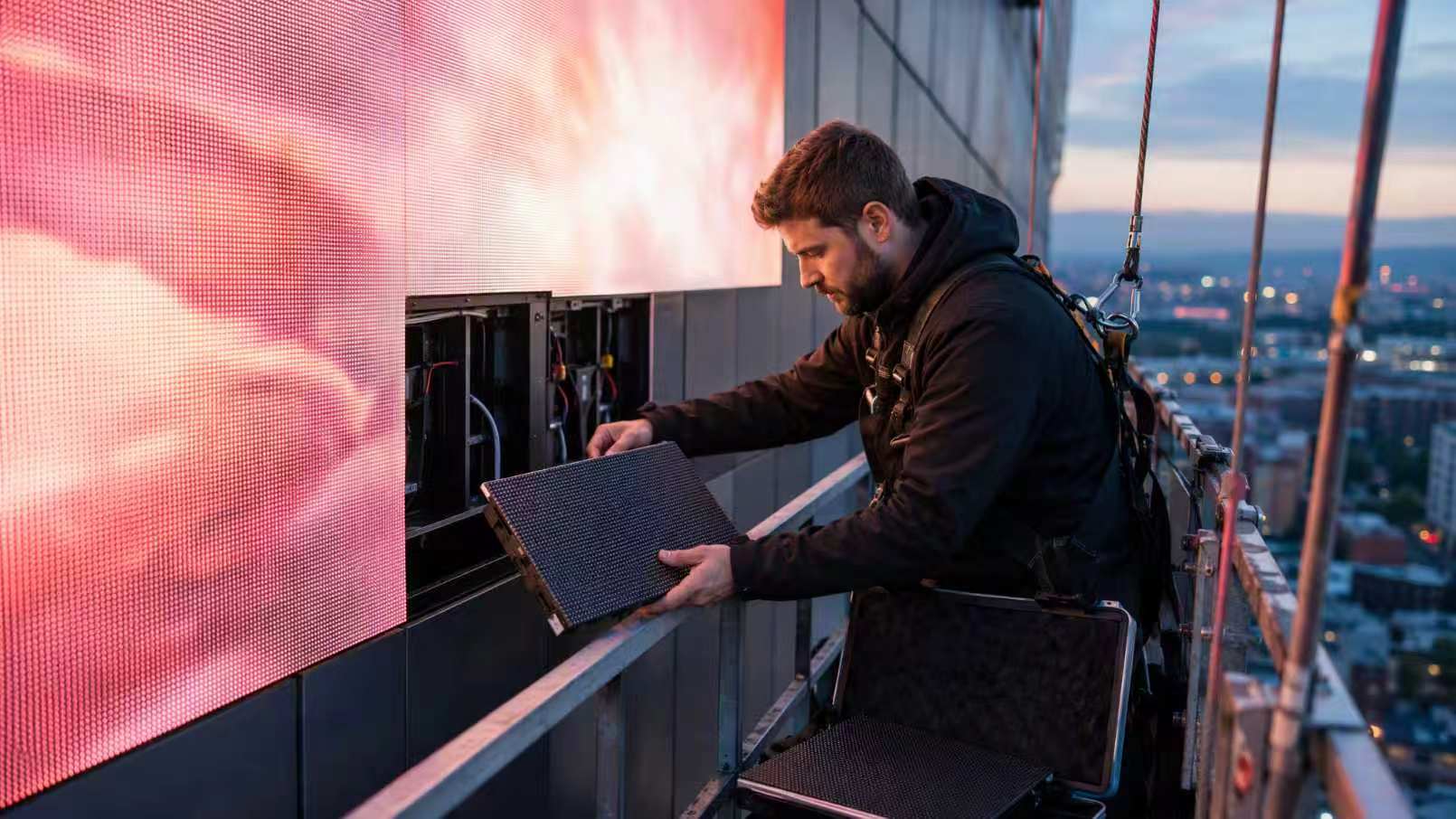
Before acceptance, run full-white and full-colour test patterns to check dead pixels and uniformity, calibrate brightness against local rules, test dimming across a full day cycle, and verify the failure alarms. Handover should include as-built drawings, controller settings, spare parts and a service procedure.
Frequently asked questions
How much does an outdoor LED screen cost per square metre?
Roughly USD 380–950 per square metre for hardware, depending mainly on pixel pitch, brightness and cabinet quality. An installed project costs considerably more once structure, installation, control and permits are added.
Do we need a permit, and how bright should it be?
Most jurisdictions require at least a sign permit and an electrical permit, often with structural review. For brightness, 5,000–6,000 nits covers most sites and 7,000–10,000 nits suits strong direct sun, always with automatic dimming.


