
OLED vs LED: Burn-In Risk, Brightness and Display Performance
When evaluating display technologies for home entertainment, competitive gaming, professional visual workstations, or commercial video walls, OLED and LED represent the two dominant paradigms in modern display engineering. While both technologies deliver stunning visual performance, their underlying physical principles, emission mechanisms, contrast dynamics, brightness envelopes, and long-term reliability profiles diverge significantly.
---
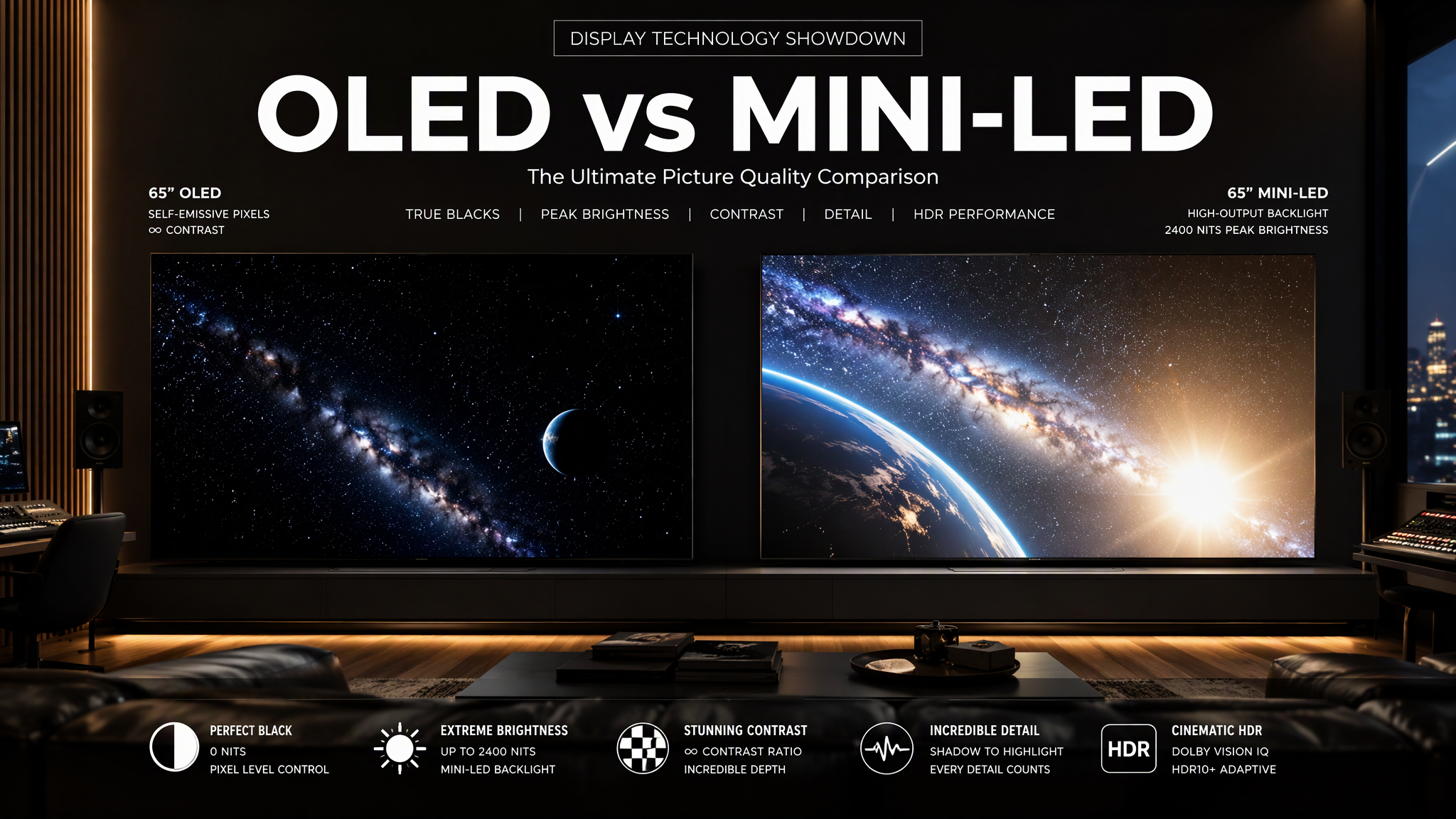
1. Demystifying the Core Display Architectures
To evaluate OLED against LED, buyers must first understand the structural physics that govern each display category:
What Is an OLED Display?
OLED (Organic Light-Emitting Diode) is a self-emissive display technology where each individual sub-pixel consists of organic carbon-based thin-film compounds that emit light when an electrical current is applied. Because each sub-pixel is its own light source, OLED displays require no backlighting unit, liquid crystal shutters, or diffusion layers.
· WOLED (White OLED with Color Filters): Employs four sub-pixels (White, Red, Green, Blue) with an extra uncolored white sub-pixel to boost peak luminance and panel longevity.
· QD-OLED (Quantum Dot OLED): Employs blue OLED organic emitters combined with printed red and green quantum dot color converters, delivering wider color volume and higher color brightness.
· AMOLED (Active-Matrix OLED): Used predominantly in smartphones and tablets, utilizing low-temperature polycrystalline silicon (LTPS) backplanes for rapid refresh rates and high power efficiency.
What Is an LED Display?
In commercial and consumer markets, the term LED Display covers two distinct physical architectures:
1. LED-Backlit LCD & Mini-LED Displays: Transmissive displays that combine an inorganic LED backlight matrix (utilizing full-array local dimming or Mini-LED zones) with an LCD panel (such as IPS or VA). Liquid crystals modulate light transmission to form images.
2. Direct-View LED (dvLED) & Micro-LED Displays: Self-emissive displays built from millions of microscopic inorganic semiconductor diodes (Gallium Nitride and Indium Gallium Nitride) mounted directly onto modular circuit boards. dvLED eliminates liquid crystals and bezels entirely, scaling from 100 inches to massive stadium video walls.
---
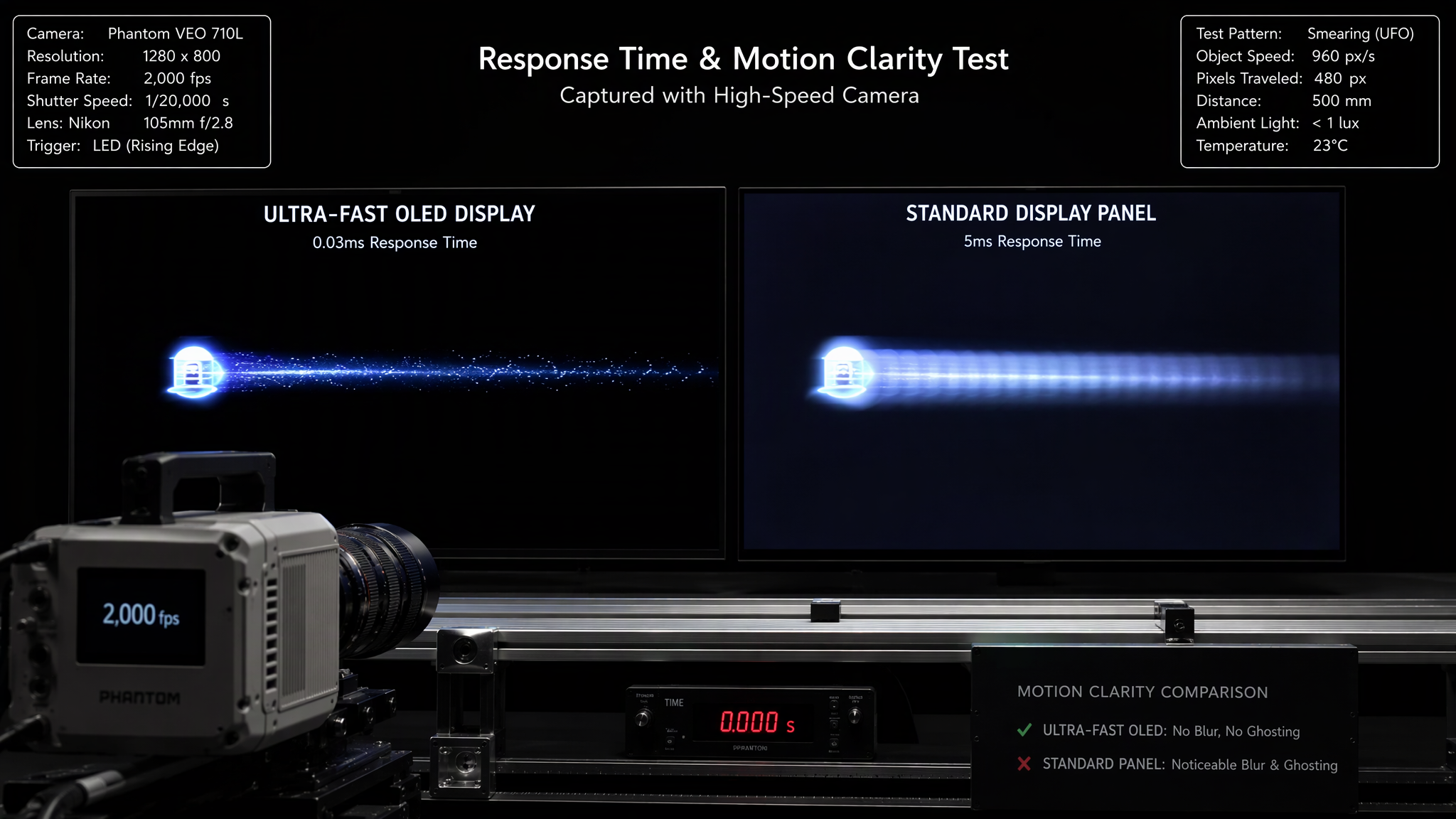
2. Head-to-Head Technical Comparison: OLED vs LED Displays
Data source: Compiled from display engineering standards, laboratory measurement benchmarks, and commercial display technical specifications.
Performance Parameter | OLED Display (WOLED & QD-OLED) | LED-Backlit LCD & Mini-LED | Direct-View LED (dvLED) | Engineering Impact & Tradeoff |
Emission Mechanism | Self-Emissive Organic Carbon Diodes | Transmissive Liquid Crystal with LED Backlight | Self-Emissive Inorganic Semiconductor Micro-Diodes | OLED and dvLED generate light at the pixel level; LCD modulates backlight |
Black Level & Contrast | Absolute True Black (0.000 Nits)<br>Infinite Contrast Ratio | 0.01 to 0.10 Nits (Local Dimming)<br>1,000 to 1 up to 50,000 to 1 Dynamic | 0.001 to 0.01 Nits<br>5,000 to 1 up to Infinite Contrast | OLED delivers flawless dark scenes; LCD exhibits blooming around highlights |
Peak Window Brightness | 800 to 1,500 Nits (at 2% to 10% Window)<br>MLA & QD-OLED up to 3,000 Nits Peak | 1,000 to 3,000+ Nits (Sustained)<br>Extreme HDR Highlights | 800 to 1,500 Nits (Indoor)<br>4,000 to 8,000+ Nits (Outdoor) | LED maintains intense brightness across full screens without aggressive dimming |
Full-Field 100% Brightness | 150 to 280 Nits (Restricted by ABL) | 600 to 1,500 Nits (Unrestricted Full White) | 800 to 5,000+ Nits (Unrestricted) | OLED dims large bright areas to protect organic materials from thermal stress |
Response Time | 0.03 ms to 0.1 ms (Near-Instantaneous) | 1 ms to 5 ms (Gray-to-Gray Liquid Crystal) | Nanosecond Diode Switching | OLED delivers unmatched motion clarity with zero liquid crystal ghosting |
Viewing Angles | 178 Degrees (Zero Contrast or Color Shift) | VA: 20 to 35 Degrees (Color Shift)<br>IPS: 178 Degrees (Subtle IPS Glow) | 140 to 170 Degrees (Uniform Dispersion) | OLED maintains perfect color and contrast from any viewing position |
Burn-In Susceptibility | Moderate Risk (Cumulative Organic Aging) | Zero Risk (Inorganic Crystals) | Zero Risk (Inorganic Semiconductors) | OLED requires software protection; LED displays are immune to burn-in |
Operational Lifespan | 30,000 to 50,000 Hours (Blue Sub-Pixel Decay) | 50,000 to 80,000 Hours (Backlight Decay) | 100,000 Hours (To 50% Luminance Decay) | dvLED and Mini-LED offer double the operational lifespan for 24-7 duty cycles |
Physical Form Factors | 27 Inches to 97 Inches (Ultra-Thin Glass) | 24 Inches to 98 Inches (Fixed Bezel Glass) | 100 Inches to Infinite Seamless Modular Size | dvLED builds completely seamless video walls of any geometric dimension |
Power Efficiency | Content-Dependent Dynamic Draw | Consistent Base Load Draw | Content-Dependent Dynamic Draw | OLED is highly efficient for dark scenes but consumes more power on full white |
2026 Price Benchmark | 650 USD to 3,500 USD per display | 200 USD to 2,500 USD per display | 1,200 USD to 6,000 USD per square meter | OLED carries premium consumer pricing; dvLED is commercial capital equipment |
---
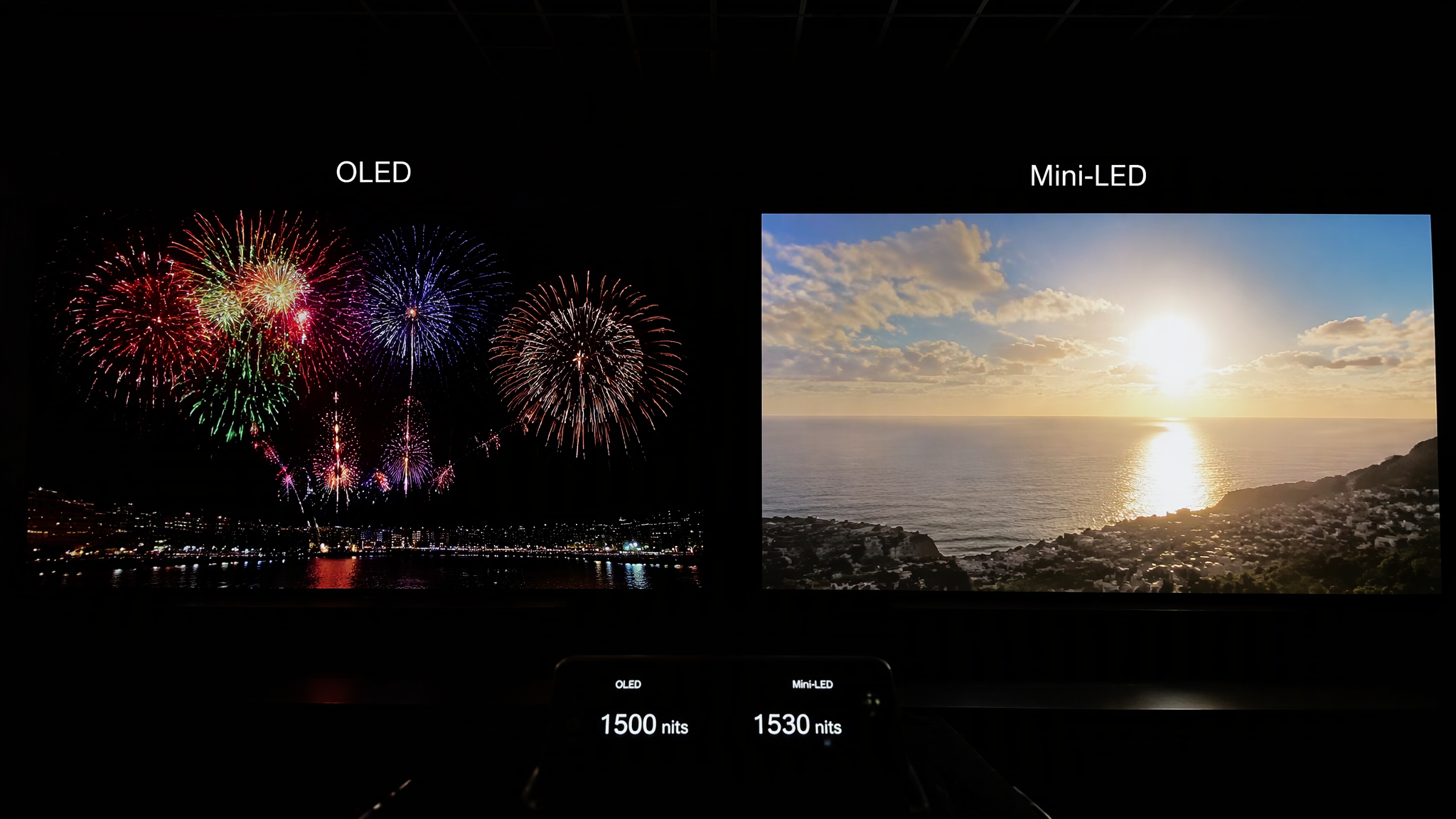
3. OLED Burn-In Explained: Causes, Physics and Mitigations
`
OLED Burn-In Mechanism
Continuous Static Luminance ───> Localized Heat & Current ───> Organic Chemical Degradation
│
Permanent Darker Silhouette <─── Differential Efficiency Loss <───────────┘
`
What Causes OLED Burn-In?
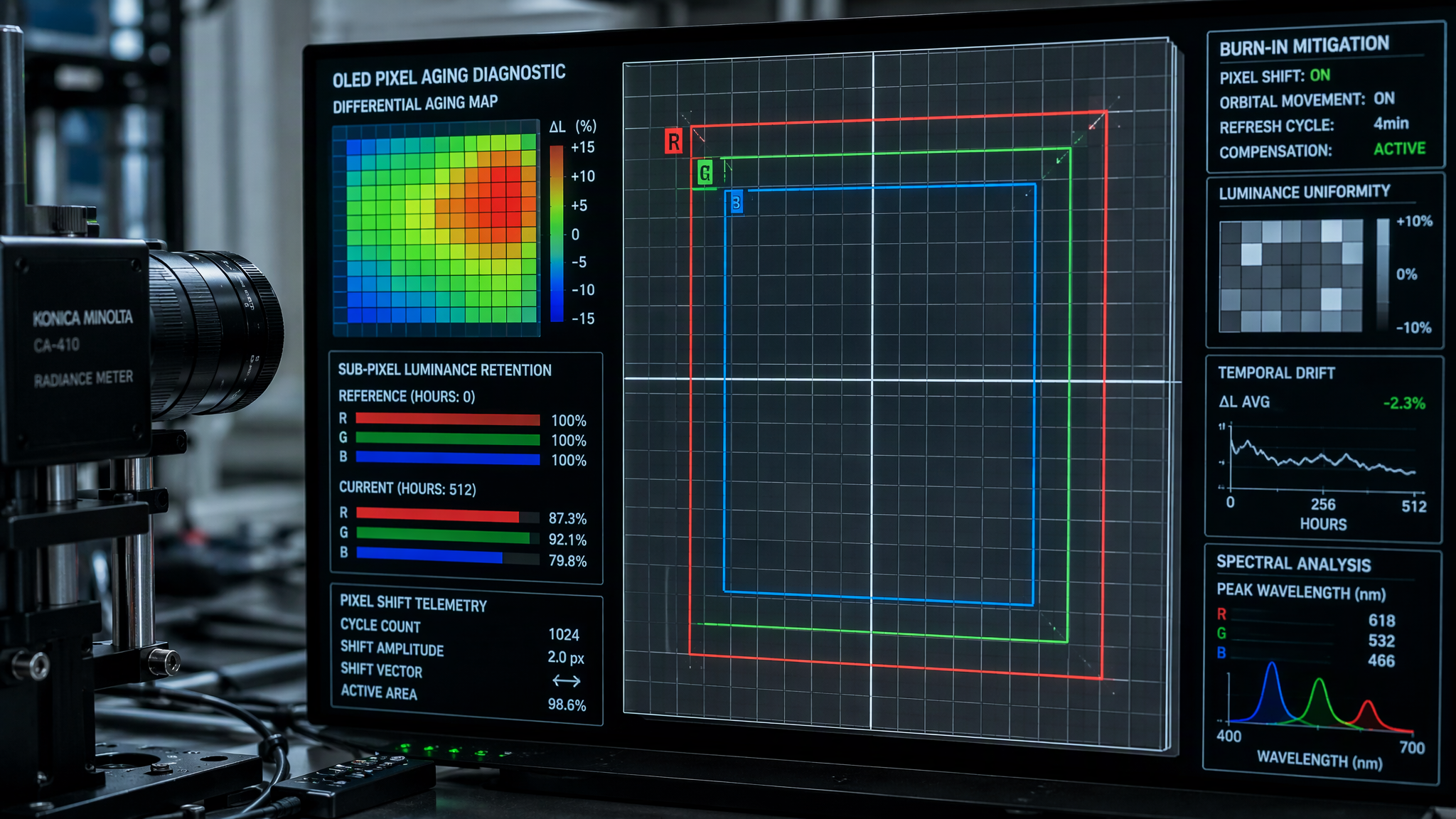
OLED burn-in (permanent image retention) is not a sudden defect; it is differential pixel aging. Because each OLED sub-pixel is an independent organic light-emitting diode, its luminous efficiency gradually degrades over its operating life as it emits light and generates heat.
When static high-contrast graphical elements (such as television news tickers, gaming health bars, desktop taskbars, sports scoreboards, or channel watermarks) remain on screen in the exact same pixel coordinates for thousands of cumulative hours, those specific organic sub-pixels degrade faster than surrounding pixels that display dynamic video.
Over time, the heavily used sub-pixels produce less light, leaving a visible, permanent ghost silhouette or darker imprint of the static graphic when viewing full-screen solid colors.
Modern OLED Burn-In Mitigation Technologies
Leading panel manufacturers have integrated sophisticated hardware and firmware protection suites to dramatically reduce burn-in risks during typical mixed entertainment use:
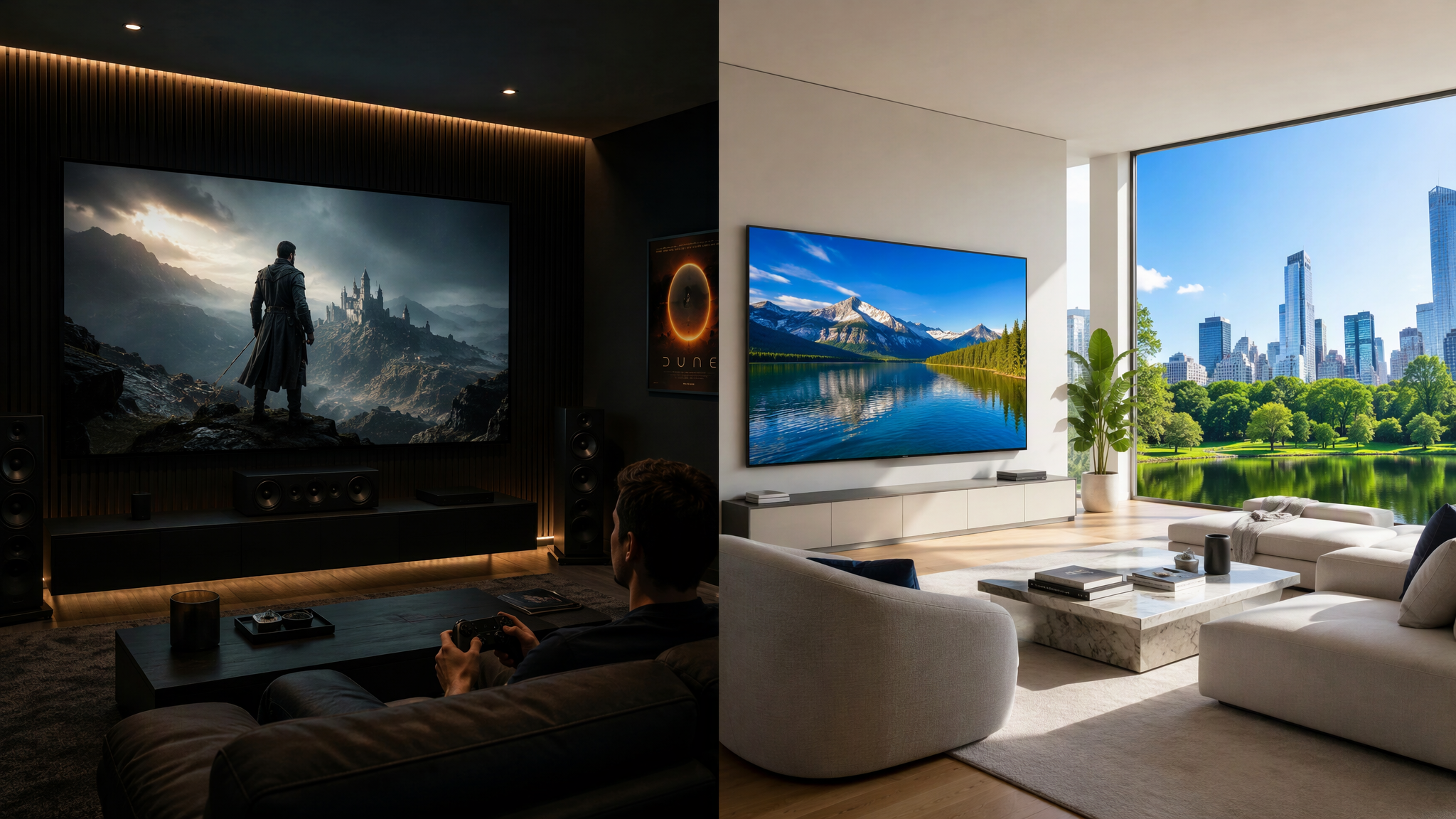
· 4. Buyer Decision Matrix: How to Choose the Right Display
To select the ideal display technology for your specific application, follow this straightforward decision workflow:
`
Buyer Selection Workflow
Need Screen Size > 100 Inches or Zero Bezel? ──> YES ──> Choose Direct-View LED (dvLED)
│
└──> NO (Standard 27 to 98 Inch Display)
│
├──> Dark Room Cinema, HDR Gaming or Studio Grading? ──> Choose OLED Display
│
└──> Bright Sunlit Room, 8+ Hour Static PC Work or 24-7 Operation? ──> Choose Mini-LED or LED-LCD
`
Use Case Scenario | Recommended Display Technology | Core Engineering Justification |
Home Cinema & Movie Watching | OLED (WOLED or QD-OLED) | True 0-nit black, infinite contrast, and zero backlight blooming in dark rooms |
Competitive eSports & Console Gaming | OLED Display | 0.03 ms response time, instantaneous pixel transition, and unmatched HDR pop |
Bright Living Room TV (Daylight Windows) | Mini-LED Display | 1,500 to 3,000 nits sustained brightness to overcome intense daylight reflections |
Desktop Office Productivity & Coding | LED-Backlit LCD or Mini-LED | Zero burn-in risk from static window borders, taskbars, IDEs, and spreadsheets |
Broadcast Television & Color Grading | OLED (Mastering) or dvLED (Studio) | OLED for critical master grading; dvLED for seamless camera backdrops |
Corporate Boardroom (Above 110 Inches) | Direct-View LED (COB or SMD) | 100% seamless modular canvas, high ambient light punch, zero bezels |
24-7 Security & Traffic Control Centers | Direct-View LED or Mini-LED | 100,000-hour continuous operational duty cycle without burn-in risks |
Outdoor Advertising & Stadium Displays | Direct-View LED (IP65) | 5,000+ nits direct sunlight readability and rugged weatherproof construction |
---
Frequently Asked Questions
Is OLED burn-in still a serious concern in 2026?
For normal, varied consumer use (watching movies, streaming TV shows, and playing a mix of games), modern OLED burn-in protection suites (pixel shifting, logo dimming, heatsinks, and refresh cycles) make permanent burn-in rare within standard 5-year lifespans. However, for continuous static workflows (such as using an OLED monitor for 8 hours daily with static code editors, spreadsheets, or fixed desktop taskbars), the risk of differential aging remains real.
Can an LED-backlit LCD or Direct-View LED screen get burn-in?
No. LED-backlit LCDs, Mini-LEDs, and Direct-View LED displays use inorganic semiconductor materials (silicon, gallium nitride, and indium gallium nitride) that do not undergo chemical organic decay. While LCD panels can occasionally exhibit temporary image persistence, it clears completely after power cycling and never causes permanent burn-in.
---
Final Thoughts
The decision between OLED and LED display technology is defined by matching display physics to your room environment, content habits, and duty cycle. OLED technology reigns supreme for dark-room cinematic viewing, professional color grading, and competitive gaming where perfect black levels, infinite contrast, and microsecond response times create an unrivaled visual experience.
Conversely, Mini-LED and Direct-View LED displays dominate brightly illuminated living rooms, continuous static productivity workstations, large-format commercial boardrooms, and 24-7 mission-critical operations where high sustained luminance, total immunity to burn-in, and 100,000-hour longevity deliver uncompromising reliability.