
6 Essential Factors to Consider Before Investing in an Outdoor LED Display
Investing in an outdoor LED display is a high-yield capital project for commercial property owners, billboard media operators, and retail developers. High-impact digital out-of-home (DOOH) screens generate substantial advertising revenues and elevate architectural assets.
However, outdoor screens face harsh operating environments: intense solar radiation, torrential rain, blizzards, coastal salt spray, and extreme thermal cycling for 14–18 hours daily. Choosing substandard hardware causes rapid diode decay, water ingress, power failures, high electric utility bills, and structural hazards.
Evaluate these 6 essential engineering, optical, and financial factors before issuing a purchase order.
```

Outdoor LED Display Investment Framework
┌────────────────────────────────────────────────────────────────────────┐
│ 1. Ingress Protection (IP66) & Anti-Corrosion Hermetic Sealing │
├────────────────────────────────────────────────────────────────────────┤
│ 2. Optical Luminance (6,500–10,000 Nits) & Daylight Contrast │
├────────────────────────────────────────────────────────────────────────┤
│ 3. Pixel Pitch (P3.9–P10) & Minimum Viewing Distance Calibration │
├────────────────────────────────────────────────────────────────────────┤
│ 4. Energy Architecture: Common Cathode (25%–40% Power Reduction) │
├────────────────────────────────────────────────────────────────────────┤
│ 5. Structural Engineering: Wind Load Certification & Service Access │
├────────────────────────────────────────────────────────────────────────┤
│ 6. 10-Year Lifecycle TCO: CapEx vs. OpEx Financial Modeling │
└────────────────────────────────────────────────────────────────────────┘
```
---
Factor 1: Environmental Durability, IP Ratings, and Hermetic Sealing
· Ingress Protection (IP Ratings):
· *Standard Minimum*: IP65 Front / IP54 Rear (enclosed building recesses with rear service rooms only).
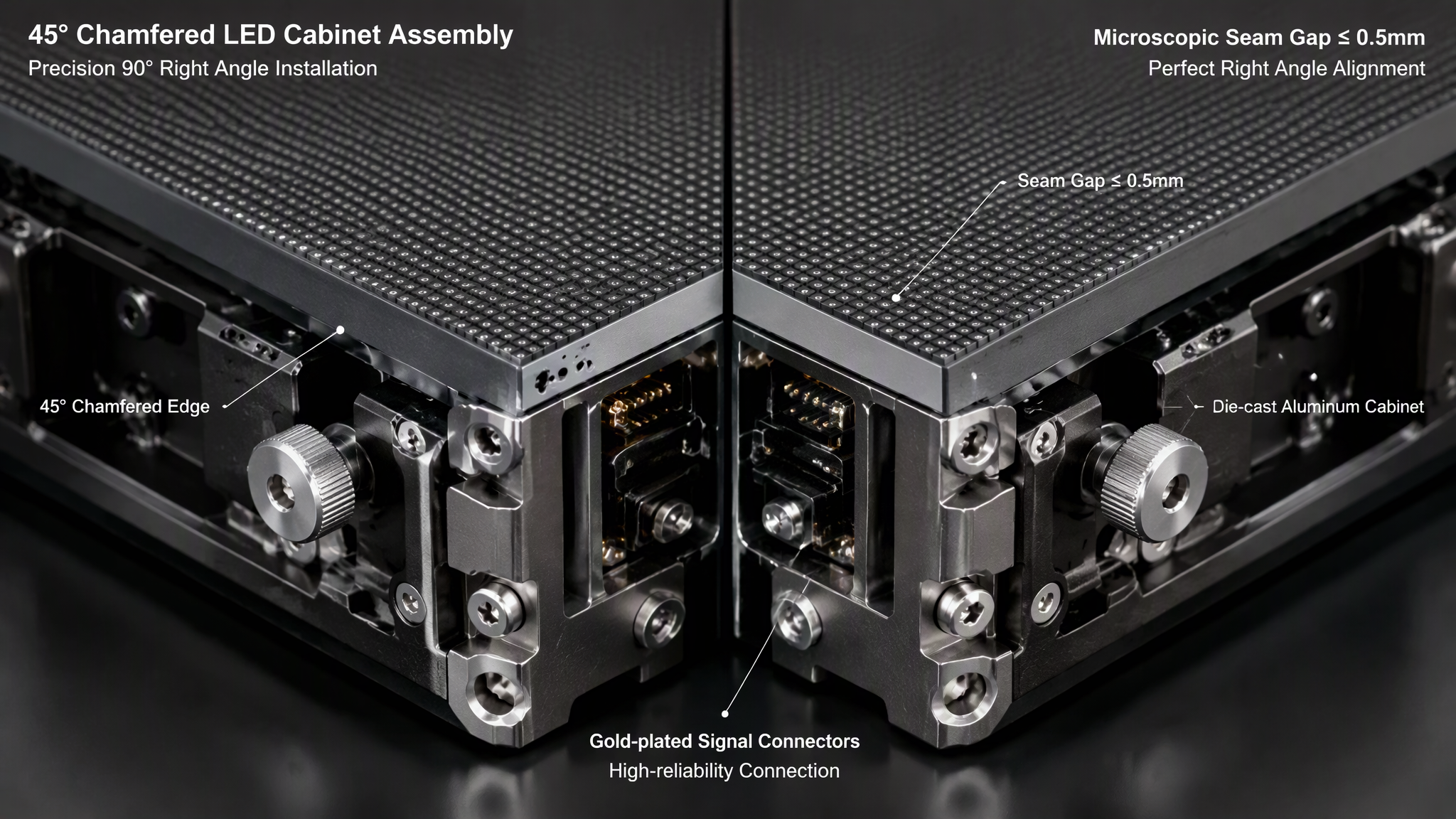
· *Heavy-Duty Standard*: IP66 Front / IP66 Rear with hermetic die-cast aluminum cabinets (mandatory for freestanding pylons and rooftop installations exposed to driving rain and jet cleaning).
· Conformal Coating & Salt-Fog Resistance: Automated three-layer conformal coating (Class 3 acrylic/polyurethane) protects PCBs against oxidation. Coastal sites ($le 10text{ km}$ from sea) mandate SUS304/SUS316 stainless fasteners and $ge 720text{-hour}$ salt-spray certified coatings.
---
Factor 2: Optical Luminance, Solar Contrast, and Adaptive Dimming
```
Solar Angle vs. Optical Power
Direct South Solar Exposure ────────> 7,500 – 10,000 Nits (Gold-Wire High Brightness)
East / West Ambient Daylight ───────> 6,000 – 7,500 Nits (Standard Outdoor Black/White Face)
North-Facing / Shaded Facades ──────> 5,500 – 6,500 Nits (Anti-Glare Matte Mask)
```
· Luminance Sizing: South-facing screens require $7,500text{ to }10,000text{ nits}$ to prevent solar washout; north-facing or shaded sites operate crisply at $5,500text{ to }6,500text{ nits}$.
· Black-Body SMD Diodes: High-efficiency black-face SMD diodes (Nationstar/Kinglight Gold-Wire) paired with matte-black micro-groove masks deliver an 8,000:1+ contrast ratio for deep blacks under direct daylight.
· Automated Dimming: Integrated multi-point photocell sensors throttle brightness across 256 gradations (100% at solar noon down to 10%–15% / $600text{–}800text{ nits}$ at night).
---
Factor 3: Pixel Pitch, Resolution, and Viewing Distance Optimization
$$text{Minimum Viewing Distance } (D_{min}) = text{Pixel Pitch } (P) times 1.0text{ meter}$$
$$text{Optimal Visual Acuity Distance } (D_{text{optimal}}) = text{Pixel Pitch } (P) times (1.5 text{ to } 2.5)text{ meters}$$
Pixel Pitch (P) | Density (Pixels/$text{m}^2$) | Min. Viewing Distance | Optimal Viewing Range | Primary Application Scenario |
P3.91 mm | $65,536$ | $3.9text{ m } (12.8text{ ft})$ | $4.0 - 10.0text{ m}$ | High-end retail storefronts, transit kiosks, eye-level street DOOH |
P4.81 mm | $43,264$ | $4.8text{ m } (15.7text{ ft})$ | $5.0 - 15.0text{ m}$ | Pedestrian shopping malls, outdoor event plazas, building facades |
P6.0 mm | $27,777$ | $6.0text{ m } (19.7text{ ft})$ | $6.0 - 25.0text{ m}$ | Roadside commercial signs, gas stations, mid-range stadium screens |
P8.0 mm | $15,625$ | $8.0text{ m } (26.2text{ ft})$ | $8.0 - 40.0text{ m}$ | Highway bypass billboards, rooftop digital displays, perimeter signage |
P10.0 mm | $10,000$ | $10.0text{ m } (32.8text{ ft})$ | $10.0 - 60.0text{ m}$ | Mega highway unipoles, stadium jumbotrons, large architectural walls |
---
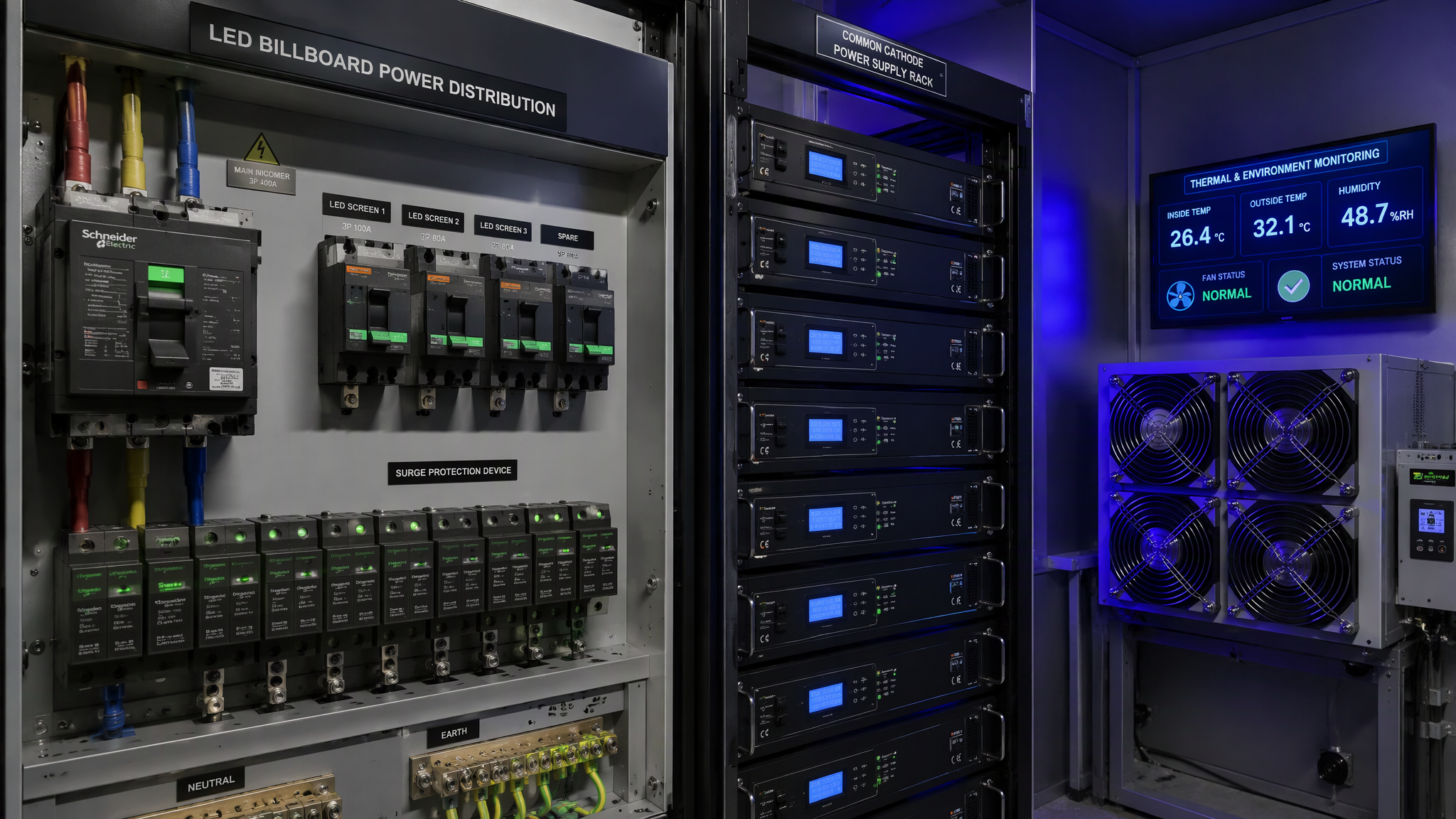
Factor 4: Energy Architecture and Thermal Dissipation (Common Cathode)
```
Power Architecture Comparison
Common Anode (5V): Uniform 5V -> Wasted 2.9V on Red converted to heat
Common Cathode: 2.8V Rail (Red) + 3.8V Rail (Green/Blue) -> Zero wasted heat
```
· Efficiency Gains: Common Cathode splits power rails ($2.8text{V}$ for Red, $3.8text{V}$ for Green/Blue), slashing power consumption by $25%text{ to }40%$ and dropping cabinet temperatures by $10^circtext{C} - 15^circtext{C}$.
· HVAC Elimination: Lower heat dissipation eliminates expensive active air conditioning in most climates, relying on natural convection.
---
Factor 5: Structural Engineering, Wind Load, and Maintenance Access
· Wind Load Certification: Billboards must withstand local peak wind forces ($120text{ to }160text{ km/h}$, Beaufort Scale 12–14 typhoon/hurricane rating) using hot-dip galvanized steel (Q235B/Q355B) with PE-stamped calculations.
· Service Access:
· *Front Maintenance (Magnetic/Tool-Lock)*: Required for flush facade mounts with zero rear cavity (depth $<150text{ mm}$).
· *Rear Maintenance (Walk-In Catwalk)*: Ideal for freestanding pylons and rooftop installations, enabling safe component servicing.
---
Factor 6: 10-Year Lifecycle TCO: CapEx vs. OpEx Financial Modeling
Initial hardware accounts for only 40%–50% of 10-year Total Cost of Ownership (TCO). High-efficiency hardware yields substantial operational savings:
10-Year TCO Cost Component | Economy 2D Display (Low-Grade) | Premium Common Cathode Screen | Financial Impact Over 10 Years |
Initial Hardware CapEx ($100text{ m}^2$) | $$60,000 - $80,000$ | $$100,000 - $140,000$ | Higher initial hardware investment |
Average Power Consumption | $350 - 450text{ W/m}^2$ | $180 - 240text{ W/m}^2$ | $40% - 50%$ lower energy draw |
10-Year Electricity Cost ($$0.15/text{kWh}$) | $$287,000 - $369,000$ | $$147,000 - $197,000$ | Saves $$140,000 - $172,000$ in electricity |
AC / HVAC Cooling Equipment | Required ($$15,000 + text{Power}$) | None / Natural Convection | Saves $$25,000+$ in HVAC CapEx/OpEx |
Maintenance & Module Replacements | High (Copper wire decay) | Minimal (Gold-wire, low thermal stress) | Saves $$30,000+$ in field repairs |
True 10-Year Total Cost of Ownership | $$392,000 - $494,000$ | $$272,000 - $367,000$ | Premium screen delivers $$120,000+$ net savings |
---
Five Golden Procurement Rules for Outdoor LED Buyers
1. Mandate Gold-Wire Encapsulation. Specify gold-wire bonding (Nationstar/Kinglight); copper bonds fail under thermal cycling.
2. Lock In 5% Same-Batch Spare Modules. Secure 5% spare modules and 3% power supplies from the identical single diode wafer bin ($Delta lambda le pm 1.0text{ nm}$).
3. Demand $ge 3,840text{ Hz}$ High-Refresh PWM Drivers. Reject $1,920text{ Hz}$ ICs to eliminate rolling black scan lines on smartphone camera recordings.
4. Specify Common Cathode Power Architecture. Energy savings over 36–48 months fully offset initial hardware price premiums.
5. Require 72-Hour Factory Full-White Burn-In. Demand time-stamped factory aging video logs and thermal imaging verification before dispatching final payment.
---
Frequently Asked Questions
What is the expected operating lifespan of an outdoor LED display?
High-grade outdoor LED screens are rated for $100,000text{ hours}$ (10–12 years running 16 hours daily), retaining $ge 70%$ initial brightness after 8 years under Common Cathode operation.
How do I choose between front and rear maintenance?
Specify front-maintenance for flush wall mounts with zero rear clearance. Choose rear-maintenance catwalk cabinets for freestanding highway unipoles and rooftop structures.
Does an outdoor LED screen require active air conditioning (HVAC)?
Traditional Common Anode displays require HVAC in hot climates ($>38^circtext{C}$). Modern Common Cathode screens operate reliably via natural convection without active air conditioning.
What control system is best for remote billboard management?
Asynchronous cloud controllers (NovaStar Taurus TB-series or Colorlight C-series) with 4G/5G modems enable remote scheduling, brightness adjustment, and automated health diagnostics.
---
Final Thoughts
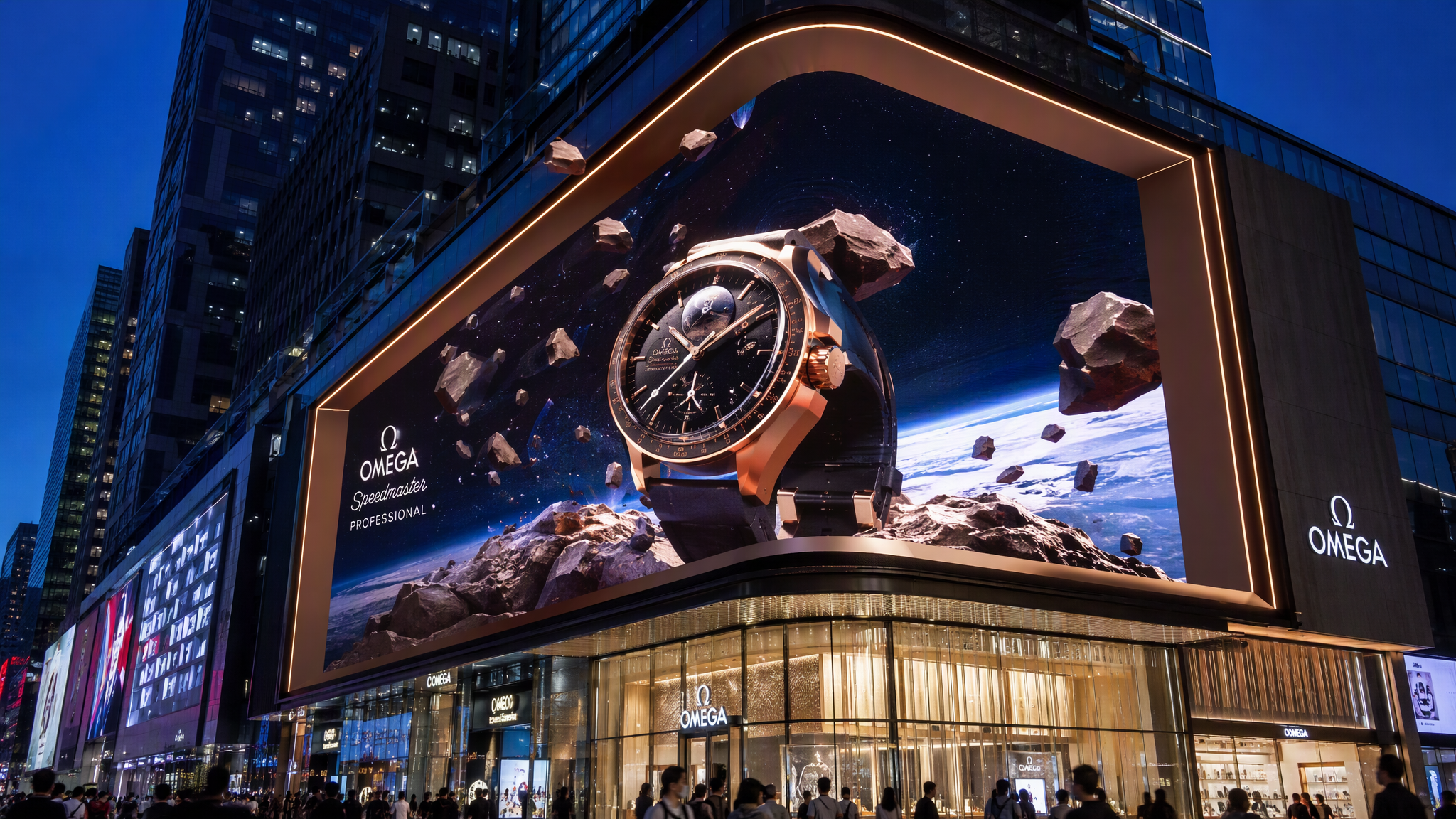
An outdoor LED display is a long-term revenue engine. Prioritizing IP66 hermetic sealing, $7,500+text{ nits}$ daylight brightness, Common Cathode energy efficiency, and certified structural engineering guarantees decade-long reliability and maximum investment ROI.


