
Understanding 3D LED Screen Specifications Before Making a Purchase
Naked-eye 3D LED displays—often featuring anamorphic visual illusions of creatures, spaceships, and luxury products bursting from architectural facades—have become the highest-yielding digital out-of-home (DOOH) assets.
However, a naked-eye 3D billboard is not a standard LED screen playing 3D video. Generating convincing optical depth requires specific hardware engineering, corner transition mechanics, high-refresh driver electronics, and calibrated content mapping. Mismatching these specifications destroys the 3D illusion and wastes capital.
This engineering guide provides buyers, media operators, and commercial developers with the essential technical specifications required before purchasing a 3D LED display.
```
Naked-Eye 3D LED Hardware Sizing Workflow
┌────────────────────────────────────────────────────────────────────────┐
│ 1. Corner Transition: 45° Chamfered Miter (<0.5mm) vs Smooth Curve (R) │
├────────────────────────────────────────────────────────────────────────┤
│ 2. Resolution Canvas: Folded 4K/8K Matrix for Deep Anamorphic Frustum │
├────────────────────────────────────────────────────────────────────────┤
│ 3. Optical Power: 6,500–10,000 Nits Brightness & 16-Bit Grayscale │
├────────────────────────────────────────────────────────────────────────┤
│ 4. Camera Immunity: >=3,840Hz / 7,680Hz PWM Drivers for Social Video │
├────────────────────────────────────────────────────────────────────────┤
│ 5. Media Pipeline: Frame-Locked Genlock Media Servers (Novastar/Disguise)│
└────────────────────────────────────────────────────────────────────────┘
```
1. Corner Transition Engineering: Chamfer vs. Smooth Curve
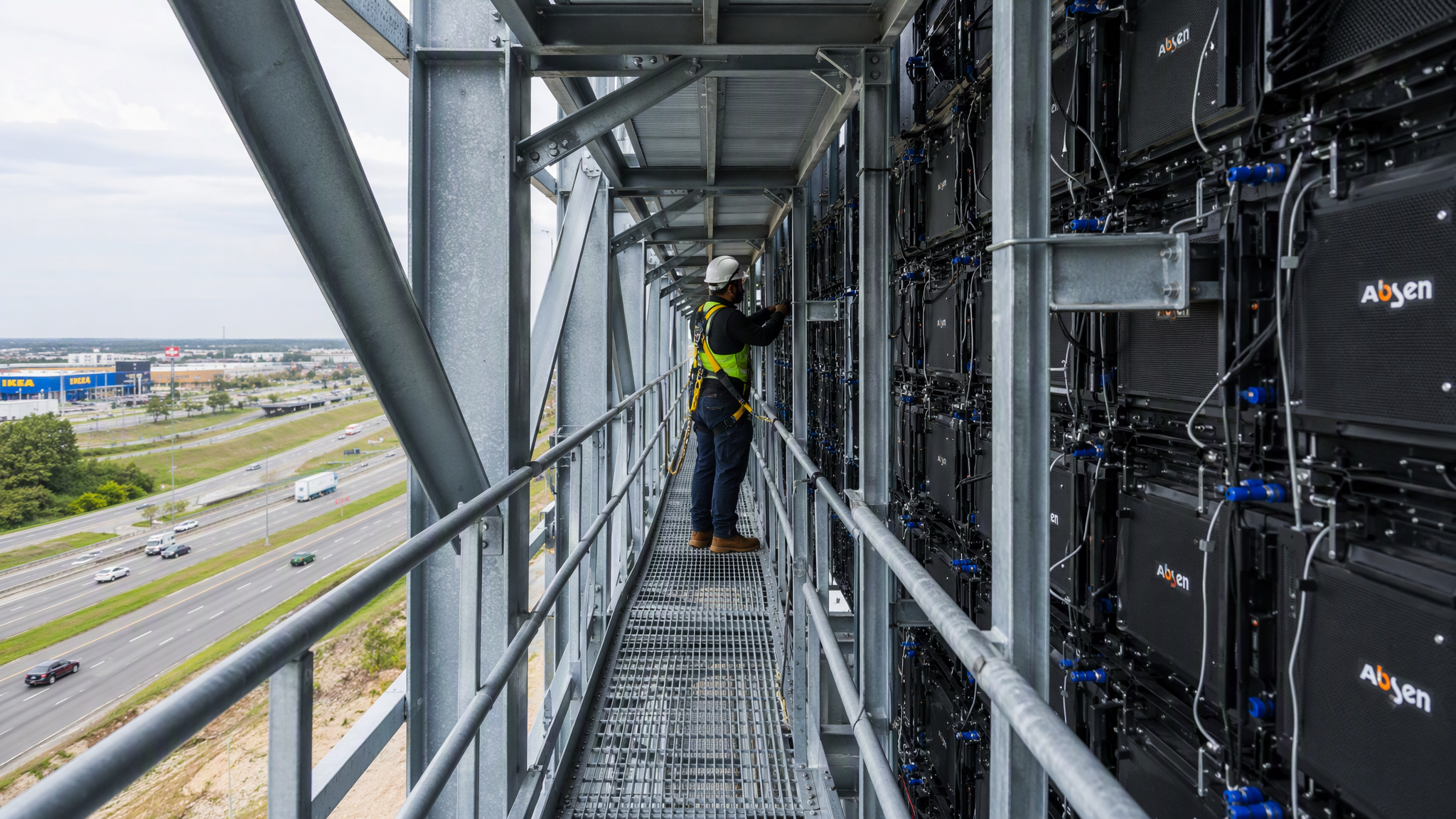
The cornerstone of naked-eye 3D is an L-shaped or curved display wrapping around a building corner. The corner acts as the optical reference frame.
1. $45^circ$ Chamfered Miter Joint: Two die-cast aluminum cabinets engineered with $45^circ$ beveled edges meet at a $90^circ$ right angle.
· *Tolerance Rule*: The physical seam gap must be $le 0.5text{ mm}$. A wider gap creates a black vertical line that shatters visual depth.
2. Continuous Curved Corner: Smooth curved modules spanning a radius of $R = 1.0text{ to }2.5text{ meters}$.
· *Optical Advantage*: Eliminates sharp mechanical edges, delivering fluid anamorphic motion from wider viewing angles.
```
Corner Transition Architectures
┌────────────────────────────────────┬────────────────────────────────────┐
│ 45° Chamfered Miter Joint │ Smooth Continuous Curve (R=1.0-2.5m)│
├────────────────────────────────────┼────────────────────────────────────┤
│ [Left Panel] ──> | <── [Right Panel]│ ╭──────────────────╮ │
│ Microscopic Seam Gap <=0.5mm │ │ Smooth Transition│ │
│ Sharp Architectural Edge │ ╰──────────────────╯ │
└────────────────────────────────────┴────────────────────────────────────┘
```
2. Master Technical Specifications for 3D LED Displays
Specification Dimension | Standard 2D Billboard | Professional 3D LED Billboard | Engineering Impact |
Corner Mechanical Seam | Flat Screen / Standard Butt Joint | $45^circ$ Chamfer ($le 0.5text{ mm}$) or Curved ($R le 2.5text{m}$) | Preserves continuous 3D optical illusion |
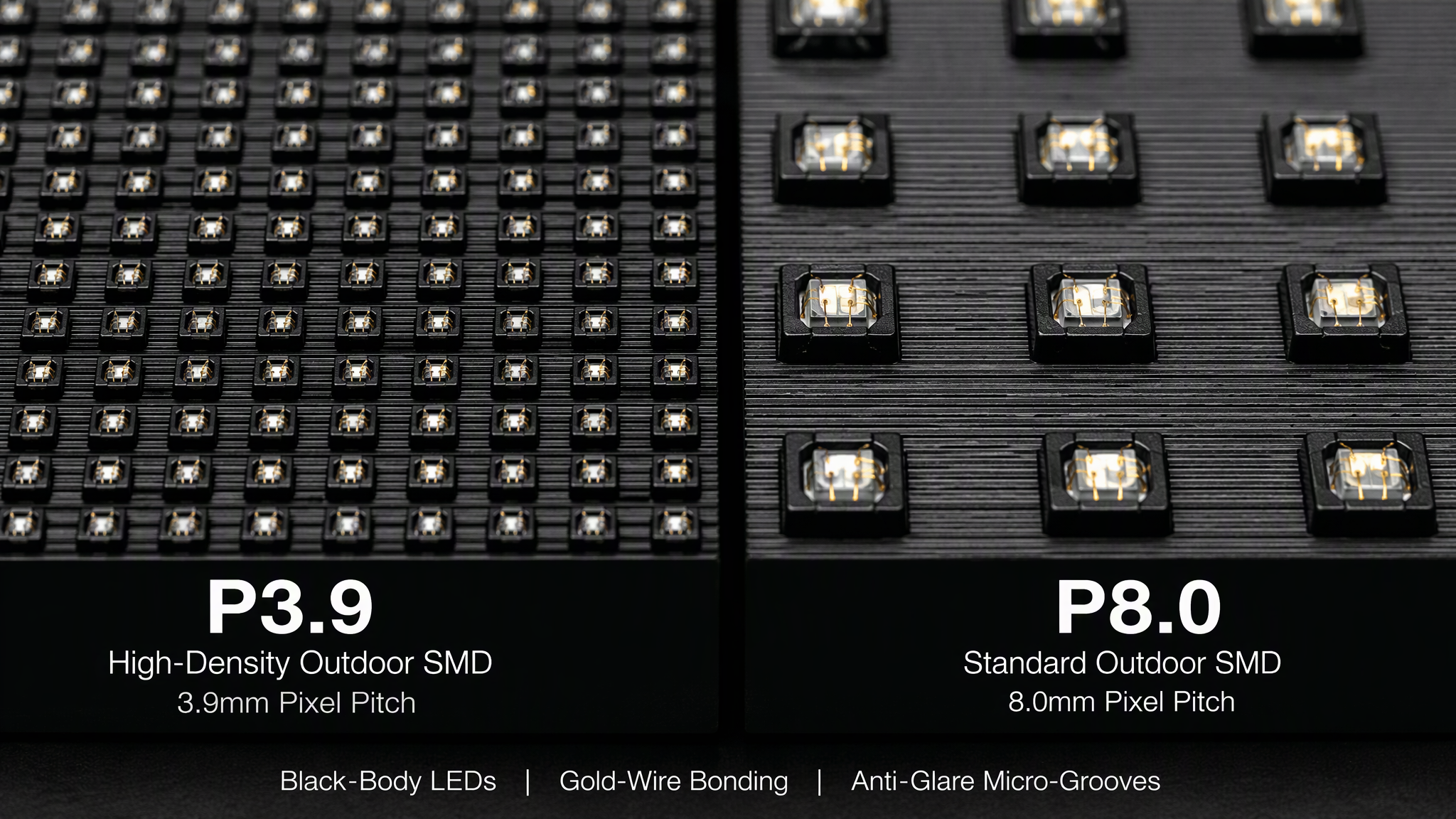
Pixel Pitch Range (P) | P8.0 - P16.0 mm | P3.91 - P8.0 mm (Outdoor) / P1.5 - P2.5 (Indoor) | Sharp depth cues and detailed micro-textures |
Minimum Resolution | 1080p ($1920times 1080$) | Folded 4K ($3840times 2160$) to 8K Canvas | Prevents pixelation in anamorphic box |
Calibrated Luminance | $5,000text{ nits}$ | $6,500 - 10,000text{ nits}$ (Gold-Wire SMD) | Overcomes direct sunlight washout |
PWM Refresh Rate | $1,920text{ Hz}$ | $ge 3,840text{ Hz} - 7,680text{ Hz}$ | Eliminates scan lines on mobile phone videos |
Grayscale Processing | $14text{-bit}$ | $16text{-bit}$ Low-Brightness Grayscale | Smooth shadow gradients in virtual box |
Cabinet Architecture | Standard Iron Cabinet | CNC Die-Cast Aluminum (Tolerance $le 0.03text{mm}$) | Perfect surface flatness, zero module step |
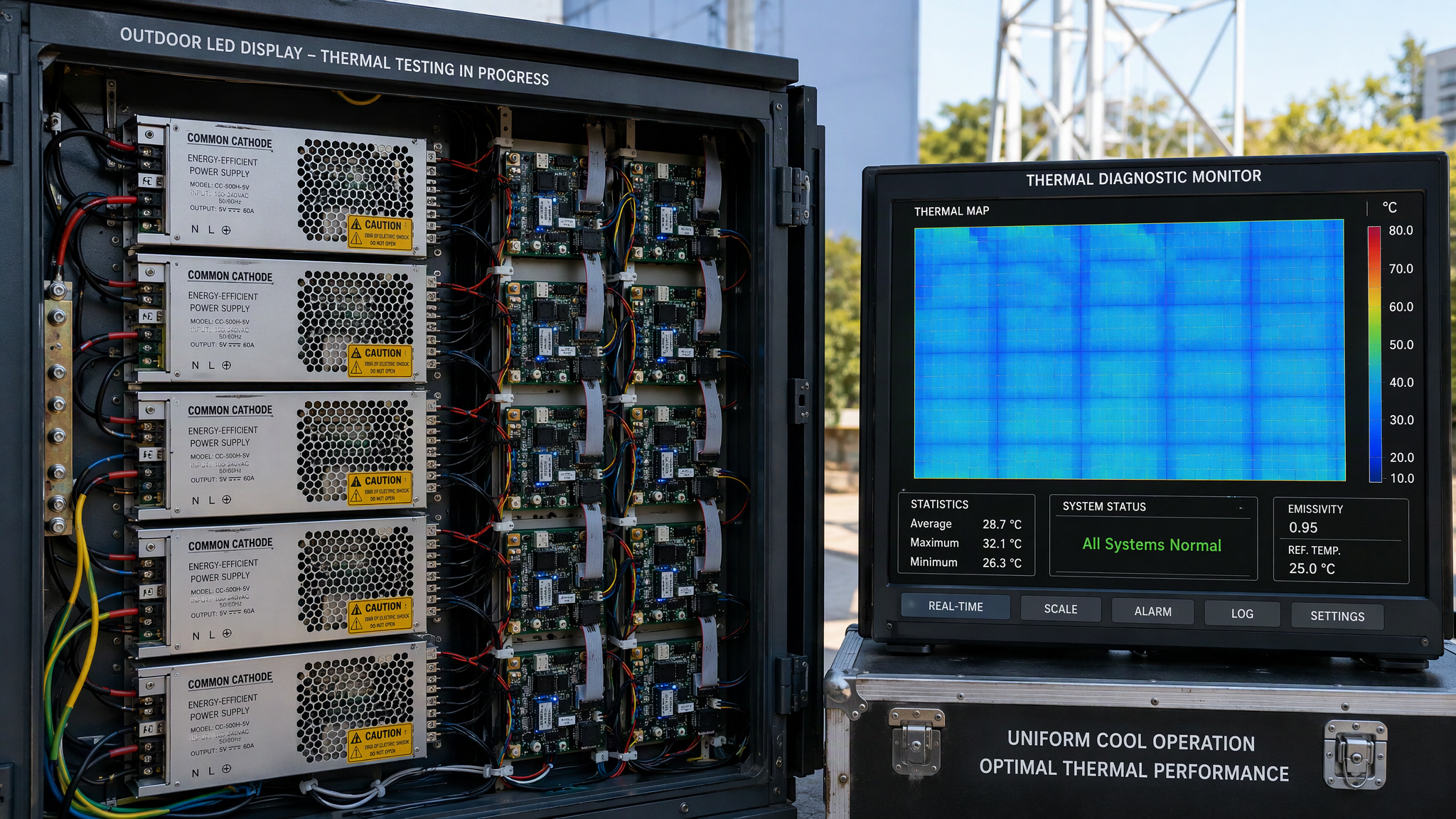
Power Architecture | Common Anode ($5text{V}$) | Common Cathode ($2.8text{V} / 3.8text{V}$) | $25% - 40%$ energy reduction, cooler run |
Media Server Sync | Standard Media Player | Genlock Frame-Synchronized Server | Zero frame tearing across the corner |
Turnkey Cost (2026 Est.) | $$800 - $1,500 /text{m}^2$ | $$1,200 - $2,800 /text{m}^2$ | Premium hardware & specialized processing |
3. Four Core Purchasing Checkpoints
1. High-Refresh PWM Drivers for Social Media Virality
Naked-eye 3D campaigns succeed through viral sharing on TikTok, Instagram, and YouTube.
· Standard $1,920text{ Hz}$ screens produce dark rolling scan lines on smartphone cameras.
· Buyers must mandate $ge 3,840text{ Hz}$ (or $7,680text{ Hz}$) PWM driver ICs (such as Macroblock MBI5252/5359 or Chipone ICN2163) with high scan multiplexing rates ($1/8text{ to }1/16$).
2. High Dynamic Range and Inky Black Levels
The 3D illusion relies on rendering a "virtual shadow box." If the screen's black levels appear gray, the boundary between the physical building and virtual room collapses.
· Specify black-body SMD diodes (Nationstar or Kinglight gold-wire) paired with matte-black masks featuring anti-glare micro-grooves.
3. Common Cathode Power & Thermal Management
Outdoor 3D displays run at high brightness for 14–18 hours daily.
· Common Cathode Architecture: Supplies dedicated $2.8text{V}$ to Red and $3.8text{V}$ to Green/Blue diodes, slashing power consumption by $25%text{ to }40%$ and lowering operating temperature by $10^circtext{C} - 15^circtext{C}$.
4. Media Server and Perspective Sweet Spot Calibration
· The 3D effect works from a specific pedestrian viewing zone (the "Sweet Spot").
· Ensure the display controller (e.g., NovaStar H-series or Colorlight) supports hardware Genlock frame-syncing and native EDID mapping for uncompressed 60fps playback.
Five Strategic Sourcing Rules for Buyers
3. Reject Standard 90-Degree Butt Joints. Never allow flat rectangular cabinets to butt together at a corner. Mandate $45^circ$ mitered CNC cabinets with $le 0.5text{ mm}$ seam gaps.
4. Lock Minimum 4K Folded Resolution. Ensure total pixel width across both faces reaches at least 3,840 pixels to render crisp 3D depth textures.
5. Mandate Factory 72-Hour Burn-In Testing. Require time-stamped video logs of continuous 72-hour full-white and RGB aging tests before overseas shipment.
6. Secure Single-Bin Diode Calibration Files. Require single-bin diode sorting ($Delta lambda le pm 1.0text{ nm}$) and store factory calibration data on USB flash drives.
7. Contract for 5% Same-Batch Spare Modules. Guarantee 10-year color uniformity by securing 5% spare modules from the primary manufacturing batch.
Frequently Asked Questions
Does a 3D LED billboard require specialized 3D LED modules?
No. 3D LED displays use standard high-grade LED diodes. The 3D effect is created by the 90-degree corner cabinet engineering, ultra-high refresh rate, and anamorphic CGI video content.
What is the minimum viewing distance for an outdoor 3D billboard?
Minimum distance equals $P times 1.0text{ m}$. For a P6 outdoor screen, viewers should stand at least $6text{ meters}$ away to perceive a seamless 3D image without visible pixel grain.
How much does a turnkey 3D LED billboard cost in 2026?
Turnkey costs typically range from $$1,200text{ to }$2,800text{ per }text{m}^2$, covering $45^circ$ CNC cabinets, 8,000-nit gold-wire LEDs, Common Cathode power, 4K video processors, and mounting frames.
Can a 3D LED screen still play standard 2D commercial ads?
Yes. A 3D LED screen can seamlessly transition between standard 2D commercial advertisements and high-impact 3D anamorphic spectacles.
Final Thoughts
A successful naked-eye 3D LED billboard is an integrated system: precision $45^circ$ corner mechanics, $ge 3,840text{ Hz}$ high-refresh driver ICs, high daylight brightness, and calibrated anamorphic content. Specifying these core standards guarantees maximum viral impact and long-term commercial ROI.


