
IP65 vs IP66: Choosing the Right Protection Rating for LED Displays
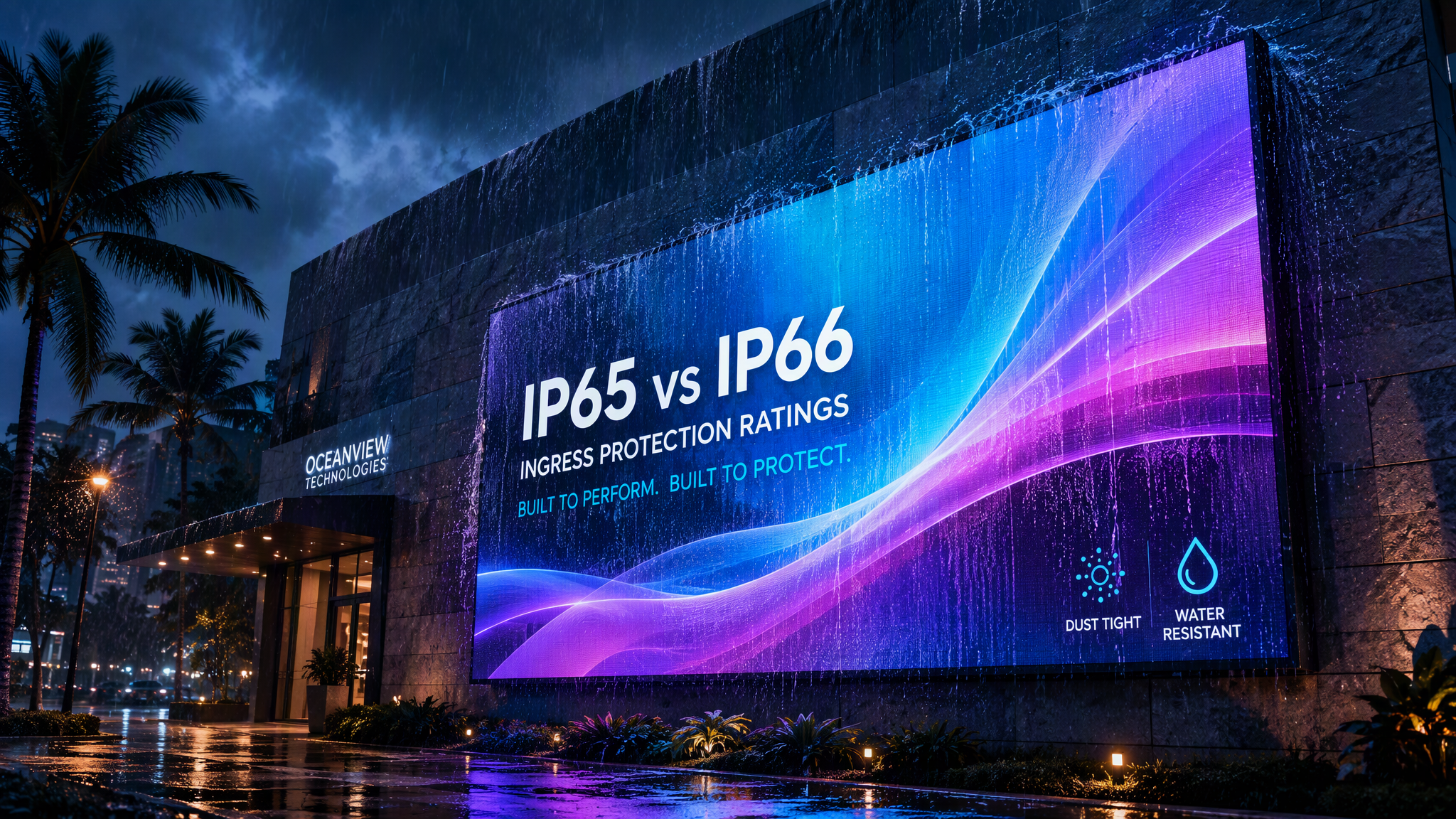
Outdoor LED displays face rain, dust, salt spray and temperature changes. The IEC 60529 Ingress Protection (IP) code helps buyers compare enclosure resistance to solids and water. IP65 and IP66 are both dust-tight; the key difference is how strongly water can be jetted at the enclosure.
1. What the ratings mean
The first digit “6” means the enclosure is dust-tight. The second digit describes water-jet resistance: IPX5 is tested against water jets, while IPX6 is tested against more powerful jets.
Test parameter | IP65 / IPX5 | IP66 / IPX6 |
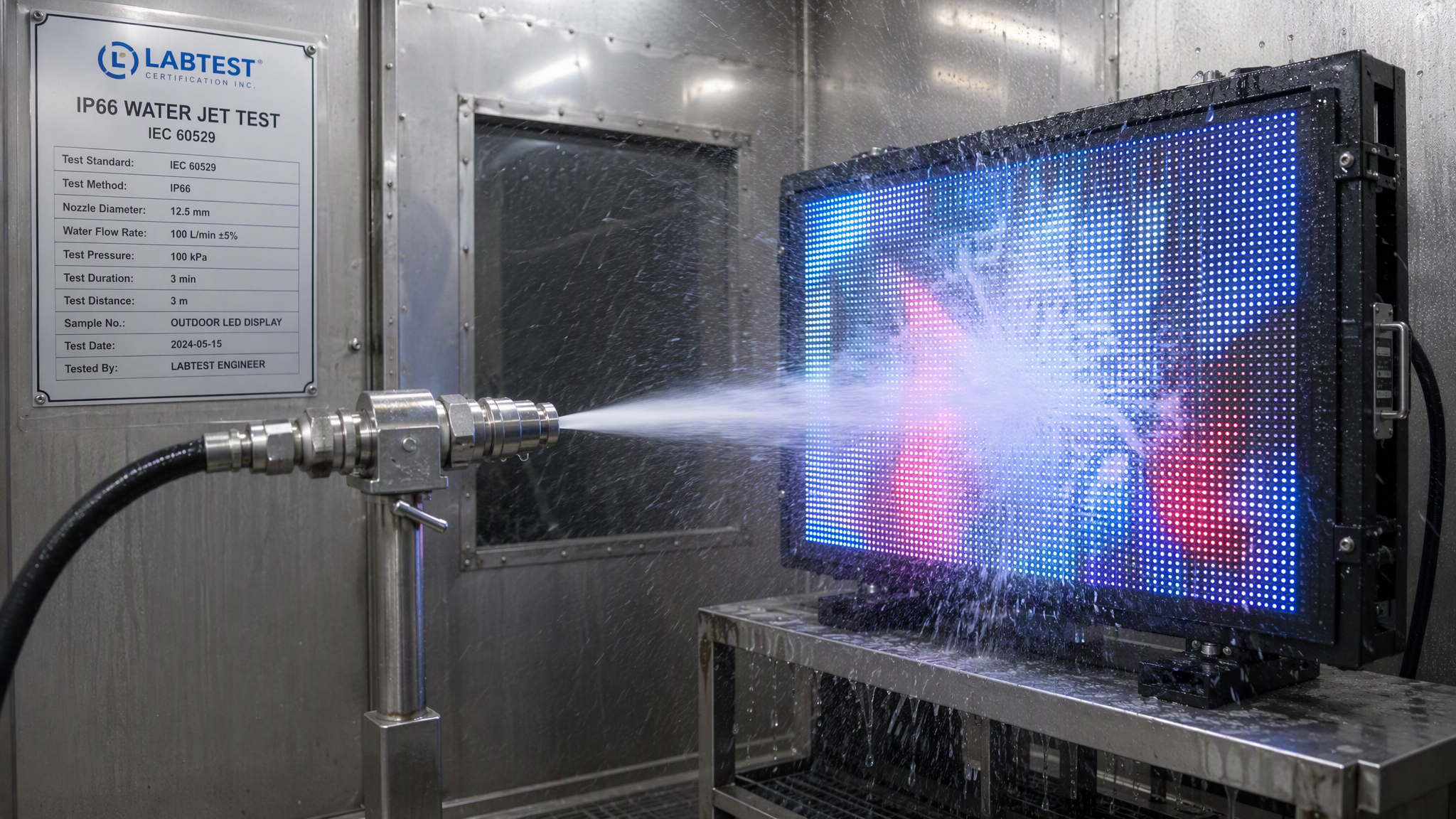
Nozzle diameter | 6.3 mm | 12.5 mm |
Water flow | 12.5 L/min | 100 L/min (8× higher) |
Pressure | 30 kPa (0.3 bar) | 100 kPa (1.0 bar; 3.3× higher) |
Dust protection | Dust-tight | Dust-tight |
Both tests use water from practicable directions at roughly 2.5–3.0 m. IP66 provides stronger resistance to forceful washdown and wind-driven water, but it does not mean the display can be submerged; submersion requires a separately specified IP67 or IP68 rating.
2. What changes in the cabinet?
A higher rating depends on the complete enclosure—not just the LED module face. Typical construction differences described in the source include:
· IP65: often uses a single EPDM or neoprene gasket, polyurethane PCB potting, and standard threaded glands or screw-in connectors.
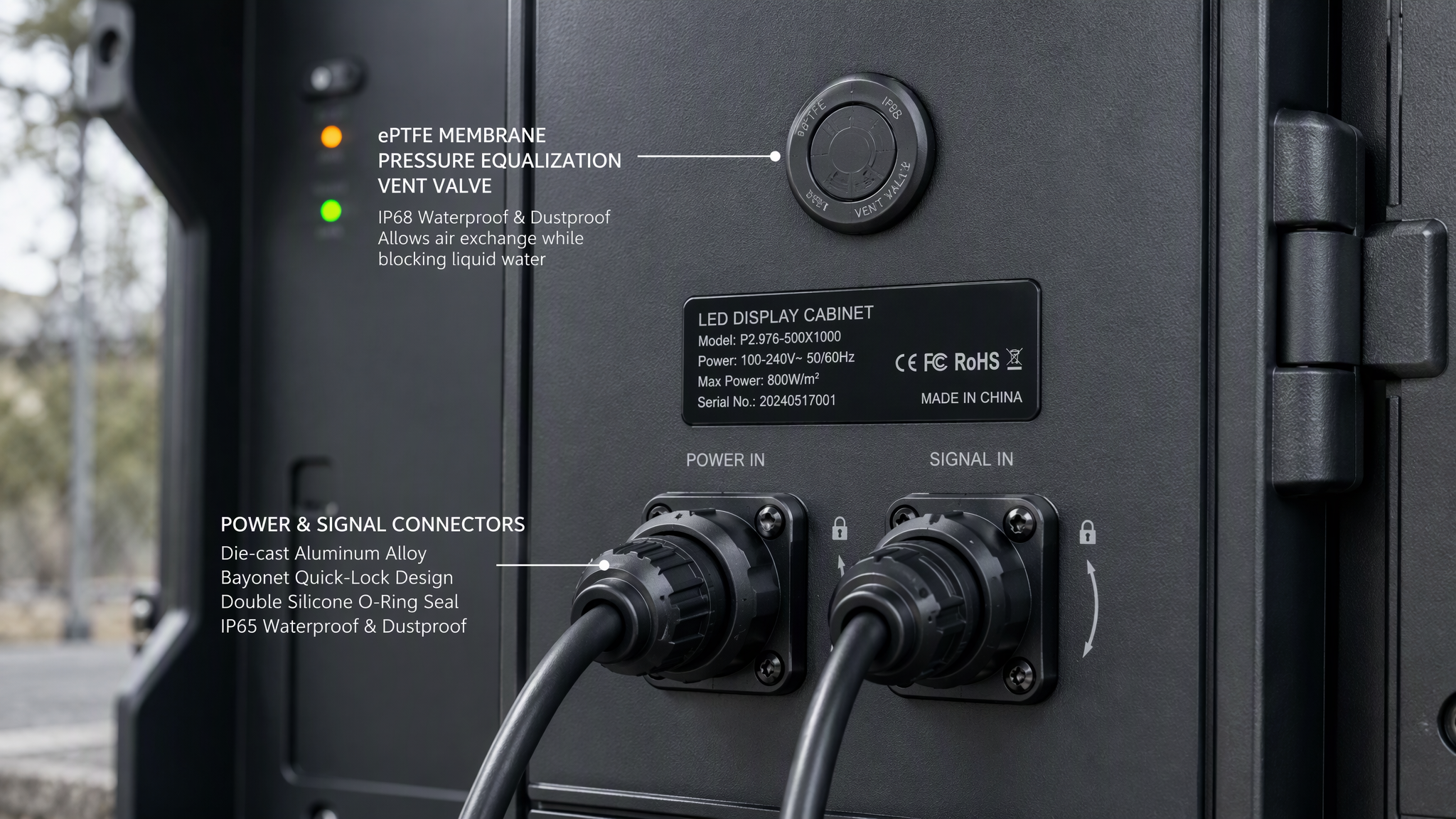
· IP66: may use molded silicone or fluororubber O-rings seated in machined channels, dual-compound silicone back-potting, Class 3 conformal coating, and waterproof breathable ePTFE pressure-equalization vents.
· Cable entries and signal/power connectors must be sealed to a rating that matches the cabinet; dual O-rings and locking connectors help protect these weak points.
3. Specify front and rear ratings separately
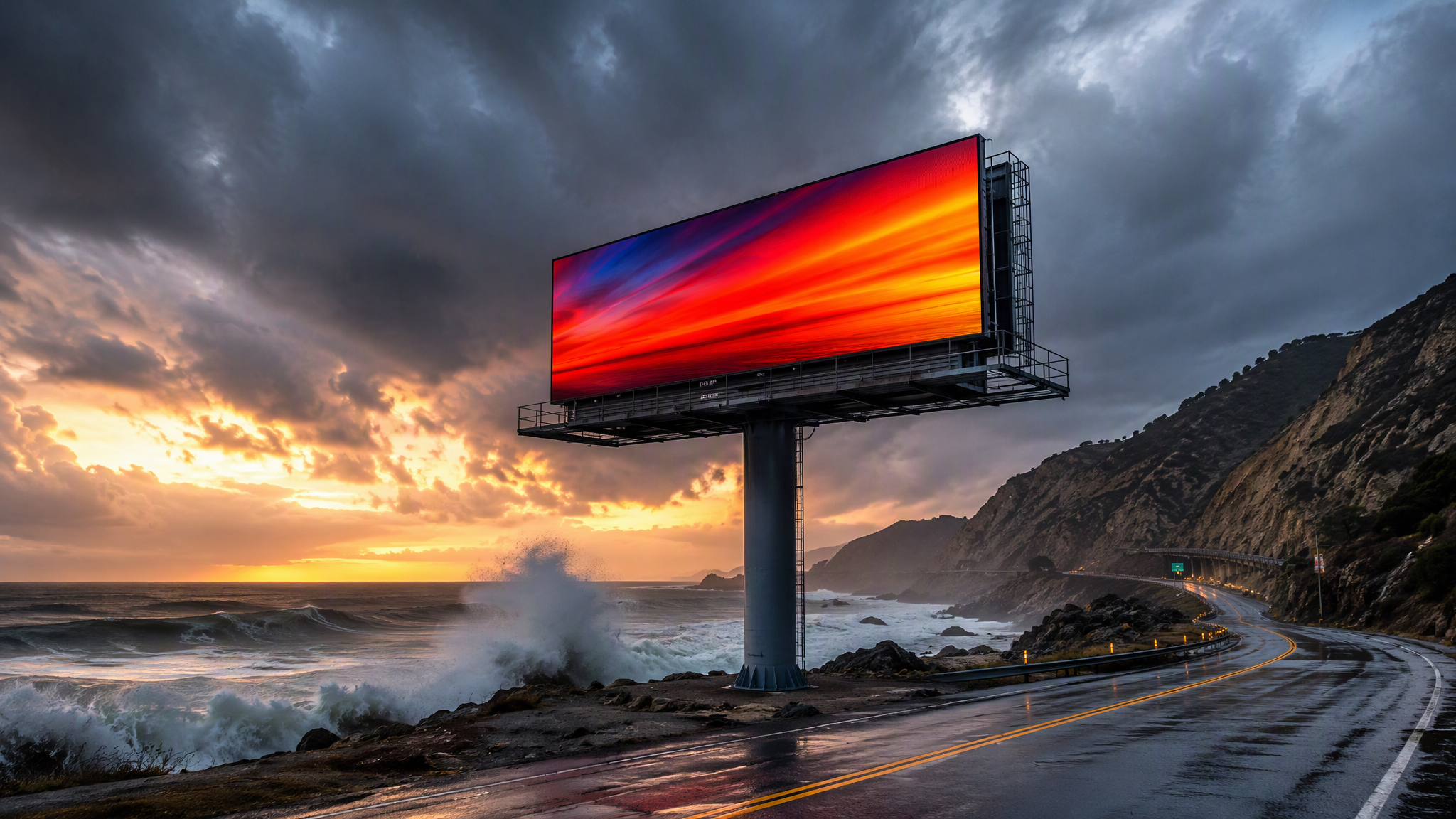
A split rating lists the front face first and the rear enclosure second. The rear can sometimes use a lower rating when it sits inside a sheltered service corridor; exposed rear doors need stronger protection.
Installation | Suggested front | Suggested rear |
Recessed wall / sheltered rear | IP65 | IP54 |
Freestanding highway billboard | IP65–IP66 | IP65 |
Coastal / oceanfront signage | IP66 | IP66 |
Exposed rooftop billboard | IP66 | IP65–IP66 |
4. Match the rating to the site
· IP65 is usually a cost-effective choice for temperate urban billboards, sheltered storefronts, covered stadium areas and displays with protected rear access.
· Consider IP66 for coastal or island sites, typhoon-prone regions, severe monsoon conditions, exposed rooftop structures, ski resorts and facilities that clean screens with water jets.
5. 2026 indicative hardware costs
The article estimates that upgrading from IP65 to IP66 typically adds about 5–15% to hardware cost. Indicative price ranges are shown below; confirm the exact scope and certification with the supplier.
Display category | IP65 price / m² | IP66 price / m² |
Standard outdoor (P5.0–P8.0) | $550–$1,200 | $600–$1,350 |
High-resolution outdoor (P2.9–P3.9) | $900–$1,800 | $1,000–$2,050 |
Coastal / marine (P4.0–P6.0) | $1,100–$2,200 | $1,250–$2,500 |
Total cost of ownership matters: the source estimates $250–$800 to replace a water-damaged module and $1,500–$4,000 for a bucket-truck or boom-crane service visit. At high-risk sites, a higher upfront rating may reduce repair exposure.
6. Procurement checklist
1. Request independent IEC 60529 test reports from an accredited laboratory; do not rely only on a supplier’s verbal claim.
2. Write the front and rear ratings explicitly into the contract (for example, “Front IP65 / Rear IP54”).
3. Inspect gasket retention channels, pressure-equalization vents, connectors, cable entries and blanking caps on a sample cabinet.
4. Ask for compatible spare modules from the same manufacturing batch and clarify service access before ordering.
Quick answers
Can IP66 be submerged? No. IP66 is a powerful-water-jet rating, not a submersion rating.
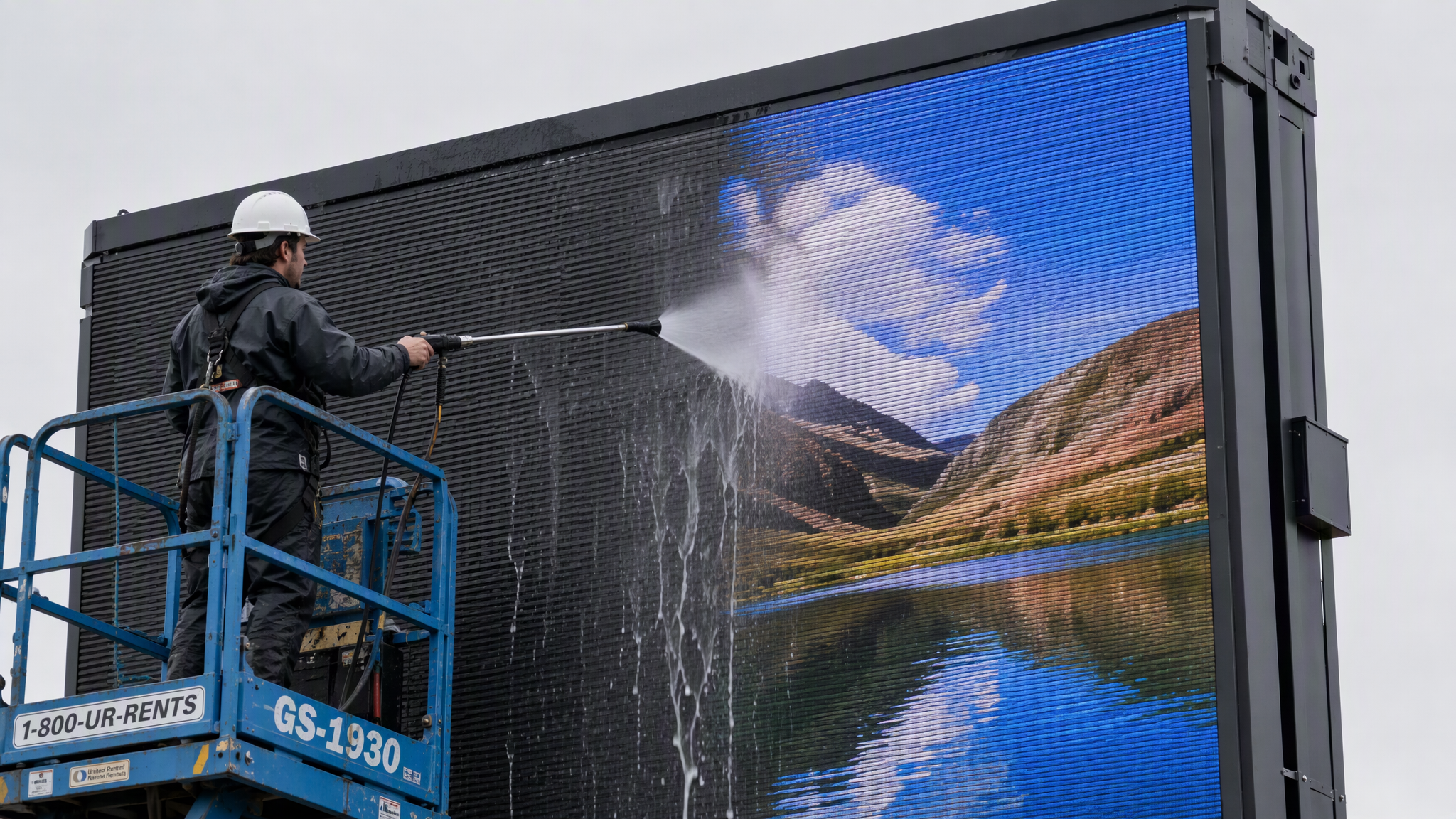
Can these displays be pressure-washed? Use the cleaning method specified by the manufacturer. The source advises low-pressure spray for IP65 and warns that industrial pressure washers can damage seals and masks even on IP66 displays.


