
A Complete Guide to LED Display Manufacturing Processes, Quality Control and Purchasing
What you are actually buying: seven components
Every direct-view LED display, from a P0.9 boardroom wall to a P10 stadium perimeter, is the same seven-part stack.
Component | What it decides | Where substitutions hide |
LED lamps | Colour consistency, brightness, lifetime | Brand named, brightness bin withheld |
Driver IC | Refresh rate, greyscale, low-brightness behaviour | "High-refresh IC" with no part number |
PCB | Thermal path, solder reliability | Layer count, copper weight unstated |
Power supply | Efficiency, failure rate, heat | Unbranded units, no datasheet |
Receiving card | Stores calibration, holds refresh stability | Cloned cards, no firmware support |
Cabinet | Flatness, weight, service access | "Die-cast aluminium" without a grade |
Control system | How you run, schedule and monitor it | Licence terms and seat limits unstated |
Two quotes at an identical pitch can differ by a third on lamps, driver ICs, power supply, cabinet material and control system alone. When a supplier undercuts the market by 30%, the discount is usually sitting in one of these rows — most often the lamp bin. Never accept a quotation that names brands but not bins and part numbers: a brand is marketing, a bin is a specification.
The production line, stage by stage
A modern module plant runs 8–12 defined stages, each with pass/fail criteria before product moves on. The count varies by factory; the sequence does not.
Stage 1 — Incoming inspection (IQC)
Lamps, PCBs, driver ICs, power supplies and cabinet extrusions are sampled before entering production. Lamps are measured in an integrating sphere for brightness bin and colour coordinates; PCBs are checked for pad flatness and mask registration; ICs for pin coplanarity and lot traceability; power supplies for ripple at full load. This gate eliminates the most common cause of a patchy screen: no downstream calibration recovers a sub-spec reel, because calibration can only correct what the hardware still resolves.
Stage 2 — Solder paste printing and SPI
Lead-free paste (typically SAC305) is printed through a laser-cut stencil, and a 3D inspection machine scans every pad, rejecting anything outside roughly ±15% of target volume. Paste defects are the leading cause of cold joints and intermittent faults, and they are far cheaper to catch before components are placed than after rework.
Stage 3 — Pick-and-place and reflow
High-speed mounters place lamps, ICs, resistors and connectors at up to about 60,000 components per hour, with accuracy near ±0.025 mm for fine-pitch parts. The board then runs a multi-zone reflow profile: preheat, soak, peak near 245 °C, controlled cooling.
This is where invisible damage happens: an over-fast ramp degrades the die or phosphor with no external mark. Good factories validate the profile per board design and per lamp specification, and re-validate when the lamp supplier changes.
Stage 4 — Board-level light-up test
Each populated board is powered on a jig simulating the final receiving card, and every pixel is driven in red, green, blue and white while an automated scan looks for dead or colour-shifted pixels. A defective pixel costs minutes to find on a bare board and twenty-plus to fix once the module is masked and glued

The six gates, as a checklist
Gate | What is tested | Method | Pass criteria |
IQC | Lamp bins, PCB pads, IC coplanarity, PSU ripple | Sphere, microscope, caliper, ripple tester | Within spec; batch rejected above the agreed AQL |
SPI | Paste volume, height, area, alignment | In-line 3D SPI | Pads within about ±15% of target |
AOI | Placement, bridging, missing parts | Multi-angle camera | No bridging or missing parts; fillet to IPC-A-610 Class 2 |
Module test | Every pixel lit, shorts, card comms | Jig with production card | Zero dead pixels; stable at rated refresh |
Aging | Stability, early failures, thermal behaviour | 72-hour rack, cycling patterns | No pixel failures, no comms drops |
Final QC | Brightness, uniformity, flatness, IP seal | Spectroradiometer, level, spray chamber | Within about 3% of target, ΔE below 3, no ingress |
SMD, COB and GOB are three different processes
Buyers treat these as three grades of one product. They are three production lines, and a factory tooled for one cannot switch by buying consumables.
| SMD | COB | GOB |
Die attach | Packaged lamp, gold wire bond, reflowed to PCB | Bare die bonded to PCB, wire-bonded or flip-chip | Standard SMD lamp, then filled |
Surface | Discrete lamps, visible mask | Flat matte epoxy | Resin over the lamps |
Repair | Single lamp, in the field | Module-level only | Lamp or module, depending on resin |
Typical failure | Single lamp or joint | Die or bond, whole module | Impact damage, then lamp |
Best pitch | P1.5 and coarser | P1.5 and finer | P1.9–P2.5, touchable areas |
Extra stage | None | Die bonding, encapsulation, cleaner room | Dispensing, curing, second inspection |
The flip-chip variant matters for one specific reason: it removes the gold wire bonds that dominate fine-pitch failure. That is a process change, not a marketing one, and it is one honest reason fine-pitch COB costs more. COB also changes inspection — you cannot see solder joints under cured epoxy, so module test and aging carry more of the quality burden than visual AOI. Ask a COB supplier for module test data rather than photographs.
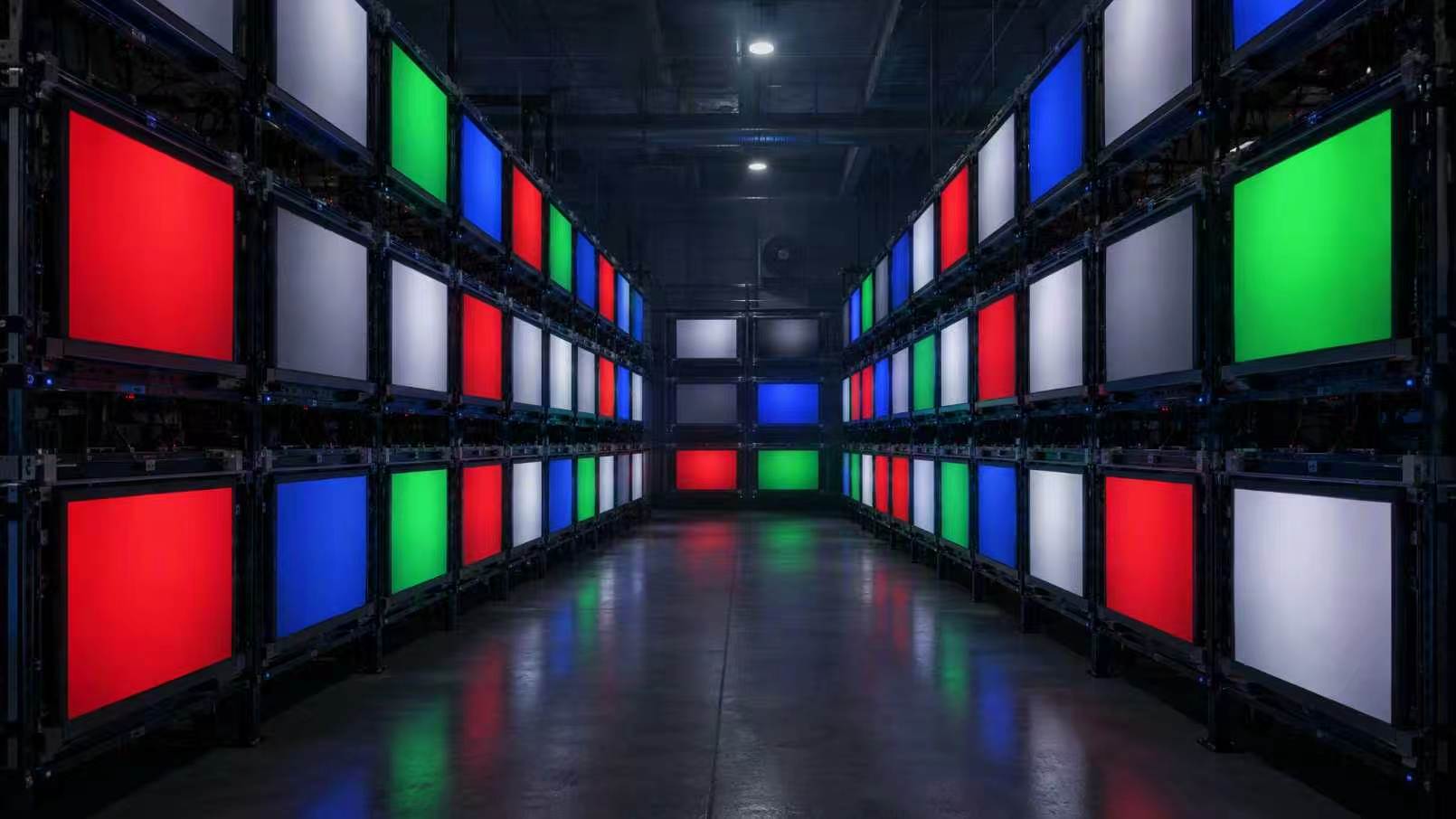
The eight numbers that predict year-three appearance
Each should appear in the contract with a test condition attached. A number without a method is an aspiration.
Metric | Typical claim | What to ask | Why it matters |
Brightness uniformity | 95% or better | Full-screen imaging photometer report | Below 95% you see patches on white |
Colour accuracy | ΔE below 3 | Target white point and instrument | Batch-to-batch drift is more visible than brightness |
Flatness | ±0.3 mm adjacent modules | Measured on your cabinet type | Steps read as shadow lines |
Refresh | 3,840 Hz and above | Value at a stated greyscale level | Anything lower flickers on camera |
Greyscale | 14–16 bit | Low-brightness gradient test | Banding appears in dark scenes |
Out-of-control pixel rate | Below 1 in 10,000 | Batch measurement, not catalogue figure | Datasheets publish it; reports often do not |
MTBF | 5,000 hours and above | Method and sample size | Separates tested product from estimated |
IP rating | IP65 outdoor, IP31 indoor | Seal test record per cabinet | Ingress failures appear in month 13 |
Four questions that separate factories
Which lamp bin? Not which brand — which bin, at which measured brightness and wavelength range. A factory that controls incoming components answers without checking.
Which driver IC, by part number? Refresh and greyscale behaviour are IC properties. "High-refresh IC" is not an answer.
Can I see the 72-hour aging report for my batch? Not last year's sample — the report carrying your serial numbers and timestamps.
How long will this exact module stay in production? A screen you cannot re-module in five years becomes scrap long before its LEDs reach half brightness. It is the first question asked after a failure and the last one asked before a purchase.
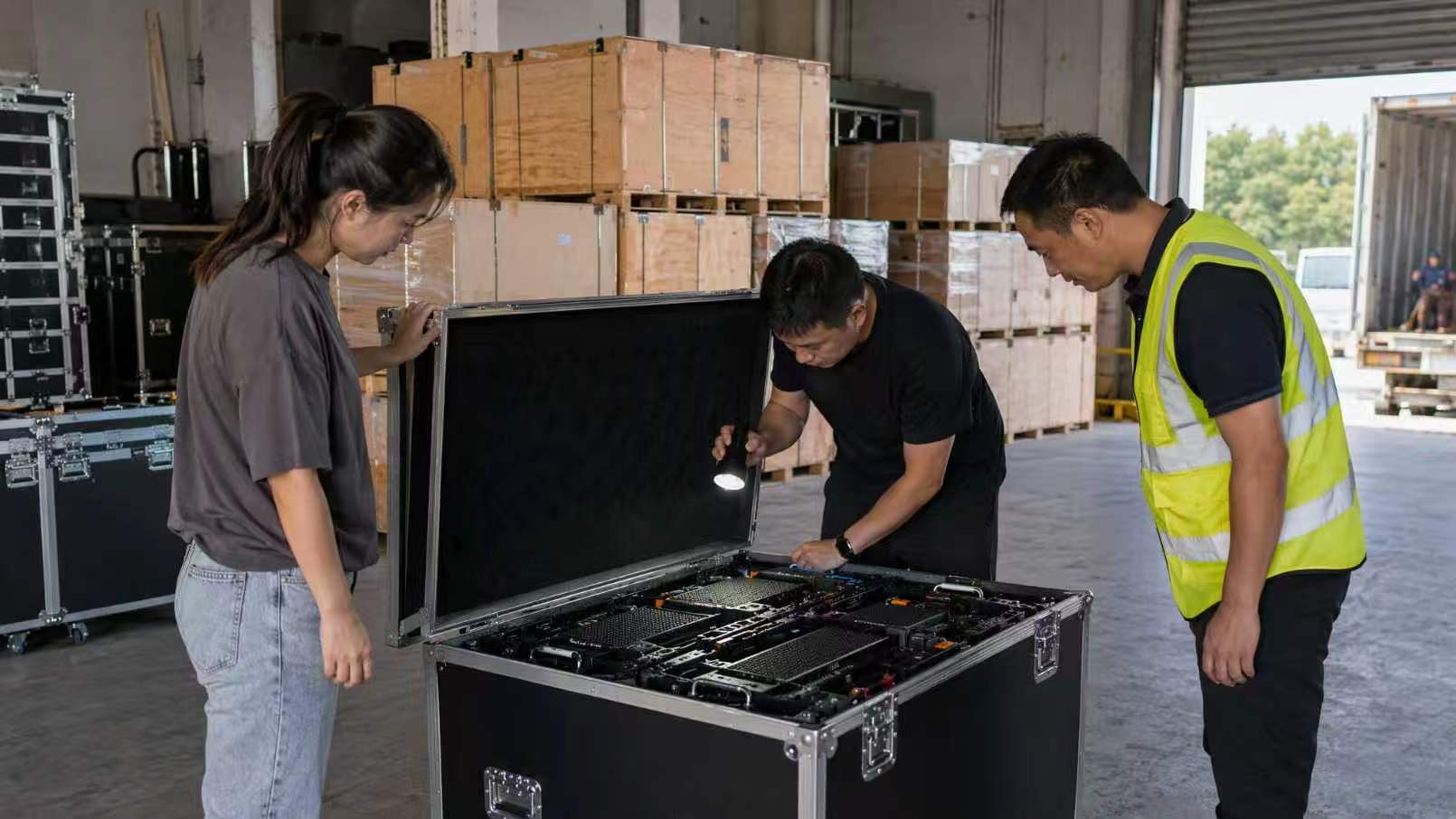
The commercial half: terms that transfer risk
Incoterms decide who owns the problem in transit
Term | Supplier handles | You control | The trap |
EXW | Nothing past the factory gate | Everything, including export clearance | Cheapest quote, most hidden work |
FOB | Export clearance and loading | Ocean freight, insurance, import | Normal for factory-direct orders |
CIF | Freight and insurance to your port | Import clearance, inland delivery | Cover may be minimum, not replacement value |
DDP | Everything to your door | Nothing until delivery | Duty is bundled and unverifiable |
Cabinets are bulky, so freight is a real percentage of order value. Get the packed volume in cubic metres before comparing delivered prices — two quotes at the same FOB price can land very differently.
Payment
The norm is a deposit with balance before shipment, commonly 30/70. That is reasonable once the supplier has passed a factory check and the contract fixes specification, delivery date and remedy. Be cautious with 100% upfront requests and with payments to an account whose name does not match the contracting entity — that mismatch is the most reliable warning sign in the whole process.

Lead time and MOQ
Standard orders commonly run 15–25 working days from confirmation to shipment, custom cabinets and large projects 25–40; modules and spares alone can ship in about a week. Minimum quantities are often as low as 1 m² for standard product, but custom cabinet tooling or non-standard sizes push the practical floor to a few square metres. Put a date in the contract with a consequence attached — a delivery date without a remedy is a forecast.
Warranty: the term is the least important word
Two factories can both offer "five years" and deliver different outcomes. A usable warranty names four things.
· Components: are power supplies, receiving cards and control hardware covered, or only modules?
· Threshold: at what dead-pixel density does a module qualify for replacement?
· Remedy: repair, replace or credit — and within how many days?
· Freight: who pays to ship the replacement, and who pays the return?
Terms commonly run from two years on standard indoor product to five on premium outdoor and rental lines. Judge the term against the threshold, not on its own.

Frequently asked questions
Is a factory always better than a trading company?
Not always, but the risk profile differs. A factory controls the bill of materials and can honour a warranty directly; a trader relays both through a third party. Three checks settle it: does the licence scope cover LED display manufacture, will they grant an unannounced walkthrough of the SMT and aging areas, and can they answer with part numbers rather than brand names?
How long does production actually take?
Standard orders typically run 15–25 working days to shipment, custom work 25–40, before ocean freight, clearance and inland delivery. For a fixed event date, work backwards from installation rather than forwards from the purchase order.


