
Your Go-To Guide to LED Poster Advertising for Retail Marketing and Event Promotion
Walk through almost any shopping mall and you will see them: tall, slim, freestanding screens running full-motion video where printed posters used to hang. The LED poster is the least glamorous product in the display catalogue and, unit for unit, the one most likely to pay for itself. There is no wall to build, no structure to engineer and no installer to book. You wheel it into position, plug it in, and it is running before the coffee goes cold.
That simplicity hides the actual buying decision. Three things decide whether an LED poster earns its price: where it stands, how bright the room is at its brightest hour, and whether anyone will genuinely refresh the content. Get those right and you have bought a broadcast channel for the price of a mid-range laptop. Get them wrong and you have bought an expensive light box. This guide covers the format, the two specifications that matter, the 2026 price bands, and the arithmetic that decides whether to buy or rent.
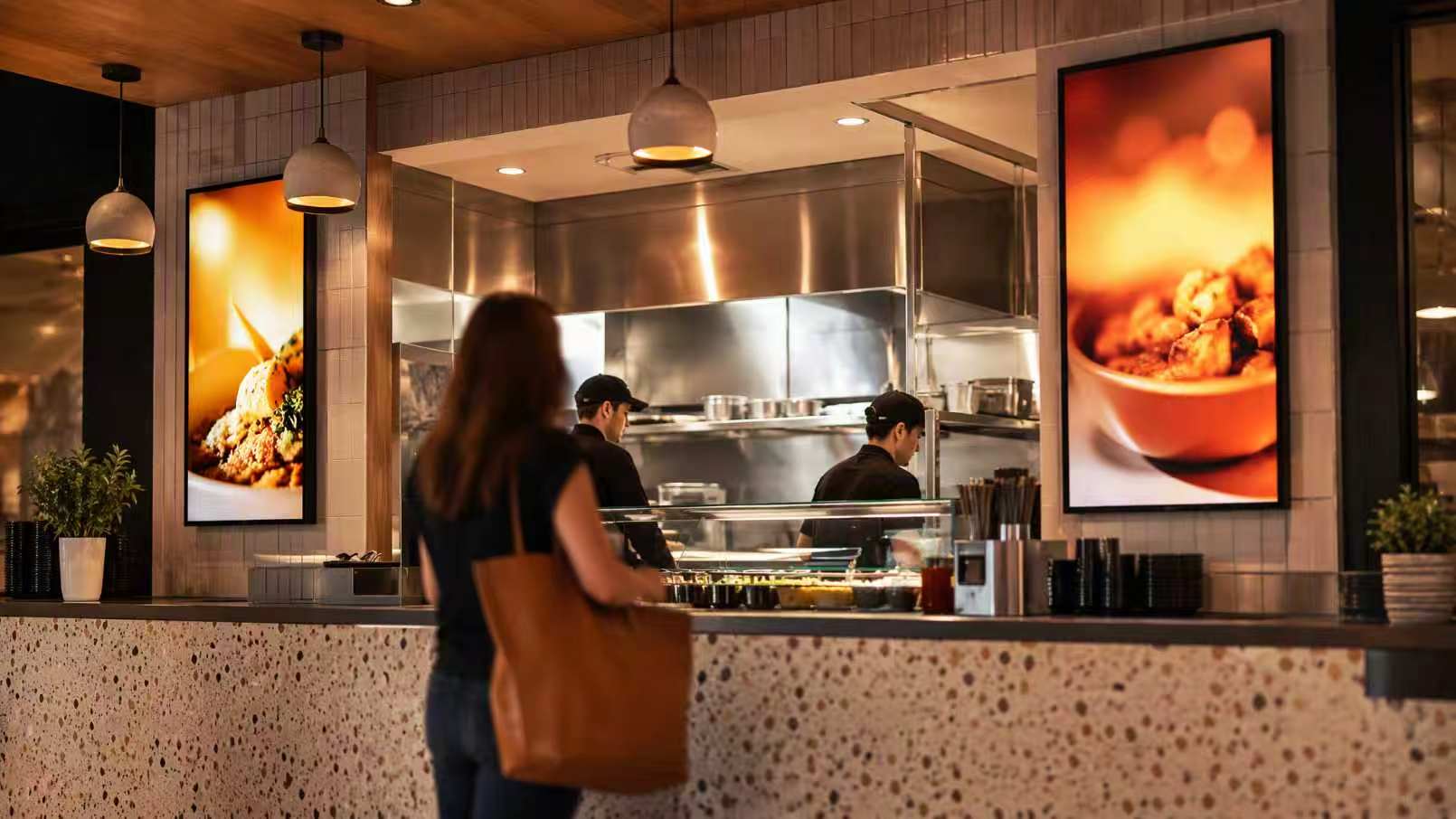
What an LED poster actually is
An LED poster is an appliance, not a cut-down video wall. The display panel, an Android media player, speakers and a content-management client all live in one slim portrait cabinet on a weighted base with casters. The standard face is 640 × 1920 mm; 960 × 2400 mm and 1280 × 1920 mm versions exist for exhibition booths and double-sided formats. Depth runs 50–100 mm, weight from about 36 kg on aluminium foldable models to 78 kg on steel tri-fold units.
The distinction that matters commercially is what it replaces. Buyers routinely confuse three products that look adjacent in a catalogue and behave nothing alike:
| LED poster | LCD digital signage | LED video wall |
Installation | Plug-and-play, minutes | Wall bracket, 30–60 min | Professional build, 4–8 hrs |
Typical size | 55–86 in, portrait | 43–98 in | Any size, custom ratio |
Seams | None, single panel | None single; bezels in walls | None |
Indoor brightness | 650–2,400 nits by model | 500–700 nits | 1,200–2,400 nits |
Lifespan | 80,000–100,000 hrs | ~50,000 hrs | 80,000–100,000 hrs |
Mobility | High, single-person move | Low, fixed mount | None |
Cost per unit | Lowest of the three | Low upfront, shorter life | Highest by far |
Read the brightness row carefully, because it is where most retail deployments are won or lost. An LCD poster in a glazed shop window at midday is a grey rectangle; a direct-view LED poster is still a poster. That single difference, not resolution, is what retailers are paying for.
Why it displaced printed posters — and where print still wins
Printed point-of-sale material has one fatal property: it is obsolete the moment the promotion changes. A print run has to be designed, produced, shipped and installed, and every subsequent change repeats the cycle at full cost. An LED poster plays unlimited content for the price of the hardware, and a cloud CMS lets one marketing team reschedule forty stores from a laptop — breakfast menu at 7 a.m., happy hour at 4 p.m., a price correction at noon.
The category is no longer experimental. Grand View Research puts the global digital signage market at USD 33.6 billion in 2026, growing at 8.2% annually through 2033, with retail the largest application segment and LED the largest display technology inside it.
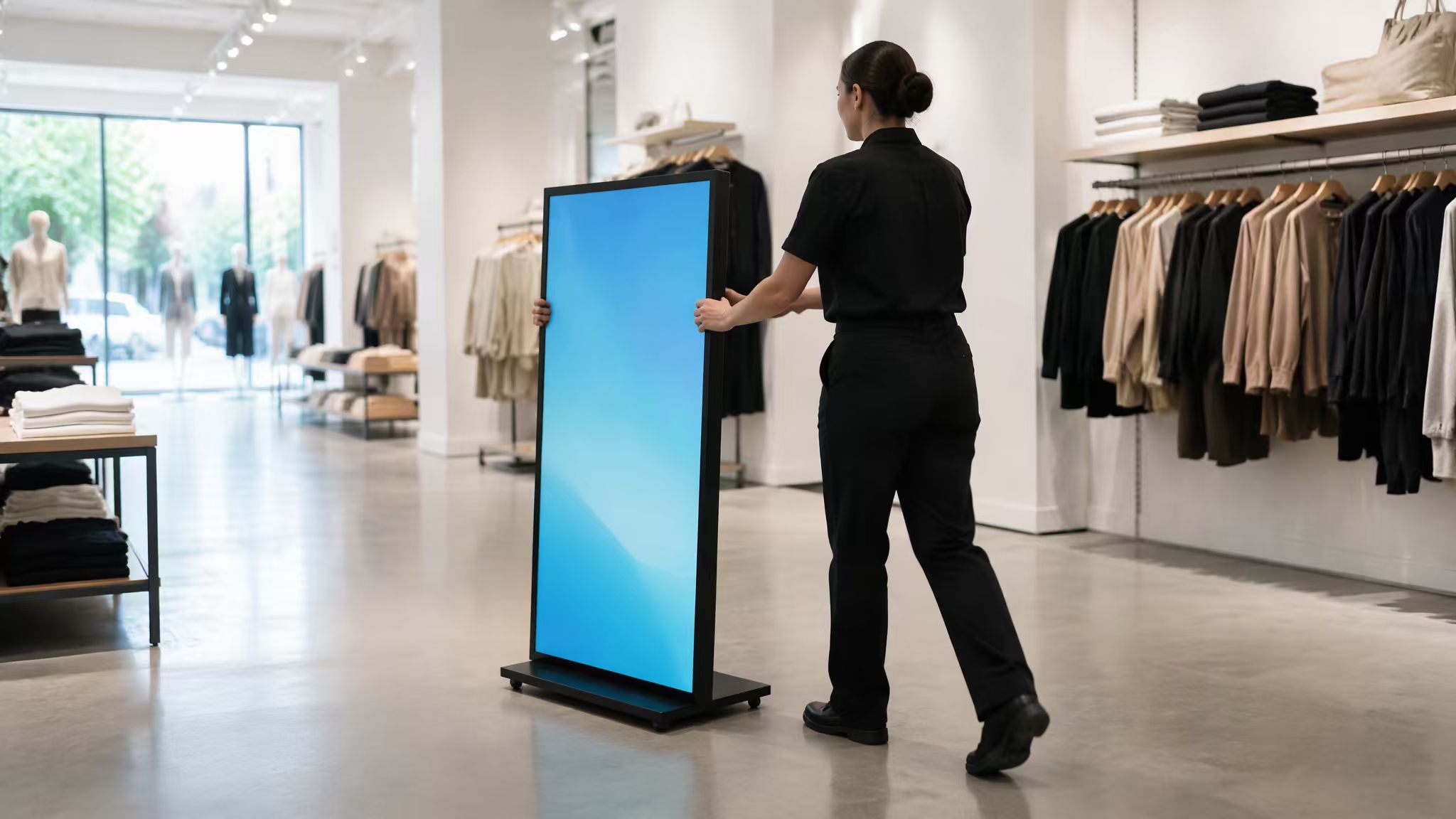
The two numbers that decide the purchase
Pitch: set by the closest shopper
Pixel pitch is the distance between adjacent pixels in millimetres, and the working rule is that the comfortable minimum viewing distance in metres is roughly equal to the pitch. For posters the relevant viewer is not the average shopper but the nearest one: in a narrow aisle, someone examines the screen from a metre away.
Face size | Typical pitch | Resolution | Where it fits |
640 × 1920 mm | P2.5 | 256 × 768 | Booths, aisles, menu boards |
640 × 1920 mm | P1.86 | 344 × 1032 | Shop windows, close inspection |
1280 × 1920 mm | P1.86 | 688 × 1032 | Exhibition stands, entrances |
1280 × 1920 mm | P1.53 | 832 × 1248 | Luxury retail, detailed graphics |
1280 × 1920 mm | P1.25 | 1024 × 1536 | Small print, tables, close range |
Resolution is a product of cabinet width and pitch, not a fixed specification. This is the quiet trap in the category: a 640 mm-wide P2.5 poster is only 256 pixels across, which is fine for a headline and a logo and hopeless for a price list. If your content carries small type, the width has to grow or the pitch has to fall.
Four formats, one decision each
· Floor-standing — weighted base, concealed casters. The default for retail; repositioned for peak hours and stored overnight.
· Wall-mounted — corridors, lift lobbies, anywhere floor space is scarce. Needs only a rated bracket.
· Double-sided — one base, two faces, one player, two audience flows. Budget 60–70% above the single-sided price.
· Foldable and tri-fold — the event format. A 1280 × 1920 tri-fold opens as one face or folds back into two 640 × 1920 strips facing opposite directions, on castors, no rigging, no wall fixings.
Power is the specification buyers forget. Published figures run 800 W/m² at peak and 200–300 W/m² average, so a 2.46 m² tri-fold draws about 1.97 kW at peak — roughly 16.4 A on 120 V, above a standard 15 A branch circuit. On 230 V it is about 8.5 A and comfortable on a dedicated circuit. Ask what else shares the ring.
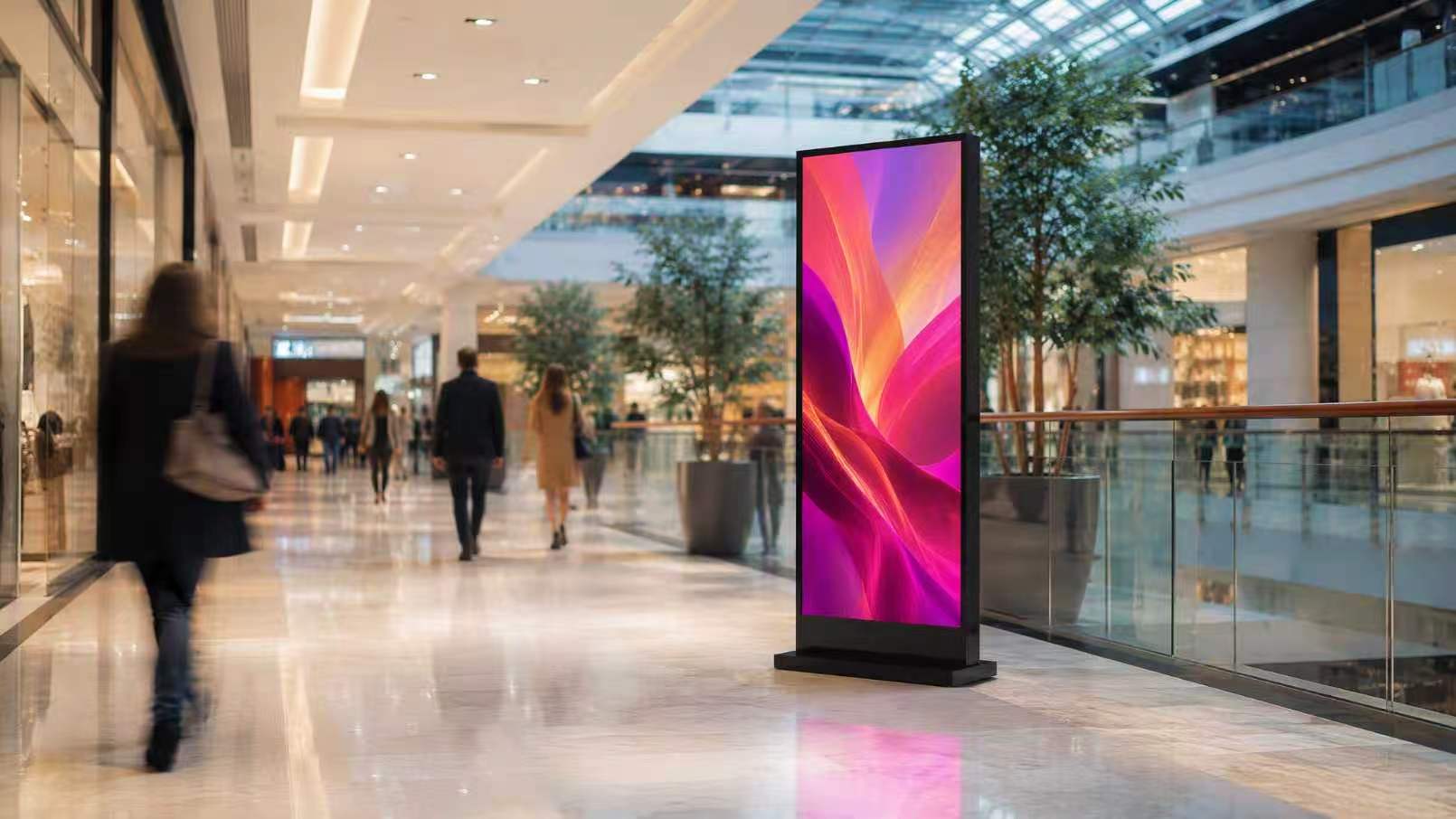
Content is half the product
The unit ships with an Android player — look for 9.0 or newer, quad-core, 2 GB RAM and 16 GB storage, because a 1 GB player stutters on high-bitrate 1080p. Content is uploaded through a cloud CMS, cached locally, and played on schedule, so a dropped connection does not blank the screen. Two CMS features separate a fleet tool from a toy: multi-location scheduling and proof-of-play reporting that confirms a campaign actually ran in every store.
One deployment surprise deserves naming: confirm the player decodes the codec your creative team produces. H.265 footage on an H.264-only player is the most common avoidable failure in the category
What an LED poster costs in 2026
Class | Typical specification | Price per unit |
Entry indoor | P2.5–P3, 55–65 in | $1,200–2,500 |
Mid-range retail | P2.0, 65–75 in | $1,800–3,500 |
Fine-pitch or GOB | P1.5–P1.8, 75–86 in | $2,500–6,000 |
Outdoor weatherproof | P3–P4, high brightness | $3,000–8,000+ |
Double-sided unit | Any of the above | +60–70% |
Factory-direct FOB listings for basic P2.5 floor-standing units appear from about $1,100 to $1,800, and the gap to the table above is not margin: it is named LED chips and driver ICs, GOB encapsulation, player specification, packing and what the seller includes. Compare quotes on identical specifications or you are comparing two different products.
Four cost lines sit outside the unit price: freight, duty and clearance; a CMS subscription, which some platforms charge per screen per month; 5–10% spare modules ordered with the batch so replacements colour-match; and electricity, which is modest — a poster averaging 300 W for twelve hours a day consumes about 1,300 kWh a year.
Where posters earn their keep
Venue | The job it does | Specify |
Mall atrium, escalator corner | Seasonal promotion rotation | P2.5, 800+ nits, GOB |
Shop window | Selling at night through glass | 1,500+ nits, matte finish |
QSR, café | Menu boards, daypart pricing | P2.5–P3, paired portrait units |
Hotel, corporate lobby | Welcome, wayfinding, agenda | P2.0, quiet cooling, slim profile |
Car, real estate, furniture | Product film, configuration | P1.8–P2.0, viewing under 2 m |
Exhibition, roadshow | Booth loop, sponsor wall | Foldable, one vehicle, flight case |
Two of these rows are about light and two are about proximity, and the rest are logistics. That is the pattern in every successful deployment: the hardware is chosen for the room, and the content is chosen for the dwell time.
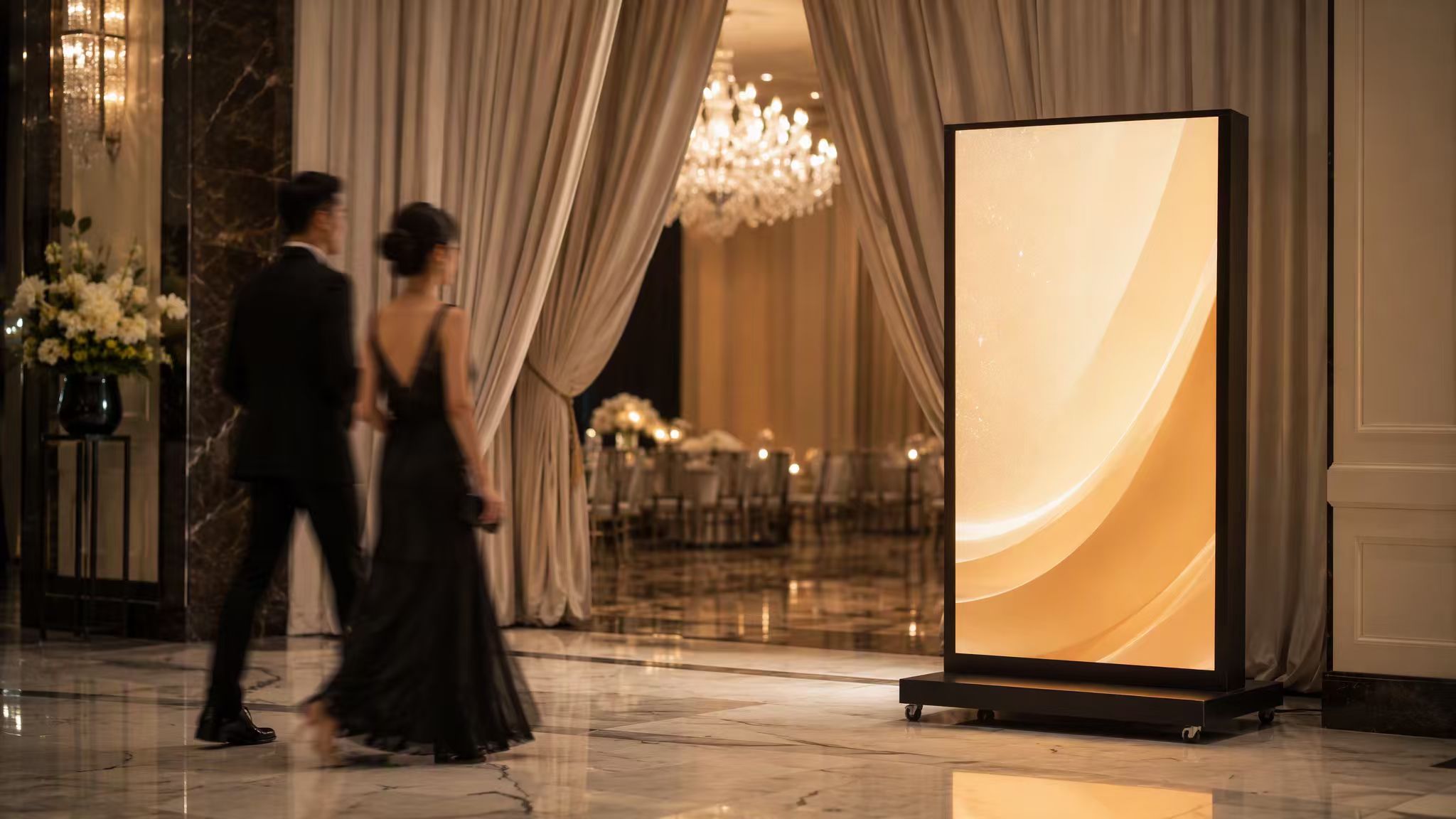
The rental arithmetic for events
For rental companies, the poster's commercial case is that one chassis sells three ways — a double-sided wayfinding screen at registration, a single-face hero screen at an entrance, and a content-only package where the venue keeps its own hardware.
Payback in months is landed cost divided by monthly net contribution, where contribution means the hire fee minus transport, crew and content cost:
Bookings per year | $80 per booking | $120 per booking | $160 per booking |
12 | 44 months | 29 months | 22 months |
24 | 22 months | 15 months | 11 months |
36 | 15 months | 10 months | 7 months |
Read that as a sensitivity test on a $3,500 landed cost, not a forecast. Because contribution excludes crew hours, a company that forgets labour understates payback by its largest line — and because the denominator is a product, halving bookings doubles the payback.
A short buying checklist
1. Pitch against the nearest shopper, not the average one.
2. Brightness against the site's brightest hour, not the showroom demo.
3. GOB encapsulation on anything standing in a public aisle.
4. Named components — LED chip brand and driver IC model on the datasheet, not "high quality LED".
5. Refresh of at least 1,920 Hz for retail, 3,840 Hz if the screen will be filmed.
6. Player and codec confirmed against your creative team's output format.
7. A two-year warranty with a written pixel-failure policy and confirmed module availability, so the unit is repairable rather than replaceable.
8. A dedicated circuit within cable reach of where the poster will actually stand.
Frequently asked questions
Is an LED poster better than an LCD signage screen?
In a bright room or behind glass, yes — roughly double the brightness and none of the washout. LCD still wins on the lowest upfront price for a single small screen in a dim interior, and its image is often sharper per dollar at close range.
How much does one LED poster cost?
Entry indoor units run about $1,200–2,500, mid-range P2.0 retail units $1,800–3,500, and fine-pitch or GOB models $2,500–6,000. Outdoor weatherproof versions start around $3,000, and double-sided units add 60–70%.
Can an LED poster be used outdoors?
Only with an outdoor-rated model. Indoor units are commonly IP31 — protection against vertically falling drips, not rain driven at an angle. A marquee with the sides open counts as outdoors for practical purposes.


