Exploring China's Naked-Eye 3D LED Billboards: Locations, Costs and Working Principles
The panda that climbs out of a Chengdu shopping mall is not a hologram, not an accident, and not cheap. A field guide to how these screens work, where the landmarks stand, and what it really costs to build or book one.
The five-second illusion
On most evenings on Chunxi Road, in the center of Chengdu, a few hundred people stop walking at roughly the same moment, tilt their heads back, and raise their phones. Above them, a panda the size of a bus hauls itself over the edge of a building, peers down at the street, and vanishes. Thirty seconds later the screen is running a cosmetics commercial again, and the crowd drifts on.
If you have seen the clip, you have probably also seen it described as a hologram. It is not one. There is no light field, no lenticular lens, no volumetric projection, and nothing is floating above the pavement. The panda is a flat video file sitting on a media server, playing on a conventional outdoor LED wall. What makes it look three-dimensional is a design decision made months earlier, in a studio, with a virtual camera placed exactly where that crowd is standing.
That gap — between what the audience thinks it is looking at and what is actually bolted to the building — is where most of the confusion, and most of the budget, in China's 3D billboard boom sits. This article works through the three questions that come up every time: how the effect is produced, where the significant installations are, and what the numbers look like on both sides of the transaction.
1. What "naked-eye 3D" actually means
The technique is called anamorphosis, and it is older than electric light. Renaissance painters stretched images so that a picture looked correct from one specific spot in a church and distorted from everywhere else. A street artist drawing a chalk pit on pavement is doing the same trick. An LED billboard does it at 8,000 nits and 25 frames per second.
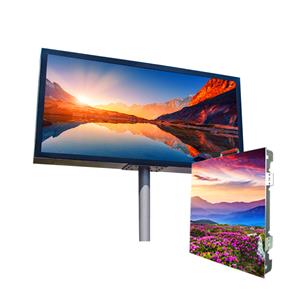
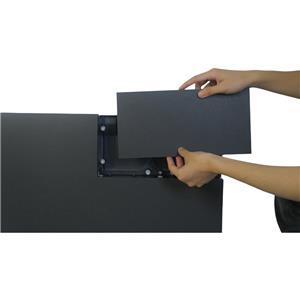
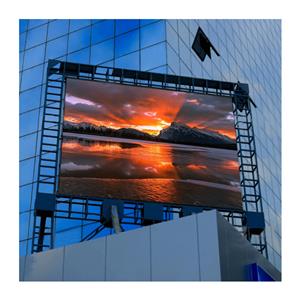
The hardware is remarkably ordinary. A 3D billboard is a standard outdoor LED display — cabinets, receiving cards, a video processor, a media player — with three practical differences: the cabinets are often machined to wrap a 90-degree corner or a curve, the pixel pitch is chosen for the distance the audience actually stands at, and the content is rendered for that one screen's exact geometry.
Everything else is perspective. The animation team builds a digital model of the physical screen, places a camera where the audience will be, and renders a scene from that position. The output looks wrong on a monitor — elongated, sheared, obviously skewed. Played on the real screen, from the real spot, the eye reads it as space. Shadows, occlusion, and relative motion do the rest.
A corner screen helps because it supplies a built-in reference plane. Two faces meeting at 90 degrees form a shallow box, and an animated object can travel from one plane to the other, apparently out of the building. This is why so many landmark installations sit on building corners — and why installing a corner screen without corner-specific content produces nothing more than an expensive L-shaped television.
One clarification worth keeping: true autostereoscopic displays, which use lenticular lens layers to send different images to each eye, do exist. Virtually none of the viral Chinese billboards use them. "Hologram" in this market is a marketing word, not a technical description.
2. One viewpoint, engineered
Every anamorphic piece has a hero viewpoint: the crossing, plaza, or turning lane where the illusion snaps into register. Stand there and the object reaches out of the frame. Step twenty meters to the side and the geometry collapses into stretched video that still plays perfectly well as an ordinary ad, just a slightly odd-looking one.
This is a design constraint, not a defect, and it drives site selection more than screen size does. A plaza where pedestrians queue, wait, and look in one direction is worth more than a bigger display facing six lanes of fast traffic approaching from every angle. The best Chinese sites — a shopping district's main crossing, a pedestrianized retail street, the mouth of a metro exit — all concentrate people in roughly the same spot for several seconds at a time. That is the raw material the format needs.
From the side (left), the same flat screen shows only sheared, stretched light. From the hero viewpoint (right), those shapes resolve into apparent depth.
3. From site survey to final render
The production pipeline is where most first-time buyers get surprised, because it is not a video project in the usual sense. It starts with a site pack: cabinet drawings, native resolution and pixel map, screen mask, corner angle or radius, the coordinates of the approved viewing area, safe zones for logos, clip duration, frame rate, and delivery codec.
A studio then models that geometry, plugs the pixel map into the render, and builds the scene against a virtual frame — a window, a ledge, a box — that gives viewers something to measure depth against. Motion is tested at the actual viewing distance, because an action that reads clearly on a 27-inch monitor can be unreadable forty meters away.
The work is not portable. A clip rendered for a Chengdu corner will not produce the illusion on a screen of different proportions in Wuhan; at best it plays as flat content with strange proportions. Budgets therefore usually include three to five creative executions at launch and a refresh cycle of several times a year, or the site starts to feel stale to the same local audience.
Approvals run storyboard, rough animation, lighting and material review, final render, then on-site calibration. The calibration step matters more than clients expect: the same file can look flat on a screen left at 60 percent brightness, and the fix is a settings change, not a re-render.
4. Where the landmarks are
China now has dozens of these installations, but a much smaller number that function as genuine city landmarks. The ones most often cited:
• Chengdu — Taikoo Li / Chunxi Road. An 888 m² double-face corner screen, frequently operated in combination with an adjacent 450 m² ultra-high-definition screen, best known for the climbing panda. The most photographed of the format.
• Chongqing — Guanyinqiao. The "Light of Asia" corner screen, which its operator describes as a 3,788 m² installation. Note that the installation figure is not the same as the bookable advertising canvas.
• Suzhou. A 903 m² naked-eye 3D screen, promoted locally as the largest of its kind in the city.
• Dongguan. A roughly 1,000 m² urban-level installation marketed as the "Eye of Dongguan."
• Wuhan. The K11 Art Mall screen, which has hosted some of the more experimental automotive and fashion work.
• Shanghai. Several, concentrated around Lujiazui and the major retail complexes, including an L-shaped public-art screen in the TLQ complex.
• Beijing, Guangzhou, Shenzhen. Multiple commercial-district screens, generally smaller and more advertising-led than the Chengdu and Chongqing flagships.
Two cautions for anyone planning a visit or a booking. First, a viral clip can outlive the programming: the panda ran as a campaign, not as permanent infrastructure, so check the current schedule rather than a 2021 video. Second, a district name is not a screen. Adjacent buildings in the same shopping area can carry different displays with different dimensions, operators, and sightlines. Ask for the screen's own name, address, and a recent unedited playback sample.
The hero viewpoint in practice: the crowd gathers at the crossing, phones up, because that is where the geometry was designed to work.
5. What it costs
There are two completely different purchases here, and conflating them is the most common costing error. One is building a screen: hardware, steel, installation, content, power. The other is booking time on a screen someone else already built. A per-square-meter marketplace price and a landmark media rate describe different products.
For the build side, 2026 supplier planning ranges cluster as follows. Treat them as order-of-magnitude figures, not quotations — two quotes for identical square footage routinely differ by 30–40 percent.
Viewing distance | Typical pitch | Hardware cost |
2.5–4 m | P2.6–P3.9 | $3,000–$4,500 / m² |
4–8 m | P3.91–P4.81 | $1,800–$3,000 / m² |
8–15 m | P6.67–P10 | $900–$1,800 / m² |
Assembled project budgets look like this:
Project type | Typical spec | Installed budget |
Mid-size outdoor corner | 10–50 m², P4.81–P6.67, custom corner cabinets | $150,000–$400,000 |
Large landmark installation | 50 m²+, premium site, high-refresh hardware | $400,000–$1,000,000+ |
Four line items sit outside those tables and are usually underestimated:
• Structure. Structural steel runs roughly $500–$1,200 per square meter before crane time and permits; a 50 m² facade can need $10,000–$25,000 of reinforcement before the first cabinet goes up. Corner screens carry wind load on two faces, which complicates the engineering.
• Corner fabrication. Right-angle and curved cabinets are not off-the-shelf. Custom tooling, angle-lock mechanisms, and factory flatness calibration add 20–30 percent to cabinet price.
• Control layer. A large installation needs a higher processor class, multiple sending cards, and playback software mapped to the exact pixel layout: typically $3,000–$8,000 for the control chain alone.
• Content. A 15–30 second anamorphic hero asset from a specialist studio generally lands between $8,000 and $25,000. This is the line item brands forget to fund for year two.
Then there is electricity, which scales with area and brightness. A 60 m² outdoor screen running at 6,000–7,000 nits draws roughly 35–60 kW depending on content, or about $8,000–$16,000 a year at commercial rates. A useful planning formula: area × average watts per square meter ÷ 1,000 × operating hours gives daily kilowatt-hours; electrical design still has to cover peak demand, not average.
The cost hides in the joint: angle-adjustable cabinets, calibrated flatness, and synchronized control across two faces.
6. Why some of them look flat
Visit enough of these sites and the failures are consistent. Almost none of them are about the screen being too small.
Brightness. Outdoor 3D installations usually run 5,000–8,000 nits. Below roughly 5,000, the separation between foreground and background washes out in direct sun, and the depth cues — which live in shadows and highlights — disappear. Glare at certain sun angles does the same thing, which is why anti-reflective module surfaces are worth specifying.
Refresh rate. The real audience of a 3D billboard is not the crowd in front of it; it is everyone who watches the clip afterwards. Under 3,840 Hz, phone footage of the screen shows rolling scan lines and the viral moment dies in the camera. Installations that expect heavy user-generated content often specify 7,680 Hz.
Seams and brightness mismatch. At the corner joint, cabinets must align within tight tolerance and match in brightness. One visible seam and the virtual box collapses into two televisions.
Content discipline. The best-performing pieces establish a frame, perform one clear action, and leave time for the brand to register. Elaborate animations that reveal the product in the final second entertain the crowd and communicate nothing.
Pitch mismatch. A 12 m by 6 m screen at a nominal 6 mm pitch is roughly 2,000 by 1,000 pixels. Buyers routinely overspend 30–50 percent on finer pitch than the viewing distance requires; at 20 meters, the eye cannot distinguish P4 from P6, and that money is better spent on brightness, refresh rate, or better corner cabinets.
7. The business logic behind the boom
For a media owner, a 3D screen is premium inventory that supports higher rates and long-term anchor tenants. For a city or a landlord, it is a landmark that generates foot traffic and free tourism coverage: Chengdu's panda turned a retail corner into a named attraction that travel guides now list.
For a brand, the calculation is different, and it is the part most decks get wrong. On-site impressions are the smaller half of the return. A landmark screen's clips circulate for months across short-video platforms, and that secondary distribution is what justifies the production budget. It also means the format rewards work designed to be filmed — high contrast, single subject, clean silhouette, an action legible on a six-inch phone screen.
The measurement problem follows directly. Scheduled plays, estimated footfall, social views, and actual sales responses are four different numbers, and only the first is verifiable from the operator's logs. Anyone comparing two sites should ask for playback logs, the audience-estimate method, and the share of the advertising loop their clip receives — none of which appear in a monthly rate card.
8. If you are planning one: a short checklist
• Confirm the site geometry before the creative brief. Screen dimensions, corner angle, native resolution, and approved viewing coordinates — in writing, from the operator.
• Match pitch to distance, not to the spec sheet. Overpaying for resolution is the most common avoidable cost.
• Fund content properly and repeatedly. Three to five executions at launch, refresh several times a year.
• Specify brightness and refresh rate together. 5,000+ nits and 3,840 Hz minimum if you want clean phone footage.
• Approve a perspective test before detailed modelling. Geometry problems are cheap to fix at storyboard stage and expensive after fabrication.
• Decide what "worked" means in advance. A playback log, a location-specific offer, and a social view count measure three different things.
The takeaway
The naked-eye 3D billboard is a useful case study in how new media formats actually spread: not through a hardware breakthrough, but through a production technique that made existing hardware worth filming. The LEDs are ordinary. The engineering is careful but not exotic. The illusion is a few hundred hours of perspective work and one very well-chosen viewing spot.
That is also why the format travels well and why it is easy to get wrong. Any city can buy the screen. The ones that become landmarks — Chengdu's panda, Chongqing's corner, the installations that show up in travel reels years after the campaign ended — are the ones where the site, the geometry, and the animation were designed as a single object. The screen is the cheapest part of the idea.