Compact Android Control for Multi-Screen LED Posters
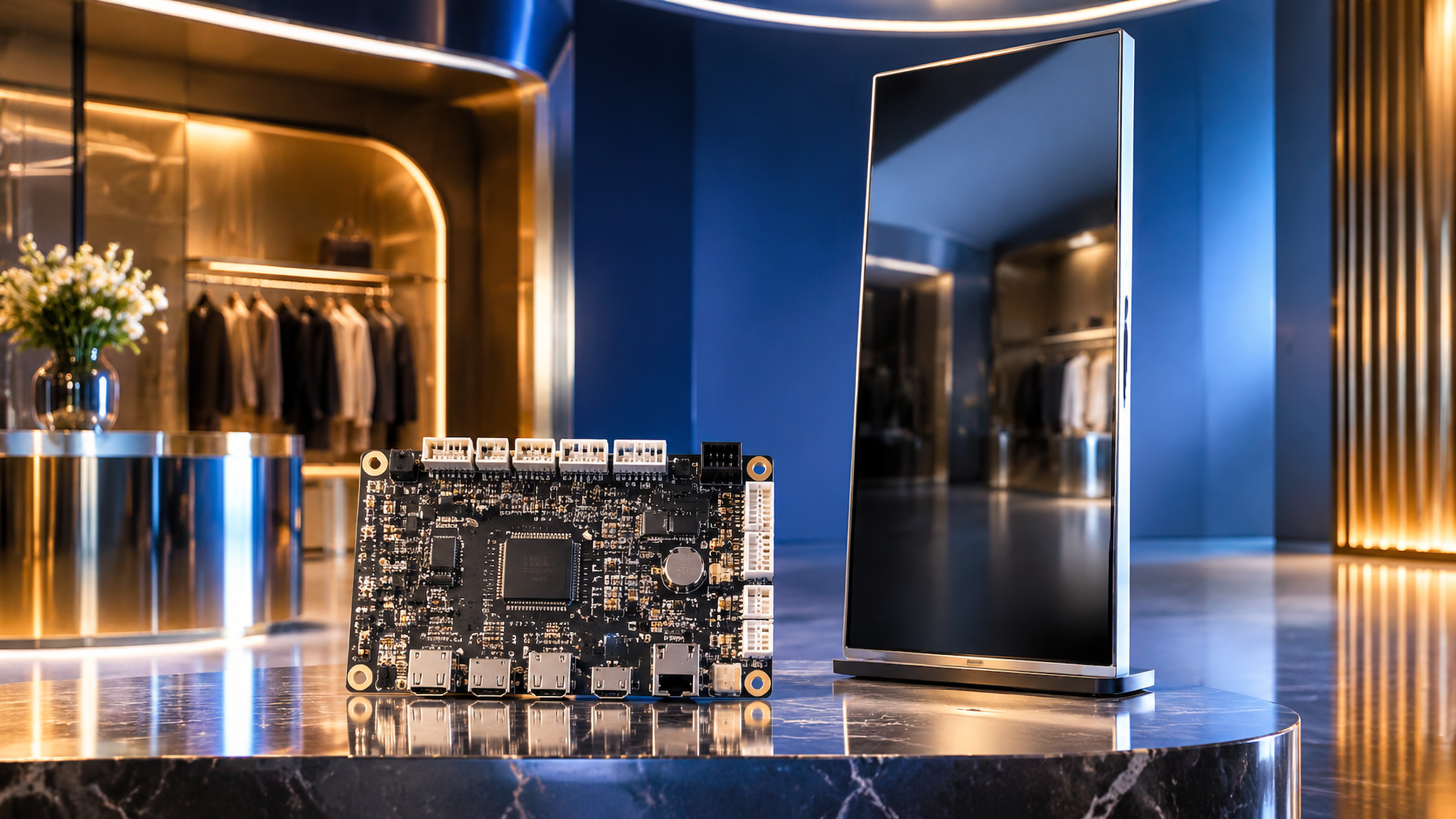
Executive Summary: The Huidu HD-B6L (B6L) is a specialized multimedia LED poster display controller engineered by Shenzhen Huidu Technology Co., Ltd. for digital mirror posters, standalone commercial advertising screens, and multi-poster spliced video walls. Integrating an embedded Android 11 operating system with hardware FPGA video processing on a single circuit board, the HD-B6L delivers a single-card loading capacity of 1.3 million pixels, dual Gigabit Ethernet outputs, and native HDMI input with loop-through output. This integrated architecture eliminates the requirement for external video splitters during multi-screen cascading, allowing up to 6 or more vertical poster displays to operate seamlessly as an unified panoramic video wall. This technical engineering guide provides an exhaustive analysis of HD-B6L hardware interfaces, synchronous and asynchronous dual playback modes, multi-screen HDMI daisy-chain setup, LedArt mobile app configuration, HDPlayer desktop mapping, and XiaoHui Cloud cluster management. |
1. Architectural Overview and Positioning of the Huidu HD-B6L
The digital poster screen market demands compact, self-contained hardware capable of running offline video programs while maintaining instant compatibility with live event video feeds. The Huidu HD-B6L addresses these requirements through a purpose-built hardware design:
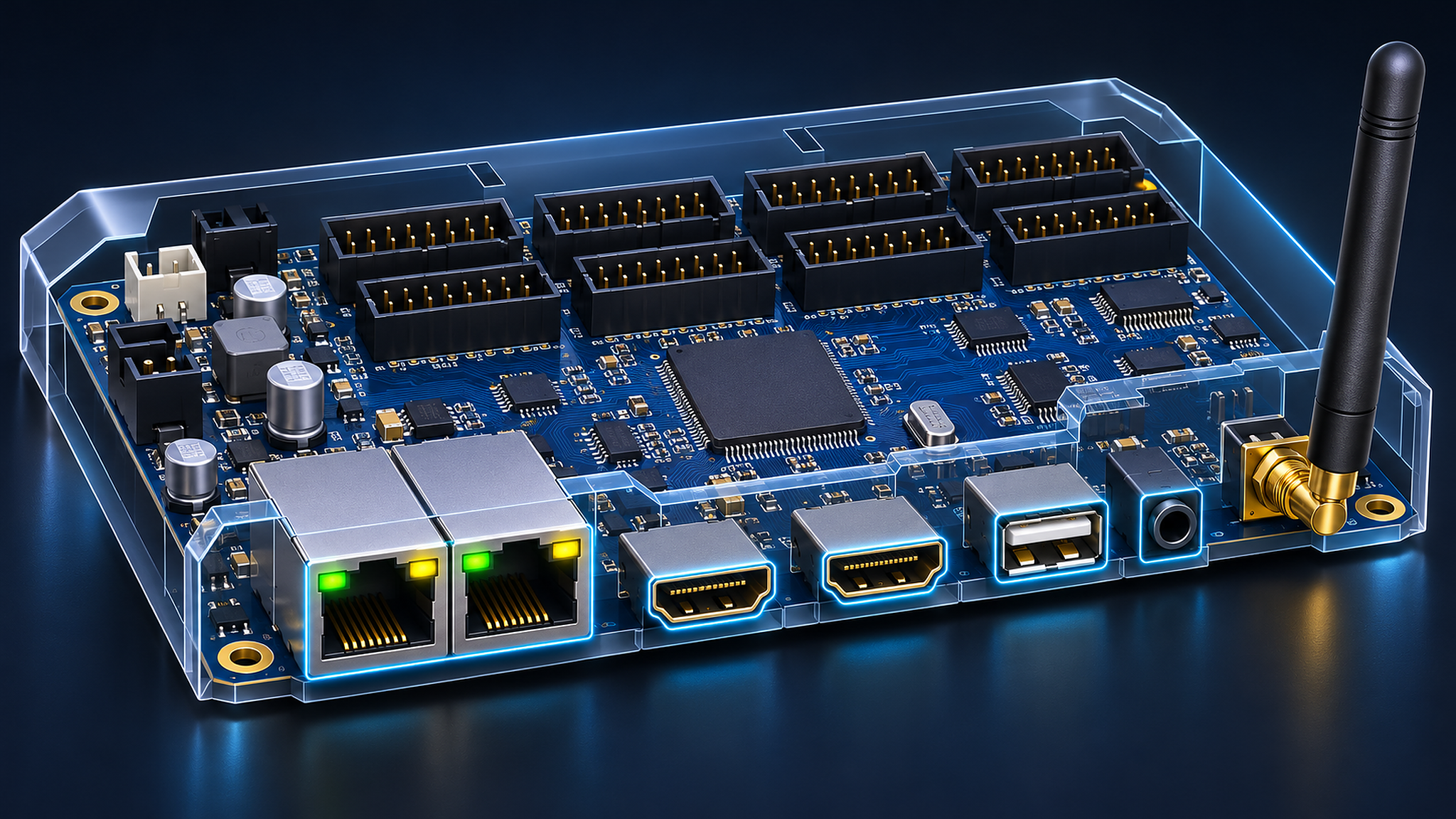
A. Embedded SoC Architecture: Unlike traditional sending cards that require an external PC host, the HD-B6L integrates a quad-core 1.6 GHz ARM processor, 1GB or 2GB of high-speed RAM, and 16GB of onboard eMMC flash storage running Android 11. It decodes 1080p and 4K media directly from internal memory or external USB drives.
B. Canvas Resolution and Loading Envelope: With a standard loading capacity of 1.3 million pixels, the HD-B6L easily drives standard vertical poster dimensions such as 640 by 1920 pixels, 768 by 1536 pixels, or landscape resolutions up to 1280 by 1024 pixels. Its flexible canvas engine accommodates maximum widths up to 16,384 pixels and maximum heights up to 65,536 pixels.
C. Native Multi-Screen Splicing and Cascading: The inclusion of both HDMI Input and HDMI Loop Output enables direct hardware daisy-chaining. When multiple LED poster units are placed side-by-side, the HDMI signal cascades across screens with zero delay, transforming individual advertising totems into an ultra-wide panoramic video wall.
2. Master Engineering Specification Matrix
The following engineering table details the full hardware, electrical, network, and environmental specifications of the Huidu HD-B6L controller.
Engineering Category | Technical Parameter | Detailed Hardware Specification | Functional Impact and Notes |
Processing and OS | Core Processor and OS | Quad-core ARM Cortex-A55 @ 1.6 GHz, Android 11 OS | Hardware video decoding, automated app background service |
Memory and Storage | RAM and Flash Storage | 1GB or 2GB RAM, 16GB onboard eMMC 5.1 Flash | Stores hundreds of high-definition video ads and playlists |
Loading Capacity | Single Card Pixel Envelope | 1.3 million pixels (Max width 16,384, Max height 65,536) | Drives 640x1920 poster or 1280x1024 commercial displays |
Ethernet Outputs | Gigabit RJ45 Network Ports | 2 Gigabit RJ45 Ethernet ports (650,000 pixels per port) | Direct connection to Huidu and compatible receiving cards |
Video Input | Synchronous HDMI Input | 1 HDMI 1.4 Input (Supports 1080p 60Hz and 720p) | Enables real-time live video feed from PC or camera |
Video Loop Output | Hardware HDMI Loop | 1 HDMI Loop Output (Zero latency passthrough) | Daisy-chain multi-poster cascading without external splitters |
Network Connectivity | Wi-Fi and Cellular | 2.4GHz Wi-Fi (AP and Station), Optional 4G LTE module | Direct smartphone app control and XiaoHui Cloud clustering |
Local Interfaces | USB and Audio | 1 USB 2.0 port, 3.5mm stereo analog audio jack | U-disk program plug and play, external amplifier audio |
Sensor Expansion | Environmental Sensors | 1 Onboard multi-function sensor communication port | Connects brightness light sensor, temperature and humidity |
Power and Thermal | Operating Power and Range | DC 5V input, power under 12W, temp minus 40 to plus 80 C | Energy-efficient industrial operation in extreme climates |
Commercial Pricing | Estimated Market Range | Approx. 110 to 160 USD (Reference price range) | Varies by memory configuration, distributor, and 4G inclusion |
3. Synchronous vs Asynchronous Playback and Multi-Poster HDMI Cascading
A standout engineering capability of the HD-B6L is its versatile dual playback engine combined with automated vice-screen parameter synchronization:
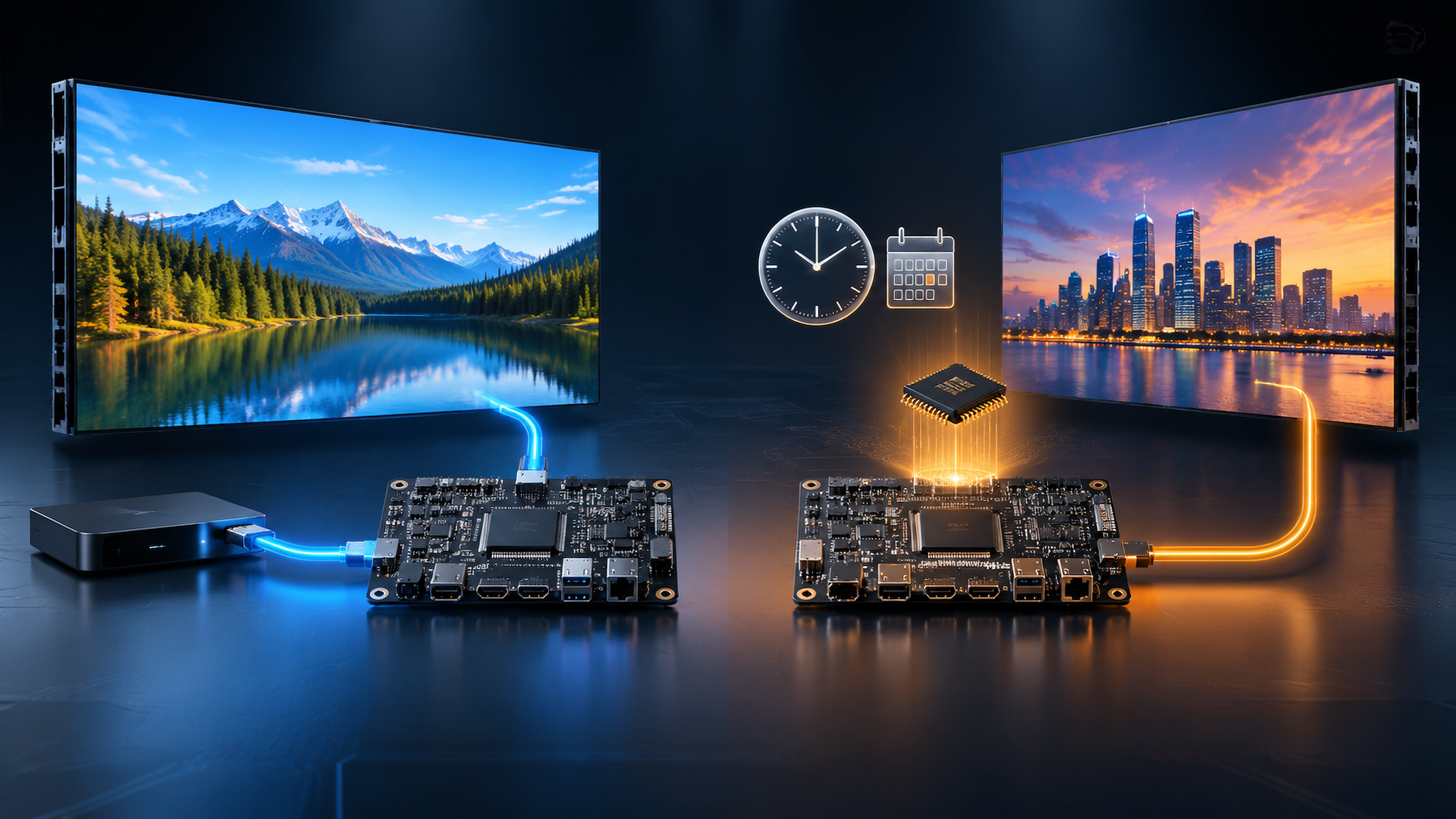
A. Asynchronous Offline Standalone Operation: In Asynchronous Mode, the HD-B6L operates as an independent media server. Scheduled video loops, split-screen layouts, digital clocks, weather widgets, and scrolling text banners play continuously from the internal 16GB eMMC storage without requiring an external video source. Programs can be updated wirelessly via Wi-Fi, 4G cloud dispatch, or U-disk plug-and-play insertion.
B. Synchronous Real-Time Live Feed Mode: When an HDMI cable is connected from a laptop, media player, or live production switcher to the HDMI Input, the HD-B6L automatically switches to Synchronous Live Mode. The screen renders low-latency live video in real time, making the poster display ideal for interactive corporate events and live product launches.
C. Multi-Poster HDMI Daisy-Chain Splicing Architecture: For multi-poster video wall installations, the primary HD-B6L receives the main video signal and routes the stream through its HDMI Loop port to the HDMI Input of the adjacent secondary controller in a daisy-chain topology. In this cascaded configuration, secondary screens automatically synchronize receiver card basic parameters, connection topology relations, and brightness calibration from the master controller, ensuring seamless image continuity across up to 6 or more physical poster screens.
4. Step-by-Step Configuration and Software Workflow Guide
Deploying an HD-B6L powered LED poster display involves a streamlined 4-step configuration workflow across mobile, desktop, and cloud platforms:
Step 1: Hardware Interconnections and Power Wiring — Connect regulated DC 5V power (2A to 3A minimum) to the controller terminal block. Connect Port 1 and Port 2 Gigabit RJ45 Ethernet cables to the LED module receiving cards. Attach the Wi-Fi antenna to the SMA port, and connect the optional sensor probe if automatic ambient brightness adjustment is desired.
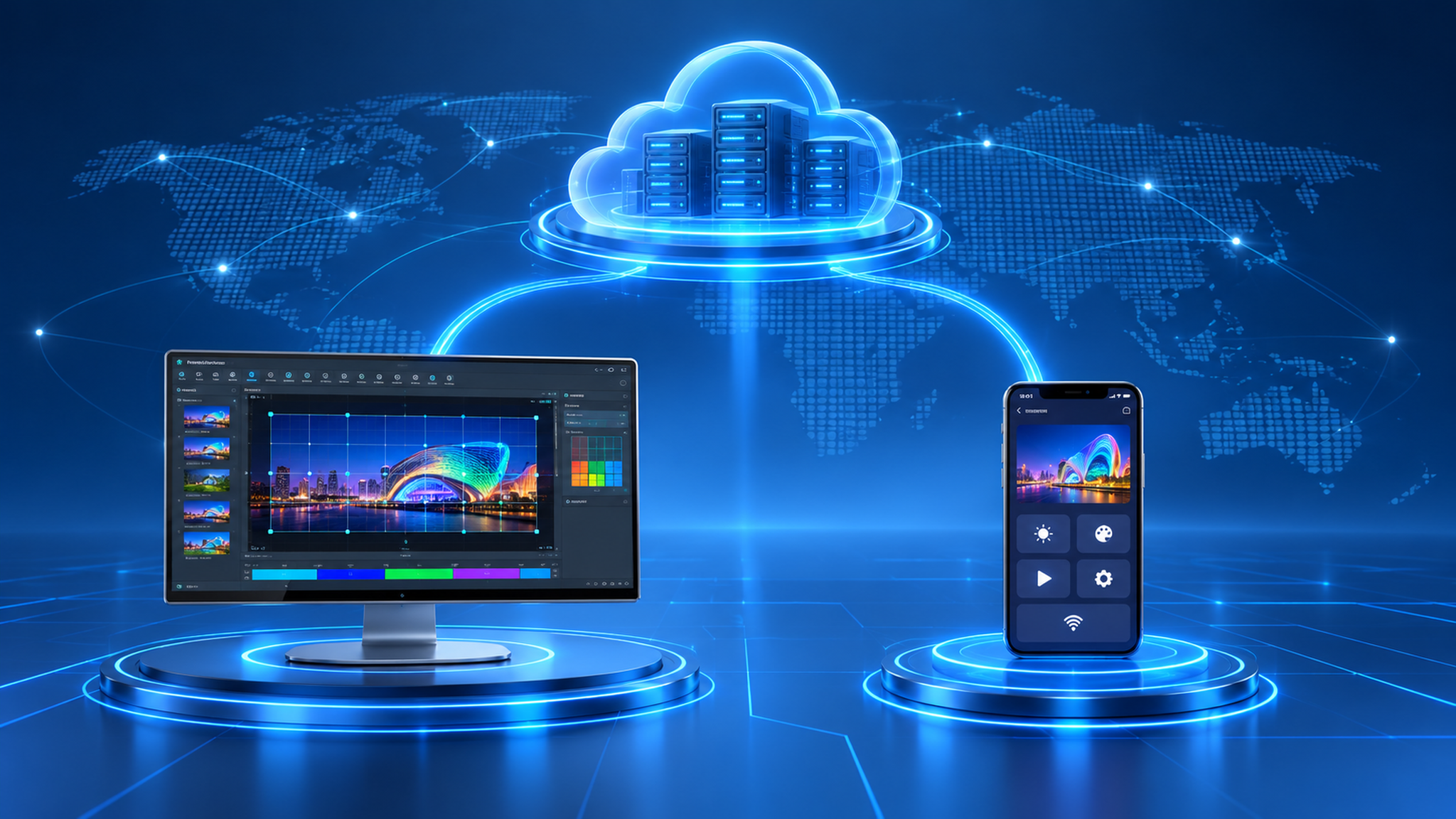
Step 2: Wireless Setup via LedArt Mobile Application — On an iOS or Android smartphone, connect to the controller's onboard Wi-Fi hotspot (default SSID typically starts with HD-B6L). Open the LedArt app to search for the device. Configure screen pixel width and height (e.g. 640 by 1920), select pre-built media templates, add text or promotional images, and send the program wirelessly.
5. Scenario-Specific Deployment and Configuration Matrix
The following engineering table correlates specific commercial deployment environments with recommended HD-B6L hardware configurations and operational modes.
Deployment Scenario | Typical Display Dimensions | Operational Playback Mode | Network Connectivity | Key Operational Features |
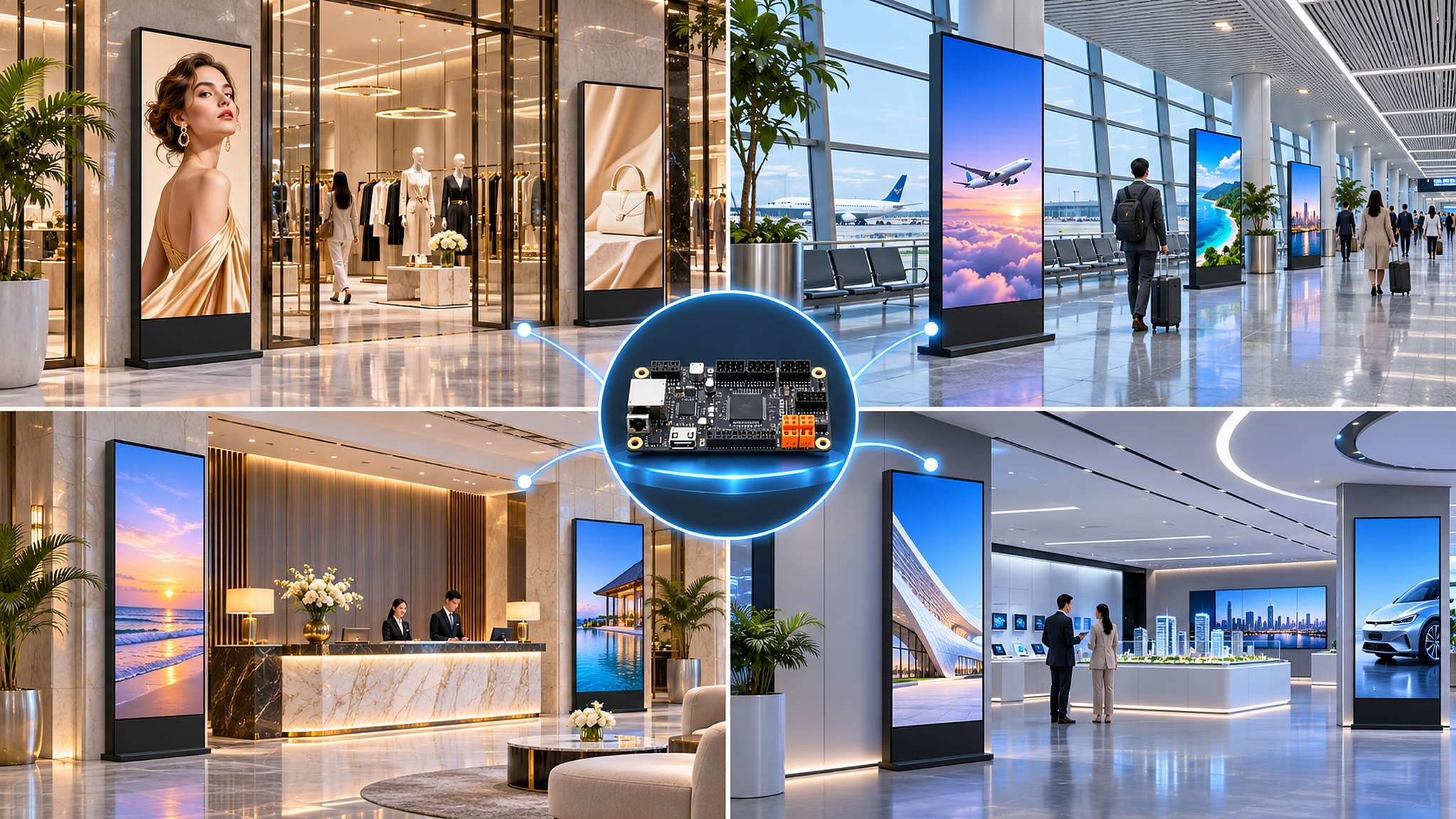
Standalone Luxury Retail Poster | 640x1920 mm (P1.8 to P2.5) | Asynchronous scheduled loop | Local Wi-Fi and LedArt app | Wireless smartphone program updates, auto-dimming |
Shopping Mall Concourse Splicing | 3840x1920 mm (6-unit cascade) | Synchronous HDMI daisy-chain | Wired LAN and HDMI loop | Seamless panoramic canvas, auto parameter sync |
Airport and Transit Terminal Totems | 768x1536 mm (P2.5 to P3.0) | Cloud cluster asynchronous | 4G LTE cellular and XiaoHui | Remote multi-city program push, GPS monitoring |
Corporate Exhibition Event Banners | 640x1920 mm (P1.5 to P1.8) | Synchronous live laptop input | Direct HDMI 1080p input | Zero-latency live video presentation, 3.5mm audio |
Hotel Lobby and Financial Display | 1280x1024 mm (P2.0 to P2.5) | Split-screen multi-window | Local LAN and Web CMS | Simultaneous video, exchange rates, and clock widgets |
6. Troubleshooting Best Practices and Frequently Asked Questions
Engineering Best Practices: Ensure clean, dedicated DC 5V power wiring directly from the switching power supply with adequate wire gauge (18 AWG minimum) to prevent voltage drop under peak brightness. When configuring HDMI cascading across multiple posters, always power on the master controller first before activating secondary vice-screens to ensure proper EDID handshake and parameter replication.
Q1: HD-B6L vs HD-B8L vs HD-B8H Comparison — Question 1: What is the primary difference between Huidu HD-B6L, HD-B8L, and HD-B8H?
Answer: The HD-B6L is the budget-optimized model with 1.3 million pixels capacity, 2 Gigabit RJ45 ports, and 16GB storage, ideal for single posters or small cascades. The HD-B8L maintains 1.3 million pixels with larger 64GB storage and enhanced cascade limits (up to 5.24 million pixels). The flagship HD-B8H doubles capacity to 2.6 million pixels with 4 Gigabit RJ45 ports, 64GB storage, and 4K processing capabilities.
Q2: Multi-Poster Video Splicing Requirements — Question 2: Does the Huidu HD-B6L require an external video processor for multi-poster splicing?
Answer: No. Thanks to the onboard hardware HDMI Loop-through output and intelligent FPGA video slicing, multiple HD-B6L controllers can be daisy-chained directly using standard HDMI cables without requiring costly external HDMI distribution amplifiers or video wall processors.
Q3: Receiving Card Compatibility — Question 3: Can third-party receiving cards be used with the Huidu HD-B6L controller?
Answer: The HD-B6L is optimized for native Huidu receiving cards (such as HD-R501S, HD-R512T, HD-R516T, and HD-R712). While standard Gigabit Ethernet cables are utilized, communication protocols are proprietary to Huidu; direct integration with NovaStar, Colorlight, or Linsn receiving cards is not supported.