Inside Modern Stadium Display Systems: Design and Integration
Executive Summary: The modern Jumbotron has evolved from its historical origins as a specialized cathode-ray display into the technological centerpiece of 21st-century sports entertainment, arena architecture, and live event production. In 2026, stadium visual ecosystems comprise massive Direct-View LED video networks spanning four-sided center-hung scoreboards, continuous 360-degree dual-sided roof halo boards, 360-degree fascia ribbon rings, end-zone mega-displays, and courtside perimeter boards. Deploying a commercial-grade Jumbotron demands precise synchronization across heavy structural engineering, motorized hoist winches, high-refresh broadcast processing (3840Hz to 7680Hz), SMPTE ST 2110 IP video networks, and real-time sports scoring data feeds. This engineering guide delivers an exhaustive technical overview of display architectures, mechanical safety, broadcast integration, capital expenditure breakdown, and commercial monetization strategies for stadium operators and AV procurement teams. |
1. Evolution and Architecture: The Modern Stadium Jumbotron Ecosystem
Originally introduced by Sony in 1985 for the Tsukuba World Expo, the term Jumbotron has become a genericized global term for large-format stadium video scoreboards. Today, the technology is defined entirely by high-density Direct-View LED arrays organized into specialized venue subsystems:
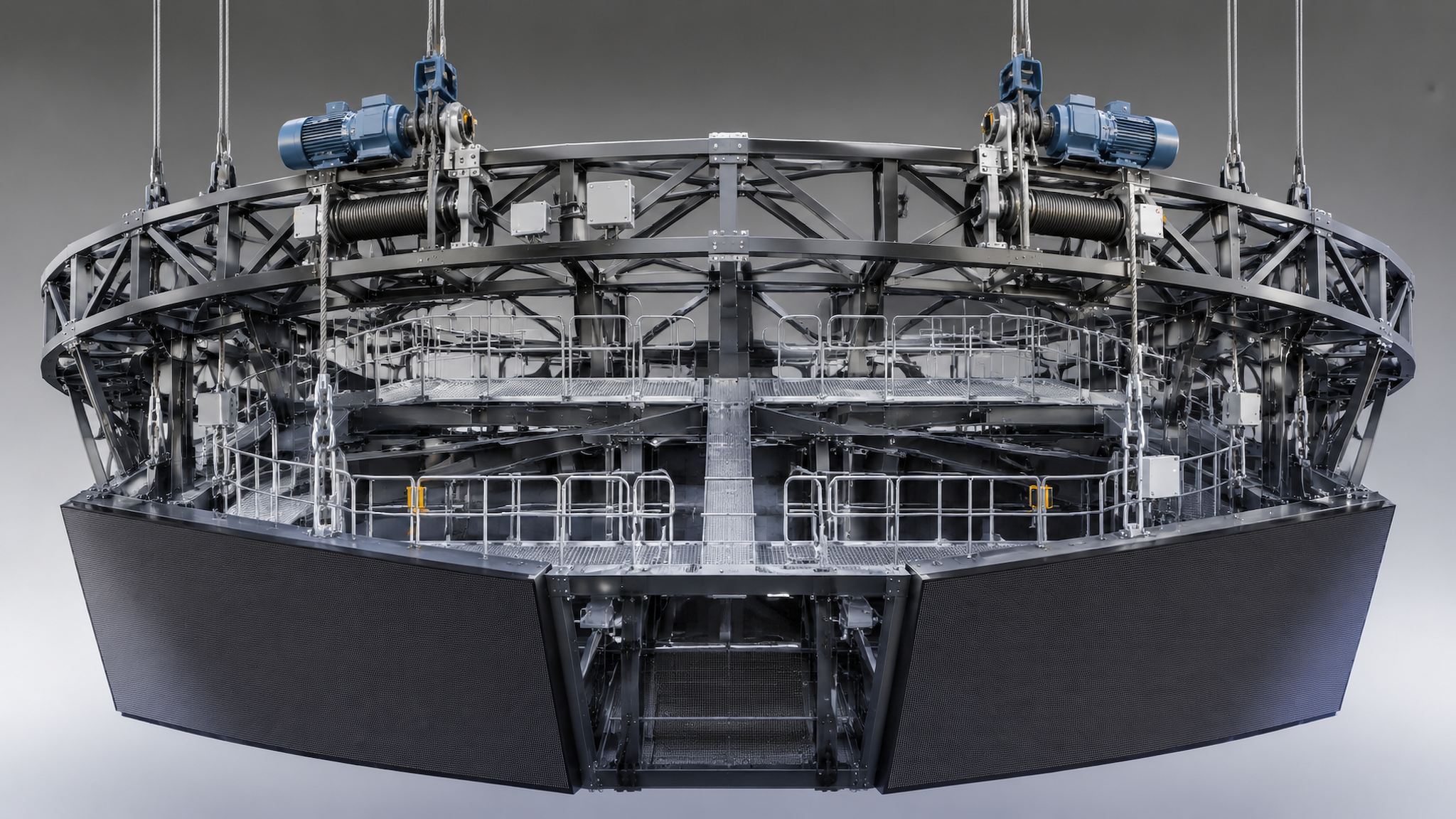
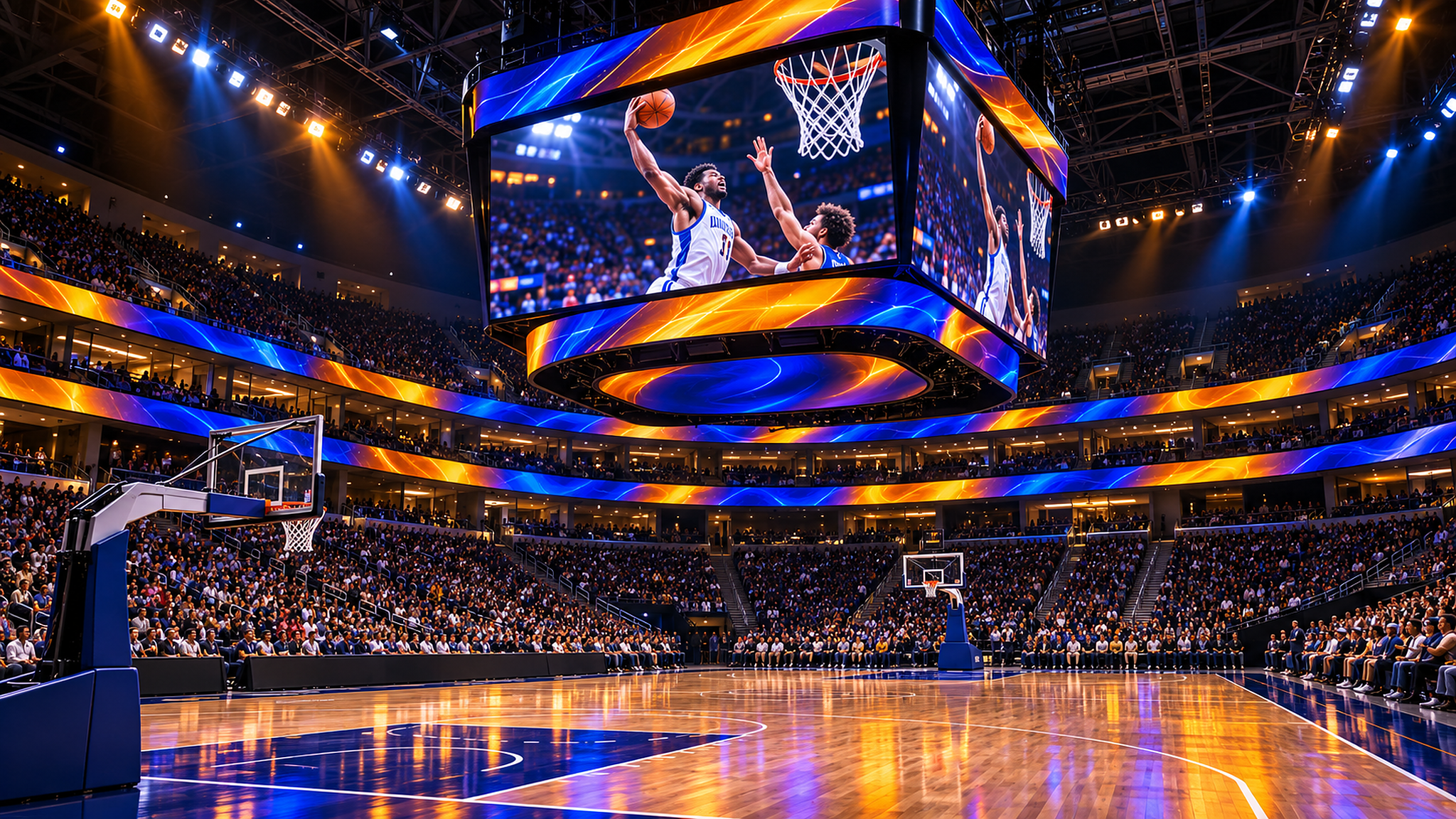
A. Center-Hung Arena Video Scoreboards: Suspended directly above the arena floor in NBA and NHL facilities, this four-sided or multi-faceted configuration delivers 360-degree sightlines. Modern designs feature seamless curved corners, upper scoring rings, and bottom-angled underbelly display wedges optimized for courtside viewers.
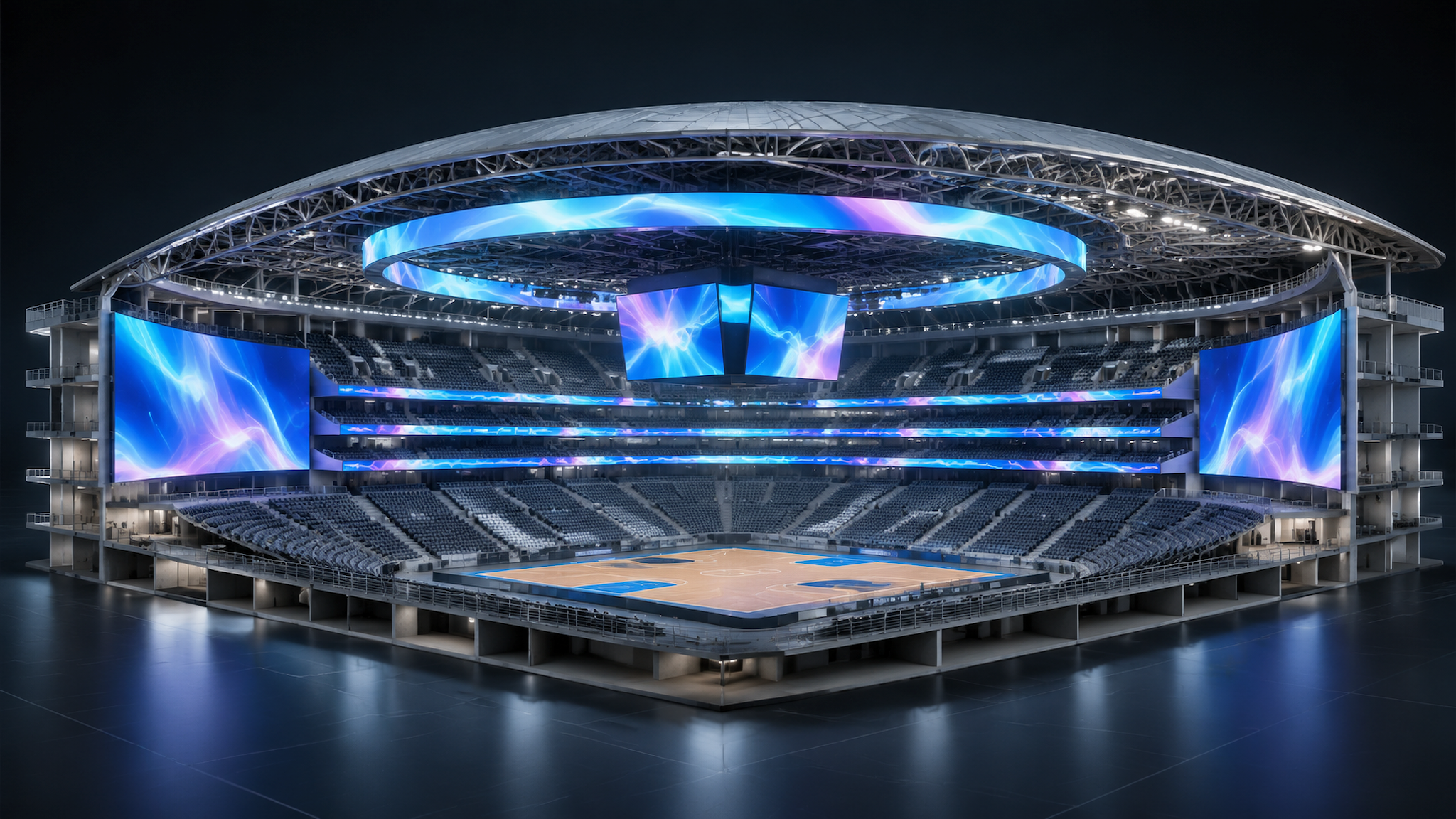
B. 360-Degree Center Roof Halo Displays: Pioneered in premier modern NFL and multipurpose mega-stadiums (such as the dual-sided continuous board at SoFi Stadium and the circular halo board at Mercedes-Benz Stadium), these massive suspended rings provide continuous panoramic video surfaces facing both the interior seating bowl and upper luxury suites.
C. 360-Degree Ribbon and Fascia Display Rings: Mounted along the fascia of upper and lower seating deck balconies, ribbon boards wrap continuously around the venue perimeter. They drive crowd immersion, synchronized goal celebrations, and dynamic digital out-of-home (DOOH) sponsor takeovers across entire game quarters.
D. End-Zone Stadium Video Walls and Outfield Mega-Screens: Massive outdoor video walls mounted in stadium end-zones or baseball outfields deliver high-impact instant replays, live game action, and concert IMAG video. These mega-displays require rugged structural engineering to withstand severe wind loads and intense direct sunlight.
2. Master Jumbotron System Architecture and Engineering Matrix
The following engineering table correlates each primary stadium LED display typology with optical specifications, ingress protection, broadcast capabilities, and structural rigging parameters.
Display Typology | Recommended Pitch | Typical Brightness | Ingress Protection | Broadcast Refresh | Structural and Rigging Specs |
Center-Hung Arena Video Cube | P2.5 to P3.91 mm (Indoor) | 1,200 to 2,500 nits | IP30 indoor rating | 3,840Hz to 7,680Hz | Electric hoist winches, 15 to 45 metric tons |
360-Degree Roof Halo Board | P3.91 to P6.0 mm (Dual-Sided) | 1,500 to 3,000 nits | IP43 semi-outdoor | 7,680Hz, HDR10 | Custom roof truss brackets, 80 to 200 metric tons |
360-Degree Balcony Ribbon Rings | P6.0 to P10.0 mm (Curved) | 1,500 to 3,500 nits | IP43 to IP65 | 3,840Hz, low latency | Curved balcony fascia brackets, slim under 80mm |
End-Zone Outdoor Mega-Screen | P6.0 to P16.0 mm (DOOH) | 6,500 to 10,000 nits | IP65 front and rear | 3,840Hz to 7,680Hz | Structural steel pylon tower, wind load 140 km per hour |
Courtside and Pitch Perimeter | P6.0 to P10.0 mm (SMD) | 6,000 to 8,000 nits | IP65 weatherproofing | 7,680Hz, Genlock | Soft silicone rubber mask, top player crash cushion |
3. Optical, Mechanical, and Structural Engineering Considerations
Engineering a stadium-grade Jumbotron involves strict structural and optical requirements beyond standard commercial displays:
A. Pixel Pitch and Optimal Viewing Distance: Indoor arena center-hung displays utilize fine pixel pitches ranging from P2.5 to P3.91 mm to maintain image sharpness for courtside premium seats (viewing distance 3 to 15 meters). Outdoor open-air football and baseball stadiums utilize P6.0 to P10.0 mm for end-zone boards where spectators sit 25 to 120 meters away.
B. Motorized Winch Hoist Systems and Catwalk Safety: Center-hung scoreboards weighing between 15 and 50 metric tons require computerized electric hoist winch systems capable of lowering the entire assembly to the arena floor for rapid ground-level maintenance. Integrated electronic load cells continuously monitor cable tension to detect unbalanced loads during concert rigging transitions.
C. Environmental Thermal and Ingress Protection: Outdoor displays require IP65 weatherproofing with marine-grade anti-corrosion aluminum alloy cabinets, conformal-coated circuit boards to resist atmospheric moisture, and automated ambient light sensors that dynamically throttle brightness between 1,000 nits at night and 8,000 nits under direct midday sunlight.
D. Player Safety and Impact Protection: Perimeter display systems deployed along football pitches and basketball sidelines incorporate impact-absorbing soft silicone rubber masks and top EVA foam crash pads. These protective features prevent player injury during high-speed collisions while shielding internal LED diodes from mechanical impact.
4. Broadcast Integration, SMPTE 2110 IP Video, and Media Control
Modern sports production requires ultra-low latency and broadcast television synchronization:
A. Broadcast Camera Synchronization (7680Hz and Genlock): Stadium video feeds must deliver ultra-high refresh rates of 7680Hz paired with Genlock frame synchronization to eliminate black rolling shutter bars, moiré patterns, and stutter on 4K HDR broadcast cameras capturing 120 frames per second ultra-slow-motion replays.
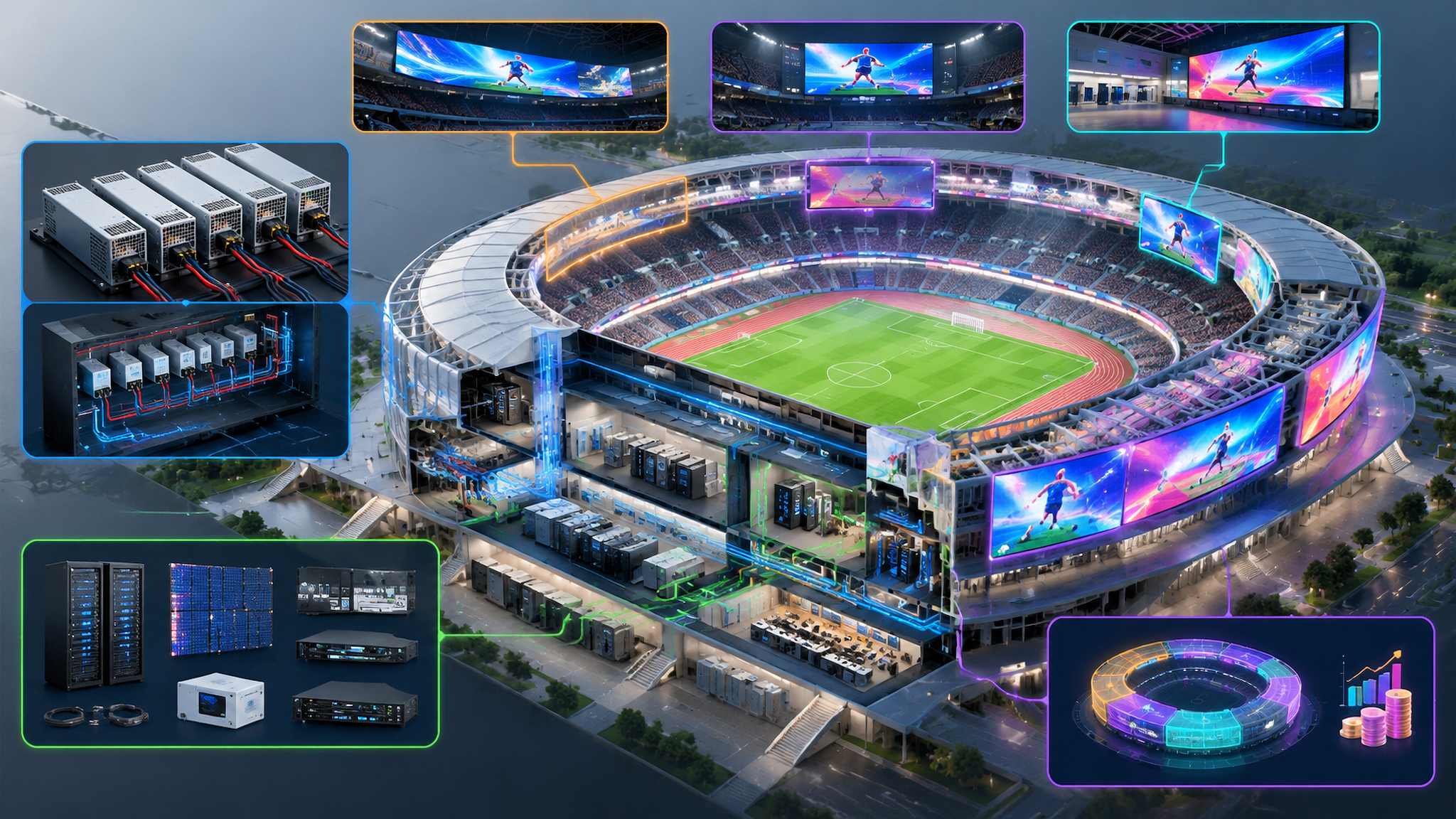
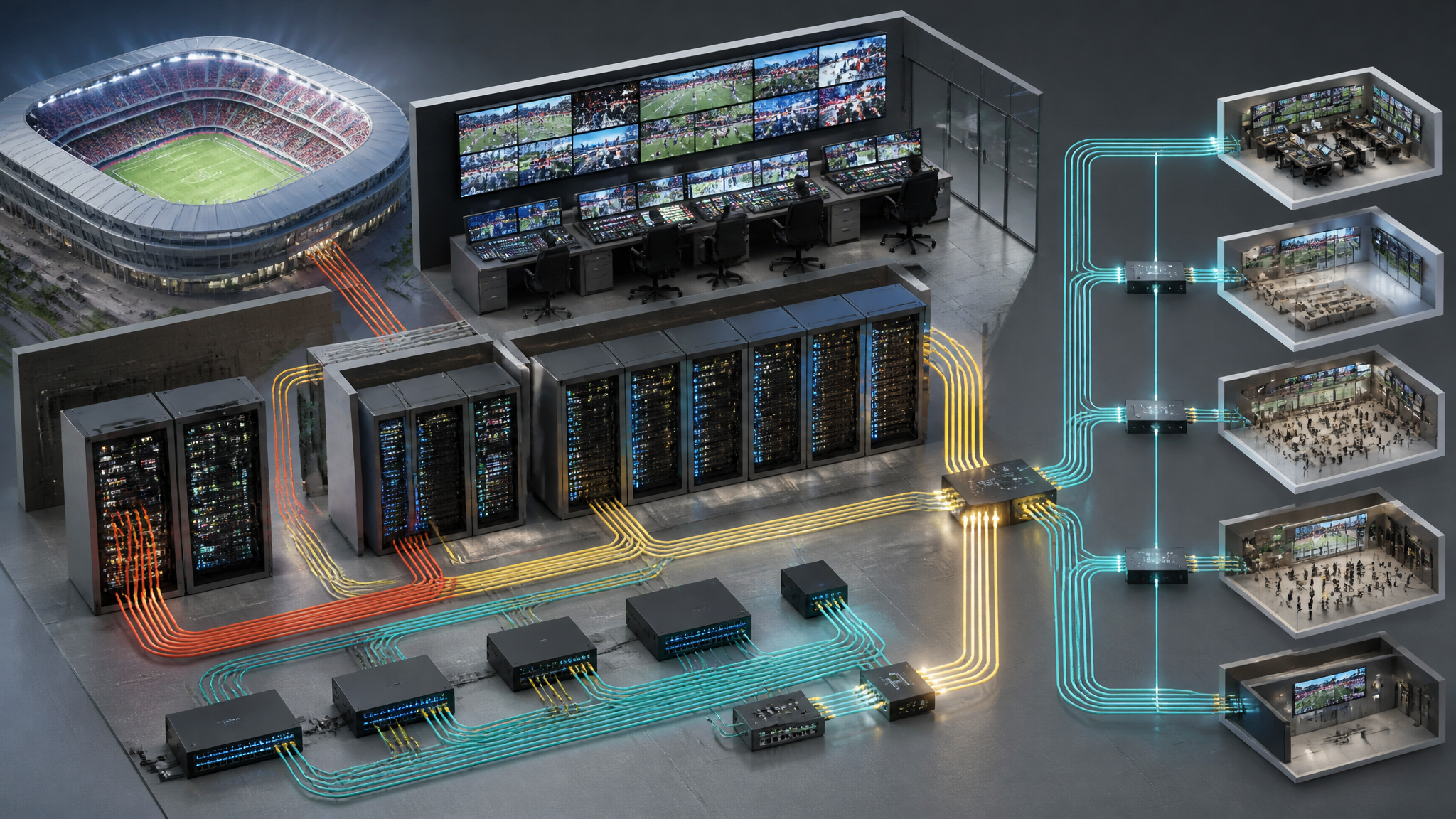
B. SMPTE ST 2110 IP Video Infrastructure: Uncompressed video streams are routed across SMPTE ST 2110 IP video networks over 10Gbps and 40Gbps redundant optical fiber backbones. Centralized media servers (such as Ross Video, Daktronics Show Control, or NovaStar processing clusters) composite live camera feeds, 3D player animations, Statcast graphics, and sponsor content with end-to-end processing latency under 1 video frame (under 16 milliseconds).
C. Automated Sports Data Integration: Real-time scoring engines interface with official league data providers (such as Sportradar, Opta, and Genius Sports) via high-speed API connections. Scoreboards instantly render shot clocks, player foul counts, penalty times, and real-time player tracking statistics without manual operator intervention.
5. Total Cost of Ownership (TCO) and Commercial Monetization Matrix
The following engineering table outlines the capital expenditure breakdown, operational cost drivers, and commercial monetization mechanisms across venue scales.
Venue Scale | Representative Hardware Scope | Estimated CAPEX Range | Primary Cost Drivers | Annual Ad Revenue Potential |
Collegiate and Mid-Sized Arena (5,000 to 10,000 seats) | 4-sided center-hung (P3.9) and 180m ribbon board | 800,000 to 2,200,000 USD | LED modules, motorized hoists, basic switcher | 300,000 to 800,000 USD estimated |
Major Professional Arena (15,000 to 20,000 seats) | Center-hung with underbelly, 360 ribbon, corner boards | 3,500,000 to 7,500,000 USD | P2.5 fine pitch, SMPTE 2110 routing, fiber | 1,500,000 to 4,500,000 USD estimated |
NFL and Outdoor Mega-Stadium (60,000 to 80,000 seats) | Dual-sided roof halo board and end-zone mega-walls | 15,000,000 to 35,000,000 USD | Structural steel truss, outdoor high-nits IP65 | 6,000,000 to 18,000,000 USD estimated |
Professional Soccer Stadium (UEFA and FIFA Tier 1) | Twin end-zone scoreboards and 240m pitch perimeters | 2,500,000 to 6,000,000 USD | 7680Hz perimeter boards, weatherproofing | 1,200,000 to 3,800,000 USD estimated |
6. Safety Redundancy, Maintenance Protocols, and Frequently Asked Questions
Mission-Critical Safety Redundancy: Stadium Jumbotron systems incorporate dual-loop Ethernet signal redundancy and N-plus-one hot-swappable power supply topologies. If an individual power supply or data line suffers an unexpected interruption during a championship match, the secondary loop immediately takes over with zero visible dropped frames.
Q1: Operating Lifespan and Diode Half-Life — Question 1: What is the typical operational lifespan of a modern stadium Jumbotron?
Answer: High-grade commercial LED diodes deliver an operating half-life rating of 100,000 hours (operating at 50 percent brightness). In typical professional sports venues operating 150 to 250 event days per year, a well-maintained Jumbotron delivers an effective service life of 8 to 12 years before requiring an overall technology refresh.
Q2: Electrical Power Demands — Question 2: How much power does a professional stadium center-hung Jumbotron consume?
Answer: Power consumption varies by pixel pitch and brightness. Modern common-cathode indoor center-hung scoreboards consume approximately 150 to 250 watts per square meter on average, with maximum peak draws reaching 500 to 700 watts per square meter during full white moments. Outdoor high-brightness boards draw 300 to 500 watts per square meter on average.
Q3: Retrofitting Structural Weight Limits — Question 3: Can existing older arenas be retrofitted with modern center-hung Jumbotrons?
Answer: Yes. Retrofitting requires a structural engineering audit of roof truss load ratings. Modern lightweight die-cast magnesium and carbon-composite cabinets have reduced screen weight by 30 to 45 percent compared to older sheet-metal cabinets, enabling larger visual displays within existing roof weight envelopes.