LED Screen Buying Guide: 9 Specs to Check
LED Screen Buying Guide: 9 Specs to Check
An Engineering Procurement Blueprint Covering Optical Metrics, Driver Architecture, Mechanical Rigidity, and Redundancy
Executive Summary: Procuring a commercial-grade Direct-View LED video wall involves substantial capital investment and long-term operational commitments. While commercial spec sheets highlight peak promotional figures, real-world display performance, color fidelity, visual comfort, and long-term reliability depend on interconnected optical, semiconductor, mechanical, and electrical subsystems. A common procurement pitfall is overpaying for unnecessary ultra-fine pixel pitch while neglecting mission-critical parameters such as low-brightness grayscale depth, driver IC PWM refresh rates, common-cathode thermal efficiency, and front-service access. This comprehensive buying guide establishes an objective engineering framework auditing the 9 essential technical specifications that systems integrators, AV consultants, and enterprise facility managers must rigorously evaluate before purchasing.
1. The Procurement Framework: Beyond Surface Level Spec Sheets
Modern LED display engineering spans highly diverse installation environments ranging from corporate command centers, luxury retail window storefronts, and television broadcast studios, to outdoor stadium scoreboards and touring concert stages. Evaluating these visual systems requires looking past generic product marketing and scrutinizing the core hardware architecture.
A. The Integrated Hardware Ecosystem: Display performance is determined by the harmonious interaction between semiconductor packaging (SMD, COB, or GOB), constant-current PWM driver ICs, precision CNC die-cast cabinet metallurgy, regulated power distribution topologies, and centralized video controller processing pipelines.
B. Strategic Specification Auditing: To ensure total cost of ownership (TCO) optimization and operational reliability, buyers must audit nine foundational engineering specifications before finalizing vendor contracts.
2. Master Engineering Specification Audit Matrix
The following engineering audit table correlates the 9 critical LED display specifications with recommended industry standards, failure risks, and testing methodologies.
Key Specification | Engineering Metric | Recommended Industry Standard | Operational Risk if Neglected | Verification Protocol |
1. Pixel Pitch and Distance | Millimeter spacing (P0.7 to P16.0 mm) | 1.0 to 1.5 meters viewing distance per millimeter of pitch | Visible pixel grid, eye fatigue, or excessive capital cost | Calculate minimum spectator distance using visual acuity formula |
2. Calibrated Nit Brightness | Candela per square meter (nits) | Indoor: 600 to 1,200 nits; Outdoor: 5,000 to 10,000 nits | Washed-out display under ambient light, or severe glare | Measure calibrated white screen using calibrated optical spot photometer |
3. Refresh Rate | Hertz (Hz) frame refresh frequency | Standard: 3,840Hz; Broadcast and XR Virtual: 7,680Hz | Camera scan lines, black rolling shutter bars, moire | Test with high-speed camera and 4K broadcast video capture |
4. Grayscale Bit-Depth | Bits per color channel (14 to 22-bit) | 16-bit standard; 18 to 22-bit with HDR10 and HLG support | Color banding, crushed shadow details at low brightness | Display 16-step to 64-step smooth linear grey gradient test pattern |
5. Ingress Protection (IP) | IEC 60529 IP Rating code | Indoor: IP30; Outdoor: IP65 front and rear with coating | Moisture corrosion, short circuits, dust accumulation | Verify third-party laboratory water jet and dust chamber certificates |
6. Cabinet Metallurgy | Chassis material and CNC tolerance | Die-cast aluminum or magnesium, CNC tolerance under 0.1mm | Visible seam lines, panel warping, uneven video wall plane | Physical feeler gauge inspection along adjacent module seam borders |
7. Energy Efficiency | Watts per square meter (W per sqm) | Common-cathode power: Average 120 to 200W per sqm | Overheating, elevated HVAC cooling costs, premature diode decay | Measure power meter draw under 100 percent full white video load |
8. Service Accessibility | Maintenance mechanism and time | Front magnetic vacuum service (under 10 seconds per tile) | Costly dismantling, long downtime, structural rear clearance needs | Perform physical front-removal test using magnetic suction vacuum tool |
9. Redundancy and Control | Signal and power backup topology | Dual-loop Ethernet ring redundancy, N-plus-one power units | Catastrophic blackout during mission-critical live events | Simulate live cable disconnection and power supply failure during playback |
3. In-Depth Engineering Analysis of the 9 Critical Specifications
A rigorous technical evaluation of each specification ensures long-term operational success:
Specification 1: Pixel Pitch and Viewing Distance Geometry — Pixel pitch defines the center-to-center distance between adjacent LED clusters in millimeters. A standard engineering rule of thumb dictates that comfortable viewing distance equals roughly 1.0 to 1.5 meters per millimeter of pitch (e.g. P1.5 requires 1.5 to 2.2 meters minimum distance). Selecting a pitch finer than necessary exponentially increases costs without perceivable visual benefit once human visual acuity limits (1 arcminute) are reached.
Specification 2: Calibrated Nit Brightness and Ambient Adaptation — Brightness must be calibrated to ambient illumination. Indoor corporate environments require 600 to 1,000 nits to prevent ocular discomfort, while direct sunlight outdoor environments require 5,000 to 10,000 nits. High-end outdoor displays must include integrated optical ambient sensors that automatically modulate brightness to preserve energy and prevent night glare.
Specification 3: High Refresh Rate and Camera Artifact Elimination — Refresh rate indicates how many times per second the hardware redraws image data. A baseline refresh rate of 3,840Hz is essential to prevent eye fatigue. Broadcast studios and XR virtual production stages demand 7,680Hz combined with Genlock synchronization to eliminate dark scan lines and rolling shutter artifacts on 120fps television cameras.
Specification 4: Low-Brightness Grayscale Depth and Linear Response — High grayscale performance (16-bit to 22-bit) ensures smooth color gradients without posterization or banding artifacts. The true mark of a premium display is low-brightness grayscale fidelity: maintaining accurate color depth when the screen is dimmed to 10 to 20 percent brightness in dark control rooms.
Specification 5: Ingress Protection Rating and Moisture Resistance — Outdoor displays require IP65 ingress protection on both front and rear surfaces, preventing water jet penetration and dust ingress. Outdoor PCBs must feature conformal polymer coatings to resist moisture oxidation and saline atmospheric corrosion in coastal environments.
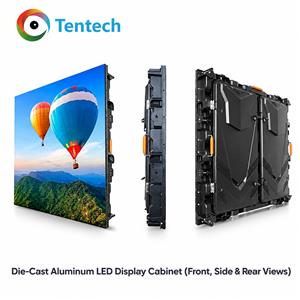
Specification 6: Cabinet Metallurgy and Precision Seam Flatness — High-precision die-cast aluminum or magnesium alloy cabinets manufactured via CNC machining achieve sub-0.1mm dimensional tolerances. This structural rigidity ensures seamless video wall flatness without visible seam gaps or misaligned module borders.
Specification 7: Common-Cathode Energy Efficiency and Thermal Dynamics — Modern common-cathode power distribution provides independent, dedicated low-voltage power rails to red (approx. 2.8V) versus green and blue (approx. 3.8V) diodes. This eliminates excess voltage drop, reducing power consumption by 30 to 40 percent and lowering operating temperatures by 10 to 15 degrees Celsius.
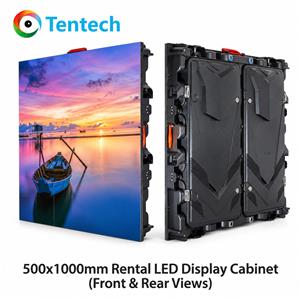
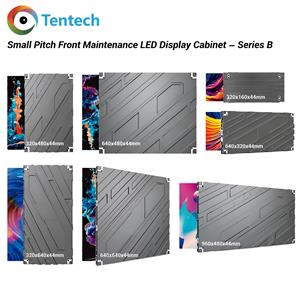
Specification 8: Front Magnetic Maintenance and Serviceability — Front-service magnetic module extraction allows technicians to remove and replace defective tiles from the front within seconds using handheld vacuum tools. This eliminates the requirement for rear service corridors, saving valuable floor space in architectural installations.
Specification 9: Signal Loop Redundancy and Power Failover — Mission-critical video walls require dual-loop Ethernet signal redundancy and N-plus-one hot-swappable power supplies. If a primary cable or power module suffers an unexpected failure, the redundant backup circuit engages instantly with zero frame drops.
4. Scenario-Specific Specification Benchmark Matrix
The following engineering table correlates specific project application environments with target specification benchmarks.
Project Application Scenario | Recommended Pixel Pitch | Target Calibrated Brightness | Refresh and Grayscale Benchmark | Mechanical and Ingress Specs |
Corporate Boardroom and Command Center | P0.9 to P1.5 mm (COB) | 600 to 1,000 nits (Auto-dim) | 3,840Hz, 16-bit low-bright grayscale | Front magnetic service, slim depth under 45mm |
Broadcast TV and XR Virtual Production | P1.5 to P2.5 mm (SMD) | 1,200 to 1,500 nits (HDR10) | 7,680Hz, 22-bit grayscale, Genlock sync | Matte black mask, optical anti-reflection surface |
Luxury Fashion Retail and Shopfronts | P1.8 to P2.9 mm (SMD) | 2,500 to 4,000 nits (High ambient) | 3,840Hz, 16-bit grayscale | Common-cathode, fanless passive thermal design |
Concert Touring and Rental Staging | P2.6 to P3.91 mm (Rental) | 1,200 to 3,000 nits (Indoor and Outdoor) | 3,840Hz to 7,680Hz, low latency | Die-cast magnesium, quick-lock curve rigging |
Outdoor DOOH and Stadium Facade | P6.0 to P10.0 mm (Outdoor) | 6,500 to 10,000 nits (Sunlight) | 3,840Hz, 16-bit, auto optical sensor | IP65 front and rear, marine-grade coating |
5. Due Diligence, Warranty SLAs, and Frequently Asked Questions
Procurement Due Diligence: Always require the manufacturer to supply all display modules from a single optical binning production batch, along with a 3 to 5 percent matching spare parts allotment. Mixing optical bins across different production batches results in visible color temperature and chromaticity variations across the screen canvas.
Q1: Common-Cathode vs Common-Anode Selection — Question 1: How does a buyer determine whether common-cathode or common-anode power is necessary?
Answer: For indoor fine-pitch video walls operating 12 to 24 hours daily or outdoor high-brightness billboards, common-cathode architecture is strongly recommended. It reduces electrical energy consumption by 30 to 40 percent and lowers surface operating temperatures by 10 to 15 degrees Celsius, extending diode lifespan and reducing facility air conditioning loads.
Q2: Low-Brightness Grayscale Significance — Question 2: Why is low-brightness grayscale performance more critical than maximum peak brightness for indoor displays?
Answer: In indoor command centers and boardrooms, displays are rarely operated at 100 percent brightness. When dimmed to 15 to 25 percent intensity to match ambient room lighting, low-grade driver ICs lose bit depth, causing crushed dark shadows and color banding. Premium PWM driver ICs preserve 16-bit grayscale even at 10 percent brightness.
Q3: Front vs Rear Service Accessibility — Question 3: What is the practical advantage of front-magnetic service over rear mechanical access?
Answer: Front-magnetic service allows module extraction directly from the front in under 10 seconds using a vacuum tool. This enables direct wall-mounting without requiring a dedicated 600mm to 800mm rear maintenance access corridor behind the video wall, saving substantial room floor space.
Q4: Spare Parts Batch Management — Question 4: What spare parts inventory should be included in an LED screen procurement contract?
Answer: Buyers should mandate a minimum 3 to 5 percent spare parts allotment including matching optical-bin LED module tiles, spare receiving cards, power supply units, flat ribbon cables, and driver IC components produced in the exact same manufacturing batch.
Q5: Diode Half-Life and Degradation Curve — Question 5: What is the typical operational half-life of commercial LED display diodes?
Answer: High-grade commercial LED diodes feature an operational half-life rating of 100,000 hours (operating at 50 percent brightness). With proper thermal management, voltage regulation, and environmental humidity control, an enterprise LED screen delivers an expected operational lifespan of 8 to 10 years.