
NovaStar H2: Modular Video Processing and LED Control
Executive Summary: The NovaStar H2 is a high-performance, compact 2U flagship modular video splicing processor designed specifically for fine-pitch LED display walls, corporate briefing auditoriums, broadcast control rooms, and live event staging. Built on a pure hardware FPGA matrix architecture, the H2 integrates true video matrix switching, multi-layer video windowing, and direct LED display controller sending functions into a single 2U enclosure. Featuring four modular input card slots supporting up to sixteen 2K or eight 4K inputs, two output card slots loading up to 13.0 million pixels (or up to 26.0 million pixels with enhanced sending cards), browser-based Web GUI control, broadcast Genlock, and dual redundant power supplies, the H2 lists commercially between 4,500 USD and 7,500 USD depending on card configuration. This technical review details hardware specifications, modular card selection, Web GUI workflows, and comparative benchmarks. |
1. Product Positioning and Architectural Core Value
Commercial video wall engineering traditionally required separate matrix switchers, video processors, and LED sending controller boxes, resulting in complex interconnect wiring, accumulated latency, and multiple points of potential signal failure. The NovaStar H2 eliminates this fragmentation by combining video processing and direct LED display control into a compact 2U chassis.
Key architectural advantages of the NovaStar H2 include:
• Pure Hardware FPGA Matrix Architecture: Pure hardware FPGA matrix cross-point architecture delivers zero operating system crash risk, zero frame tearing, and deterministic sub-frame ultra-low latency.
• Flexible Modular Card-Slot Topology: Equipped with 4 input slots and 2 output slots, supporting custom configurations across HDMI 2.0, DP 1.2, 12G-SDI, 3G-SDI, DVI, VGA, IP streams, and 16x RJ45 Gigabit Ethernet sending cards.
2. Core Technical Parameters and Engineering Specifications
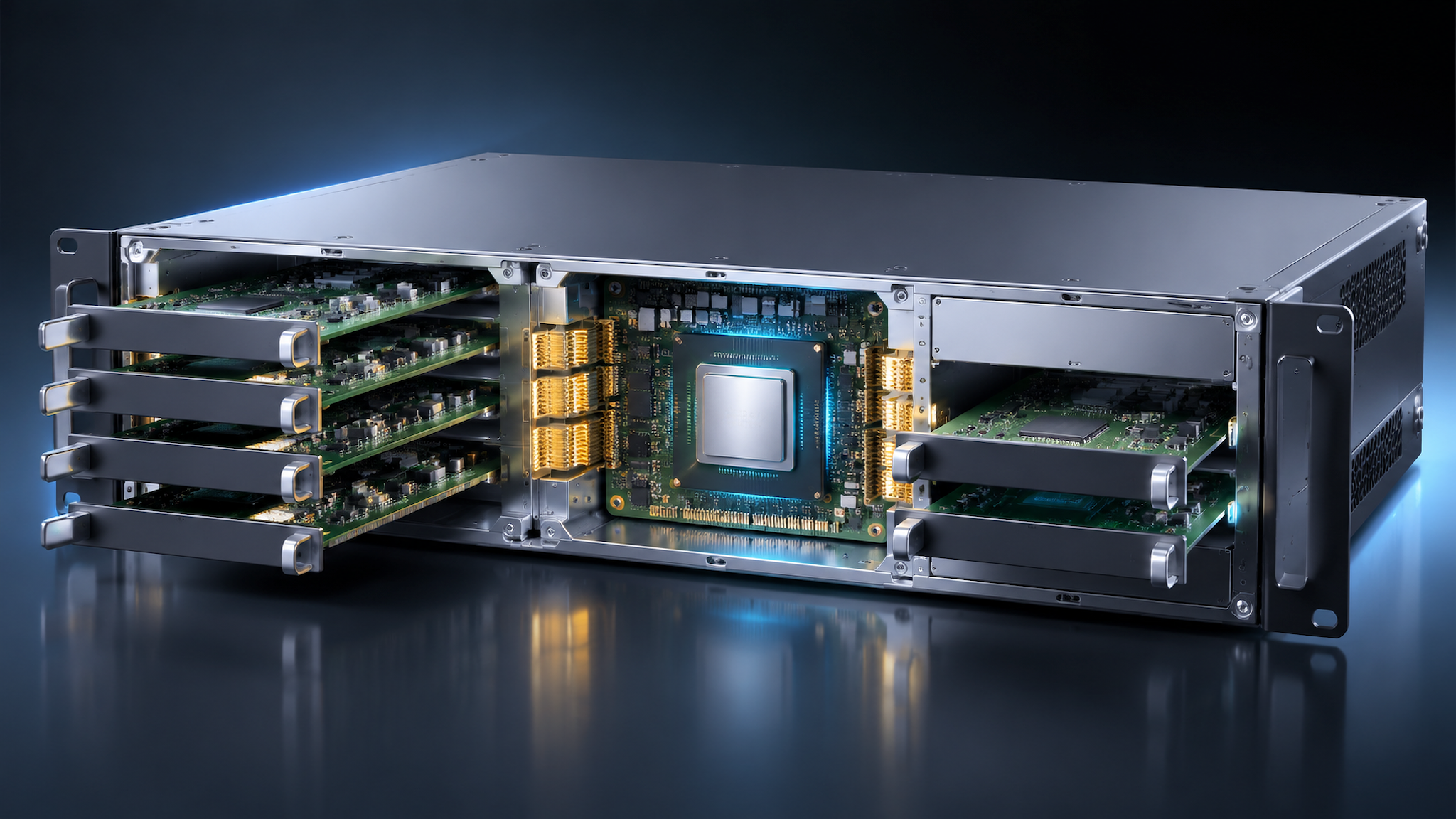
The technical parameters and card capabilities of the NovaStar H2 are synthesized in the following master table based on verified manufacturer engineering documentation.
Technical Dimension | H2 Hardware Specification | Engineering Notes and Operational Scope |
Chassis Enclosure Form Factor | 2U Standard 19-inch Rack-Mount Enclosure | Dimensions 482.6 mm by 452.0 mm by 88.0 mm, net chassis weight approximately 15.6 kg |
Modular Card Slots | 4 Input Card Slots and 2 Output Card Slots | Hot-swappable modular cards with high-speed gold-plated backplane connectors |
Maximum Input Channels | Up to 16x 2K Inputs or Up to 8x 4K Inputs | Supports custom mixing of HDMI 2.0, DP 1.2, 12G-SDI, 3G-SDI, DVI, VGA, and IP stream decoding cards |
Maximum Pixel Loading Capacity | Up to 13.0 Million Pixels (Standard Sending Cards) | Expands up to 26.0 Million Pixels with 2x Enhanced 4K LED sending cards (max width and height 10,240 pixels) |
Modular Output Card Types | 16x RJ45 Gigabit, 16x RJ45 plus 2x OPT, 20x RJ45, HDMI Out | 16x RJ45 card occupies 2 slots; HDMI output cards available for preview and LCD mosaic |
Multi-Screen Management | Up to 4 Independent Screen Canvas Groups | Independent canvas resolution and irregular screen layout management across different display zones |
Multi-Layer Video Windowing | Up to 16x 2K Layers or 4x 4K Layers Simultaneously | Free window roaming, scaling, overlay, PIP, cross-fade transitions, and BKG plus OSD graphics insertion |
Processing Latency | Zero-Frame Mode (Under 1 ms Sub-Frame Processing) | Pure hardware FPGA data pipeline eliminates operating system buffer delays |
Broadcast Synchronization | Bi-level and Tri-level Genlock In plus Loop (BNC) | Phase-locks output frame rate to external master studio reference clock generators |
Device Control Interfaces | Dual Gigabit RJ45 Control Ports (Ethernet 1 and 2) | Integrated Web GUI browser control, TCP IP network commands, and USB Type-A and Type-B cascading |
Power Supply and Redundancy | 100V to 240V AC, 50 to 60 Hz Dual Redundant Power | Supports dual hot-swappable AC power supply modules for uninterrupted 24-hour mission-critical operation |
Typical Commercial Price Range | 4,500 to 7,500 USD (Configured with Input and Output Cards) | Empty 2U chassis lists between 2,500 and 3,500 USD; total price depends on modular card selection |
3. Modular Card Architecture and Hardware Interface Cabling
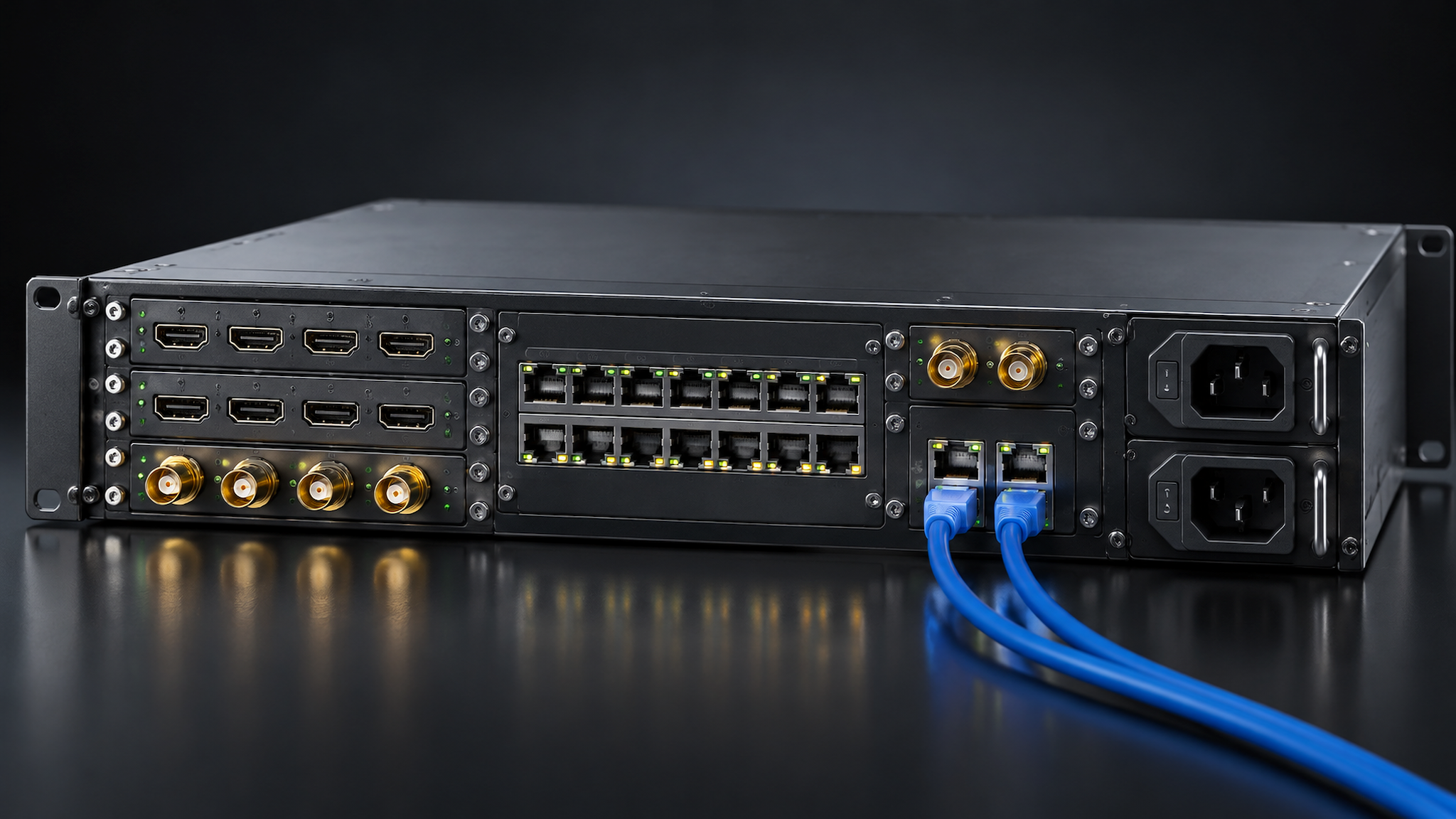
The NovaStar H2 rear panel is structured into modular input card slots, output card slots, control interfaces, and redundant power bays:
A. Modular Input Card Options: Slots 1 through 4 accept modular input cards, including 4x HDMI 1.3 or DVI (4-channel 2K), 1x HDMI 2.0 plus 1x DP 1.2 (4K), 2x HDMI 2.0, 2x DP 1.2, 4x 3G-SDI, 1x 12G-SDI, and IP RTSP and RTMP stream decoding cards.
B. LED Sending and Video Output Cards: Slots 5 and 6 house LED sending cards and video output cards. The flagship 16x RJ45 Gigabit Ethernet sending card occupies two slots, driving up to 13,000,000 pixels with primary and backup loop outputs.
4. Software Ecosystem, Web GUI Setup, and Commissioning Workflow
Commissioning the NovaStar H2 utilizes the built-in browser-based Web GUI control platform, providing zero-installation accessibility:
• Web GUI Browser Architecture: The Web GUI operates natively inside any standard web browser (Chrome, Edge, Safari), offering visual drag-and-drop screen configuration, real-time input preview, and multi-user privilege management.
• Multi-Layer Windowing and Presets: Enables operators to stage up to 16 video windows simultaneously, configure seamless cross-fade transitions, capture static background (BKG) images, and save up to 2,000 scene presets.
Engineering Commissioning Workflow Step-by-Step
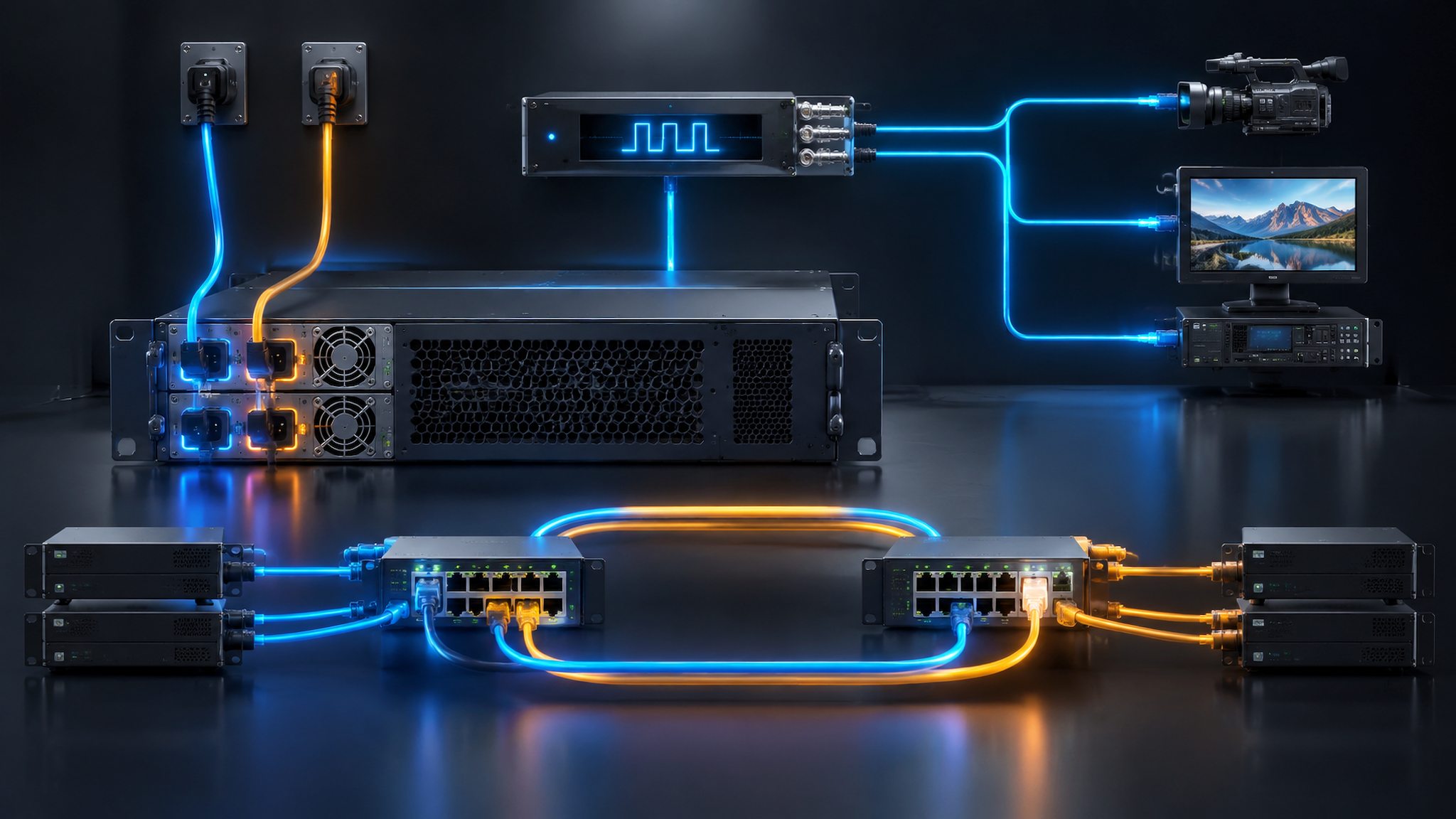
Step 1: Physical Mounting and Card Seating — Mount H2 in standard 19-inch AV rack, connect dual AC power feeds, insert input cards and 16x RJ45 sending cards, and connect Cat6 Ethernet cables to LED display cabinets.
Step 2: Web GUI Network Access — Connect control laptop to Ethernet Control port, assign static IP address in the local subnet, open web browser, and enter device IP to access Web GUI.
Step 3: Screen Canvas and Cabinet Mapping — Navigate to Screen Configuration tab, define display resolution, set cabinet grid arrays, and click Send to Hardware to burn RCFGX parameters to receiving cards.
Step 4: Input EDID and Signal Ingestion — Access Input Settings, verify active signal detection, customize EDID timings (such as 3840 by 2160 at 60Hz), and adjust color temperature curves.
Step 5: Multi-Layer Window Staging — Drag input sources onto canvas to create video windows, adjust layer hierarchy (PIP), configure cross-fade transition speeds, and save layouts to preset banks.
Step 6: Genlock Sync Activation — Attach studio black-burst sync cable to Genlock In BNC port, enable Genlock mode in Web GUI, and verify zero-jitter frame phase locking.
5. Cross-Model Horizontal Comparison and Benchmarking Matrix
Selecting the optimal NovaStar H Series processor requires evaluating chassis height, card slot counts, and total pixel loading capacity. The following matrix benchmarks the H2 against sibling models in the H Series lineup.
Technical Dimension | NovaStar H2 | NovaStar H5 | NovaStar H9 | NovaStar H15 | NovaStar H20 |
Chassis Enclosure Height | 2U Rack-Mount Chassis | 5U Rack-Mount Chassis | 9U Rack-Mount Chassis | 15U Rack-Mount Chassis | 20U Rack-Mount Chassis |
Input Card Slots | 4 Input Card Slots | 10 Input Card Slots | 20 Input Card Slots | 30 Input Card Slots | 40 Input Card Slots |
Maximum Input Channels | Up to 16x 2K or 8x 4K Inputs | Up to 40x 2K or 20x 4K Inputs | Up to 80x 2K or 40x 4K Inputs | Up to 120x 2K or 60x 4K Inputs | Up to 160x 2K or 80x 4K Inputs |
Output Card Slots | 2 Output Card Slots | 3 Output Card Slots | 10 Output Card Slots | 10 Output Card Slots | 20 Output Card Slots |
Standard Pixel Loading Capacity | Up to 13.0 Million Pixels | Up to 39.0 Million Pixels | Up to 65.0 Million Pixels | Up to 130.0 Million Pixels | Up to 260.0 Million Pixels |
Enhanced 4K Pixel Capacity | Up to 26.0 Million Pixels | Up to 52.0 Million Pixels | Up to 130.0 Million Pixels | Up to 208.0 Million Pixels | Up to 416.0 Million Pixels |
Simultaneous Layer Capacity | Up to 16x 2K Layers | Up to 48x 2K Layers | Up to 80x 2K Layers | Up to 120x 2K Layers | Up to 160x 2K Layers |
Typical Commercial Price Range | 4,500 to 7,500 USD | 8,500 to 14,000 USD | 16,000 to 25,000 USD | 28,000 to 42,000 USD | 45,000 to 68,000 USD |
Target Application | Showrooms, Medium Auditoriums | Large Arenas, Control Rooms | Mega Sports Stadiums, TV Hubs | City Surveillance, Transport Hubs | National Command Centers |
6. Frequently Asked Questions (FAQ), Price Analysis and Procurement Guidelines
Commercial Price Analysis: The NovaStar H2 chassis lists between 2,500 USD and 3,500 USD for the empty frame, while a fully configured system with modular input cards (such as 4x HDMI 2.0 inputs) and a 16x RJ45 output sending card typically lists between 4,500 USD and 7,500 USD (or 4,200 EUR to 7,000 EUR). Pricing varies based on specific input card selections, optical output modules, and regional distributor logistics.
Q1: Modular Card Swapping Compatibility — Question 1: Can input and output cards be mixed or swapped between different H Series chassis models?
Answer: Yes. All standard input cards and output sending cards are completely interchangeable across the entire NovaStar H Series lineup, including the H2, H5, H9, H15, and H20.
Q2: Web GUI Platform Accessibility — Question 2: How does the H2 achieve zero-client control via Web GUI?
Answer: The H2 hosts an embedded web server on its hardware control board. Connecting a tablet, Mac, or PC to the control network allows full access via standard web browsers without installing software.
Q3: Enhanced 4K Loading Capacity — Question 3: How is the enhanced 26 million pixel capacity achieved on the H2?
Answer: When equipped with two enhanced LED 4K sending cards, each card drives up to 13,000,000 pixels across high-density output channels, doubling total chassis loading capacity to 26,000,000 pixels.