
Detailed Breakdown of Sphere LED Display Sizing Options, Pixel Pitch and Core Cost Factors
Sphere Sizing Options and Surface Area Geometry
Evaluating a sphere LED display begins with understanding its underlying geometry. The surface area of a sphere scales quadratically with diameter, governed by the classic mathematical formula:
$$text{Surface Area } (A) = 4pi r^2 = pi D^2$$
Where $D$ is the sphere diameter and $r$ is the radius ($D/2$).
Because surface area governs the total quantity of LED modules, receiving cards, power supplies, and structural frames, doubling a sphere's diameter quadruples its surface area and hardware requirements. A 1-metre sphere commands an active display area of roughly $3.14text{ m}^2$, whereas a 2-metre sphere expands to $12.57text{ m}^2$, and a 4-metre globe reaches over $50.27text{ m}^2$ of active display surface.
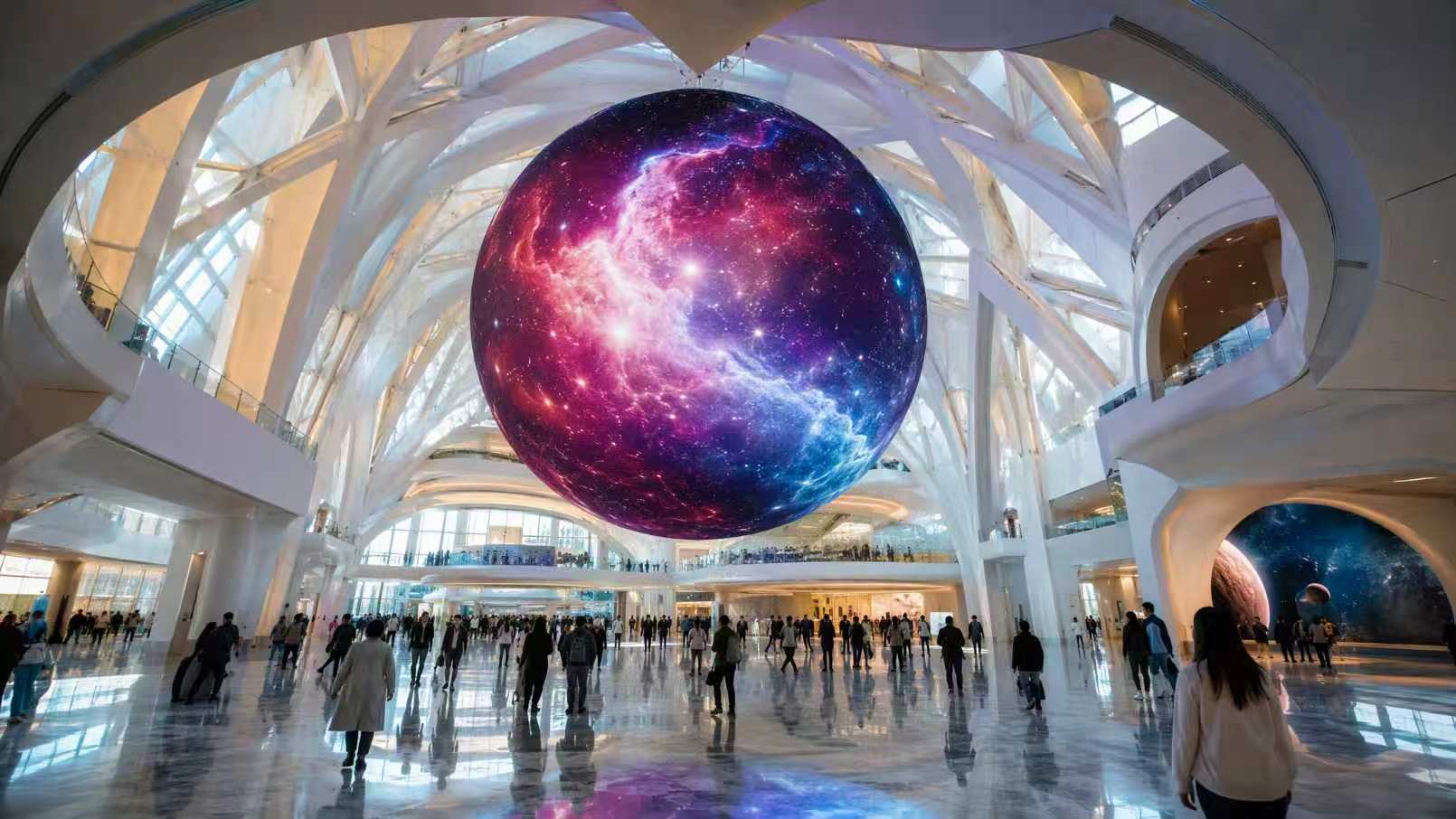
Sphere Diameter | Approximate Surface Area | Internal Volume | Native Pixel Resolution (at P2.5) | Typical Structural Weight | Recommended Venue Setting |
1.0 m (3.3 ft) | 3.14 m² (33.8 sq ft) | 0.52 m³ | ~502,600 total pixels | 65 – 95 kg | Retail flagship pedestals, corporate reception desks, trade show booths |
1.5 m (4.9 ft) | 7.07 m² (76.1 sq ft) | 1.77 m³ | ~1,131,000 total pixels | 140 – 210 kg | Museum exhibit halls, high-end retail centerpieces, hotel lobbies |
2.0 m (6.6 ft) | 12.57 m² (135.3 sq ft) | 4.19 m³ | ~2,010,000 total pixels (≈2K) | 260 – 380 kg | Corporate atriums, airport concourses, science museum rotundas |
3.0 m (9.8 ft) | 28.27 m² (304.3 sq ft) | 14.14 m³ | ~4,524,000 total pixels (≈4K) | 580 – 850 kg | Major transportation hubs, shopping mall central voids, planetariums |
4.0 m (13.1 ft) | 50.27 m² (541.1 sq ft) | 33.51 m³ | ~8,043,000 total pixels (≈8K) | 1,100 – 1,600 kg | Theme park central plazas, casino entertainment atriums, civic centers |
6.0 m (19.7 ft) | 113.10 m² (1,217.4 sq ft) | 113.10 m³ | ~18,095,000 total pixels | 2,800 – 4,200 kg | Monumental architectural landmarks, stadium atriums, mega entertainment hubs |
```
Sphere LED Display Engineering Stack
┌─────────────────────────────────────────────────────────────────┐
│ Optical & Geometrical Layer: 360-Degree Continuous Surface │
│ • Diameter (1.0m–6.0m+) • Pixel Pitch (P1.5–P6.0) • Petal PCBs │
└────────────────────────────────┬────────────────────────────────┘
│
┌────────────────────────────────┴────────────────────────────────┐
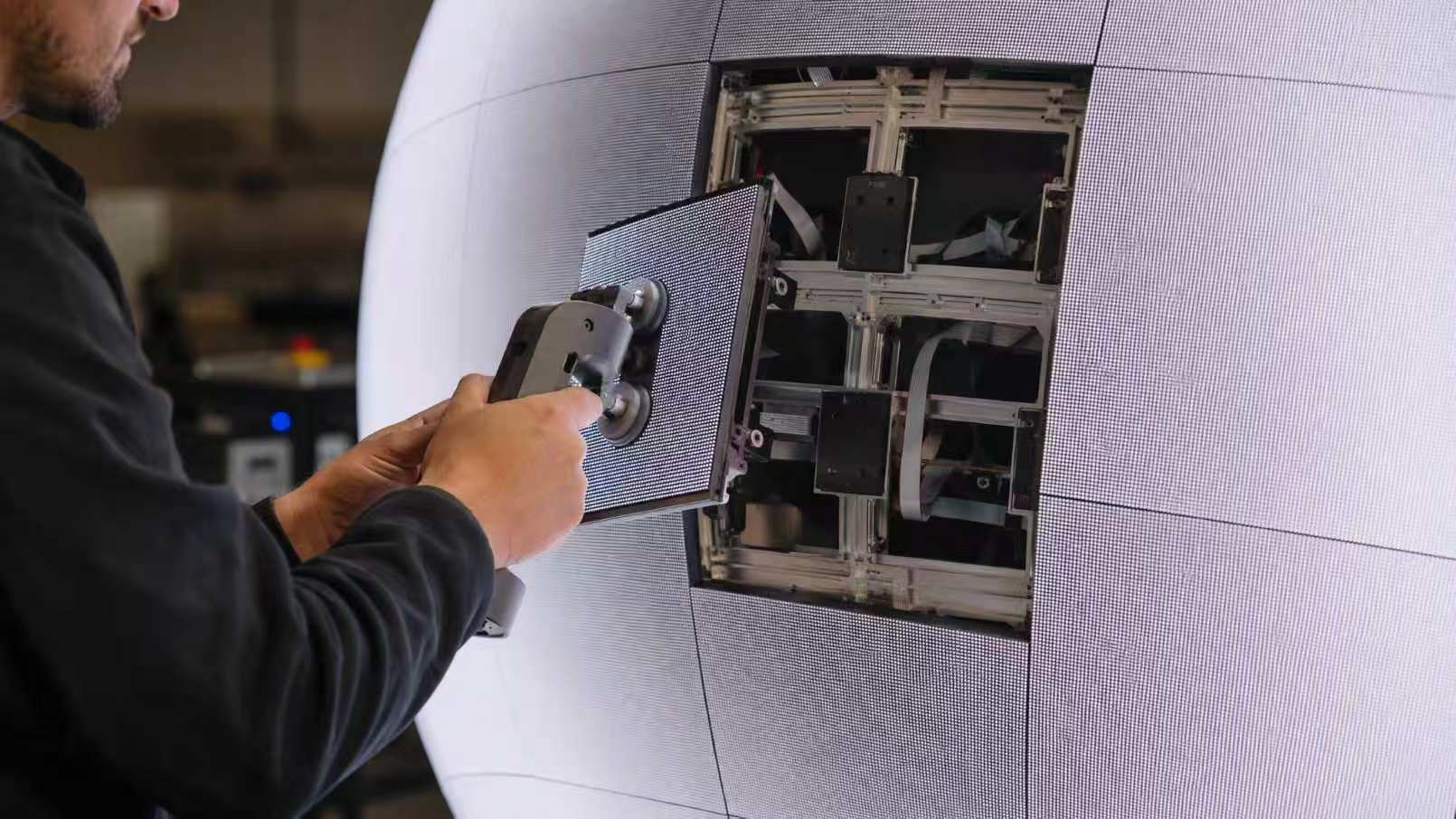
│ Mechanical & Structural Layer: Precision Internal Framework │
│ • Spherical Steel Ribs • Magnetic Front Access • Chimney Cooling│
└────────────────────────────────┬────────────────────────────────┘
│
┌────────────────────────────────┴────────────────────────────────┐
│ Processing & Mapping Layer: 3D Equirectangular Real-Time Warping│
│ • 2:1 Spherical Unwrapping • Polar Correction • Media Server │
└─────────────────────────────────────────────────────────────────┘
```
Standard Diameter Tiers and Application Profiles
Commercial sphere displays generally fall into four operational tiers:
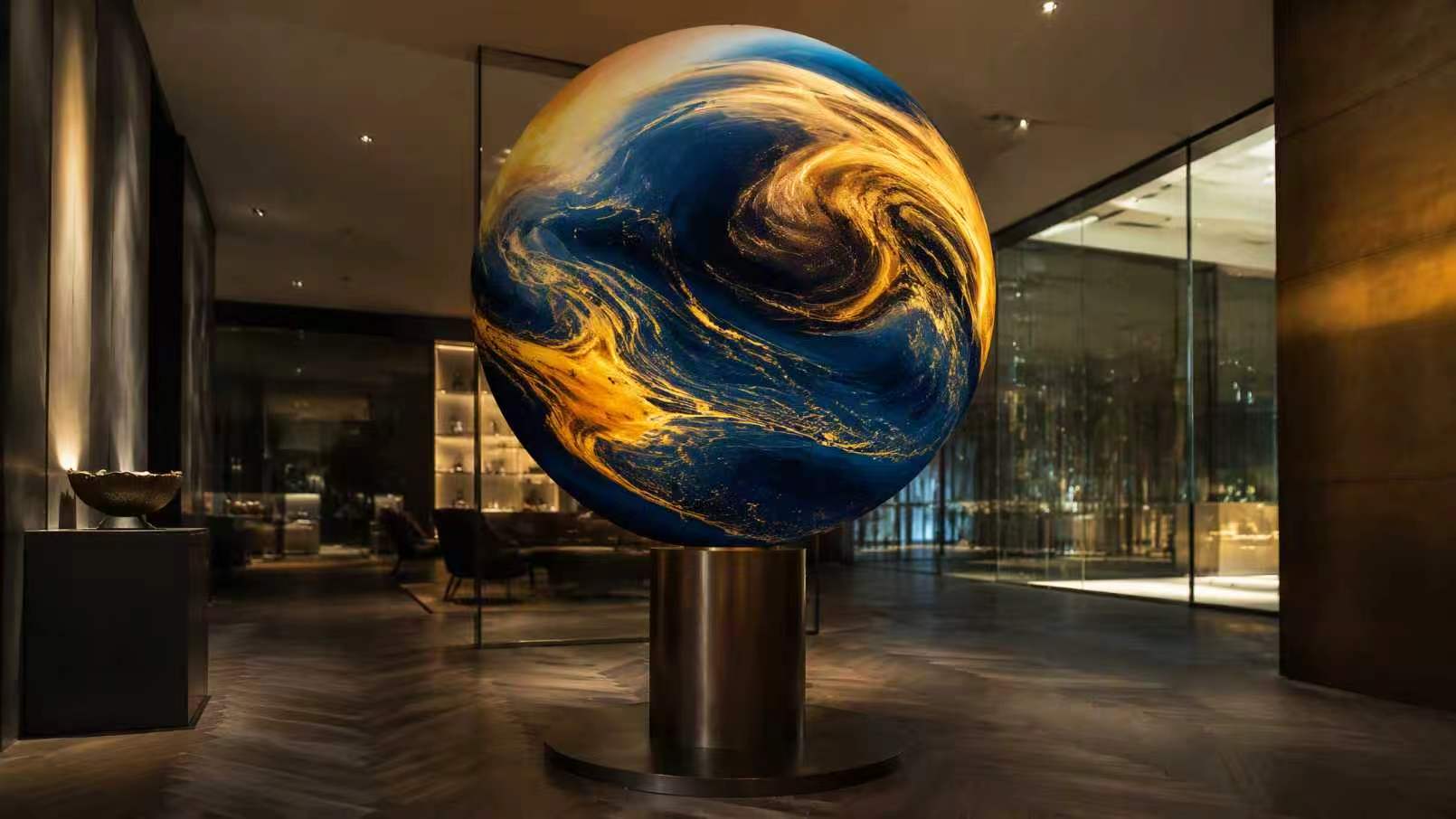
· Compact Pedestal Spheres (0.8 m to 1.5 m): Designed for close viewing (1.5–5 m) on floor pedestals in luxury retail, showrooms, and museum galleries.
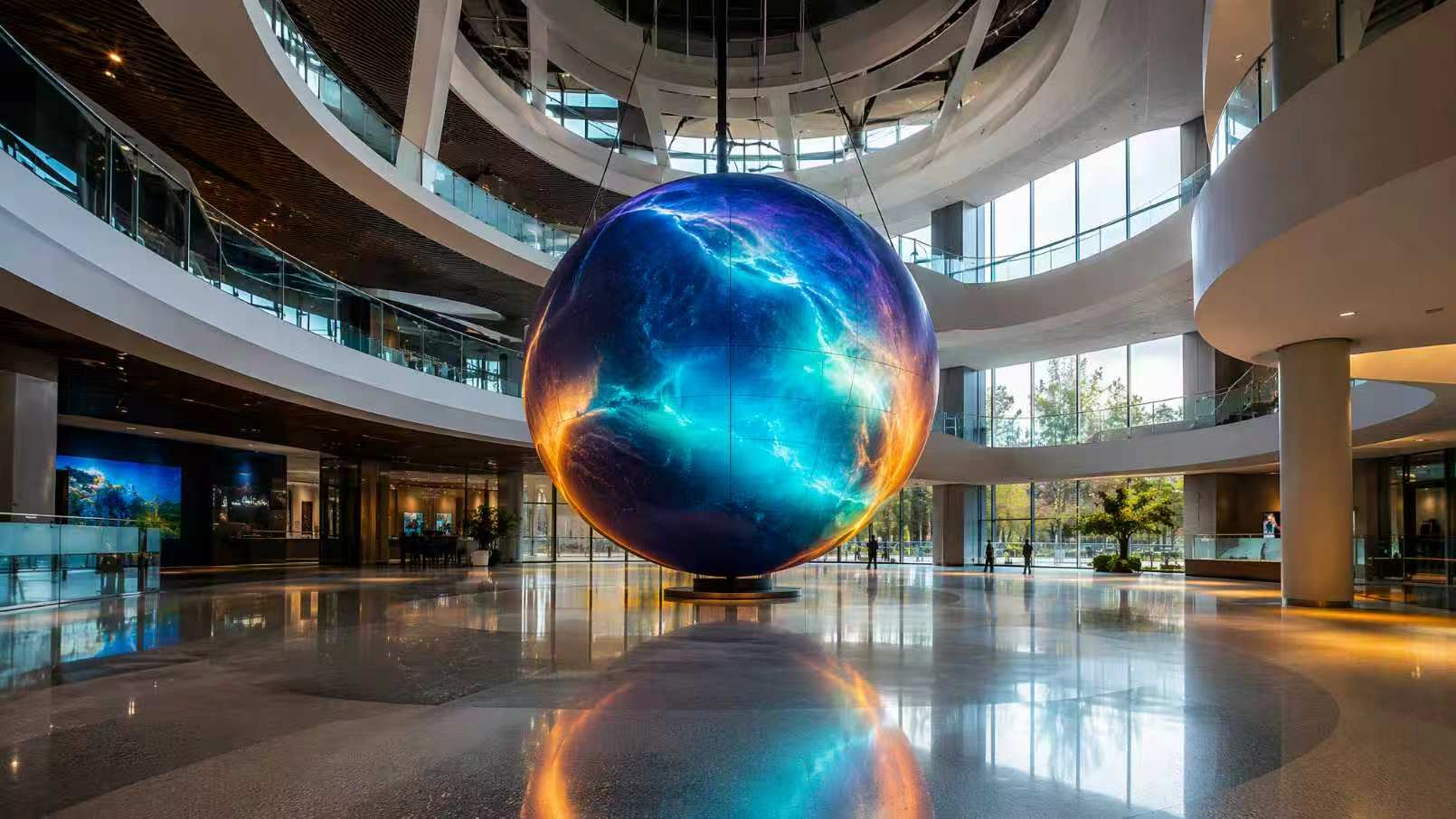
· Mid-Size Atrium Spheres (2.0 m to 3.0 m): The primary commercial standard, sized for two- to three-storey voids in corporate headquarters, airports, and universities.
· Monumental Feature Spheres (4.0 m to 6.0 m): Suspended landmark centerpieces for large public spaces, casino entertainment floors, and science museums.
· Mega Architectural Spheres (8.0 m to 20.0+ m): Custom civil structures for planetariums, immersive attractions, and major outdoor entertainment venues.
Pixel Pitch Selection, Module Topology and 3D Video Mapping
Designing a spherical display balances optical resolution against mechanical layout and 3D processing.
Pixel Pitch vs. Viewing Distance Geometry
Because spectators view the sphere from all angles, pitch balances sharpness against cost:
$$text{Minimum Visual Acuity Distance (m)} = text{Pixel Pitch (mm)} times 2.0 text{ to } 3.0$$
· P1.5 to P2.0 Pitch: Best for 1.0–1.8 m globes viewed from 1.5–4 m without pixelation.
· P2.5 to P3.0 Pitch: The commercial standard for 2.0–3.5 m atrium spheres (4–12 m viewing).
· P4.0 to P6.0 Pitch: Suited for large 4.0 m+ monumental globes viewed from 10–30 m.
Sphere Diameter | Recommended Pixel Pitch | Total Surface Pixel Resolution | Minimum Viewing Distance | Primary Visual Advantage |
1.0 m – 1.2 m | P1.5 – P1.86 | ~800,000 – 1,200,000 px | 1.5 m (5 ft) | Ultra-fine sharpness for close-up retail and museum touchpoints |
1.5 m – 2.0 m | P2.0 – P2.5 | ~1,500,000 – 2,500,000 px | 2.5 m (8 ft) | Crisp 2K equivalent resolution across mid-sized corporate atriums |
2.5 m – 3.0 m | P2.5 – P3.0 | ~2,500,000 – 4,500,000 px | 3.5 m (11 ft) | True 4K visual fidelity for high-traffic multi-level commercial voids |
4.0 m – 6.0 m | P3.0 – P4.0 | ~4,500,000 – 12,000,000 px | 5.0 m (16 ft) | Massive visual impact with balanced power draw and processing loads |
The Three Module Engineering Topologies
Creating a smooth sphere using flat rigid PCBs requires dividing the surface into custom polygonal segments:
1. Watermelon Slice (Petal) Topology: Vertical tapered meridian wedges converging at circular polar caps. The most common design for 1.0–3.0 m spheres, simplifying cabling along vertical ribs.
2. Polyhedral / Geodesic Subdivision: Triangular and hexagonal tiles based on icosahedral geometry. Delivers superior geometric uniformity on large globes (>4.0 m) without polar distortion.
3. Flexible Stepped Concentric Strips: Flexible silicone-backed PCB strips mounted along horizontal latitude rings with customized line mapping.
2026 Core Cost Factors and Budgeting
Procuring a sphere LED display involves specialized custom manufacturing and processing costs.
Sphere Diameter & Pitch Tier | Typical Surface Area | 2026 Turnkey CapEx Budget Range (USD) | Primary Project Inclusions & Hardware Scope |
1.0 m (P1.86–P2.0 Indoor) | 3.14 m² | $14,000 – $28,000 | Custom petal modules, internal frame, floor pedestal, 3D video controller |
1.5 m (P2.0–P2.5 Indoor) | 7.07 m² | $24,000 – $48,000 | Spherical chassis, power distribution, pedestal or hanging kit, basic 3D player |
2.0 m (P2.0–P2.5 Indoor) | 12.57 m² | $38,000 – $75,000 | High-precision CNC frame, 2K/4K 3D media server, front magnetic tools, installation |
3.0 m (P2.5–P3.0 Indoor) | 28.27 m² | $75,000 – $150,000 | Full architectural sphere, certified hanging rigging or heavy pedestal, full 3D mapping engine |
4.0 m (P3.0–P4.0 Indoor) | 50.27 m² | $140,000 – $280,000 | Heavy internal structural skeleton, high-power cooling fans, multi-output 3D server, commissioning |
6.0 m (P4.0–P6.0 Indoor/Outdoor) | 113.10 m² | $320,000 – $650,000+ | Monumental custom steel frame, motorized hoist, redundant power/data, full engineering stamp |
```
Turnkey Sphere LED Budget Anatomy
┌───────────────────────────┬───────────────────────────┐
│ Custom Spherical Modules │ Internal Structural Frame │
│ 40% – 50% │ 15% – 20% │
├───────────────────────────┼───────────────────────────┤
│ 3D Media Server & Mapping │ Rigging & Pedestal Base │
│ 12% – 18% │ 10% – 15% │
├───────────────────────────┴───────────────────────────┤
│ Installation, Commissioning & Spares: 10% – 15% │
└───────────────────────────────────────────────────────┘
```
The Four Primary Cost Drivers
4. Non-Standard PCB Tooling and Molds: Spherical trapezoid and petal modules require custom injection molds. Ordering a non-standard diameter incurs $5,000 to $20,000 in upfront tooling and engineering (NRE) fees; choosing standard catalog sizes eliminates this cost.
5. Diode Density and Pixel Pitch: Finer pixel pitches multiply diode counts exponentially across curved surfaces. A 2.0 m sphere at P2.0 requires roughly 3.1 million diodes, compared to 1.4 million diodes at P3.0, nearly doubling raw module costs.
Frequently Asked Questions
How is video content created and mapped for a spherical LED screen?
Content is produced in standard 2:1 equirectangular format (e.g., 3840 × 1920 or 4096 × 2048 pixels), matching 360-degree VR video. The media server's 3D mapping software takes this flat unwrapped image and wraps it seamlessly around the 3D spherical coordinate grid in real time.
Can a sphere LED display be installed outdoors?
Yes. Outdoor spherical LED displays feature IP65/IP66 weather-sealed modules, silicone potting, anti-UV shaders, and high-brightness diodes (5,500 to 7,500 nits) on heavy steel structural frames, typically using pixel pitches between P4.0 and P10.0.


